Monen Joost, Hattersley Neil, Muroyama Andrew, Stevens Deanna, Oegema Karen, Desai Arshad
Ludwig Institute for Cancer Research & Department of Cellular and Molecular Medicine, University of California San Diego, La Jolla, California, United States of America.
PLoS One. 2015 Apr 28;10(4):e0125382. doi: 10.1371/journal.pone.0125382. eCollection 2015.
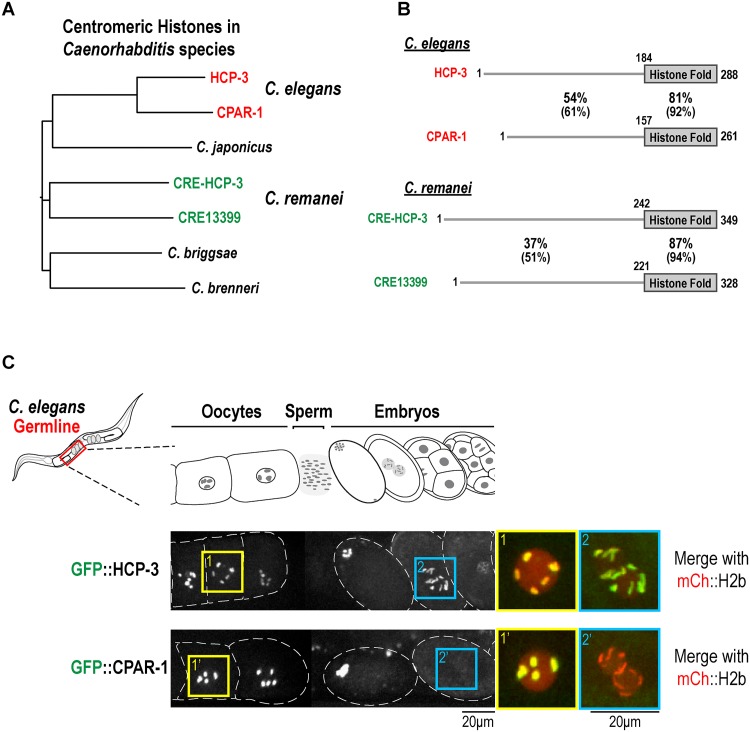
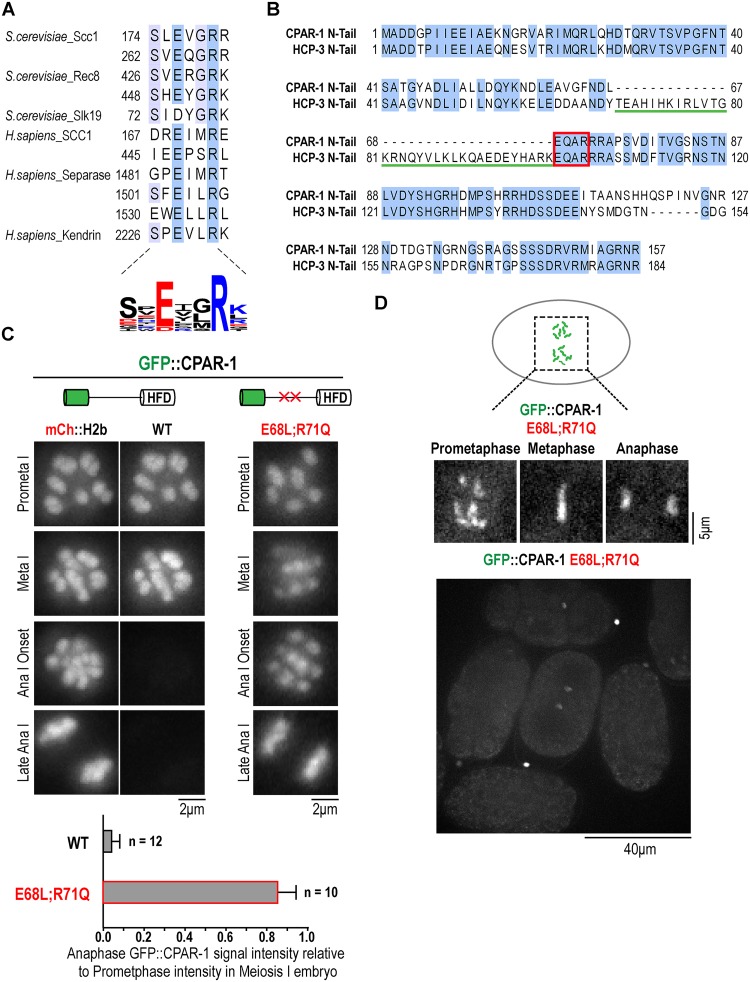
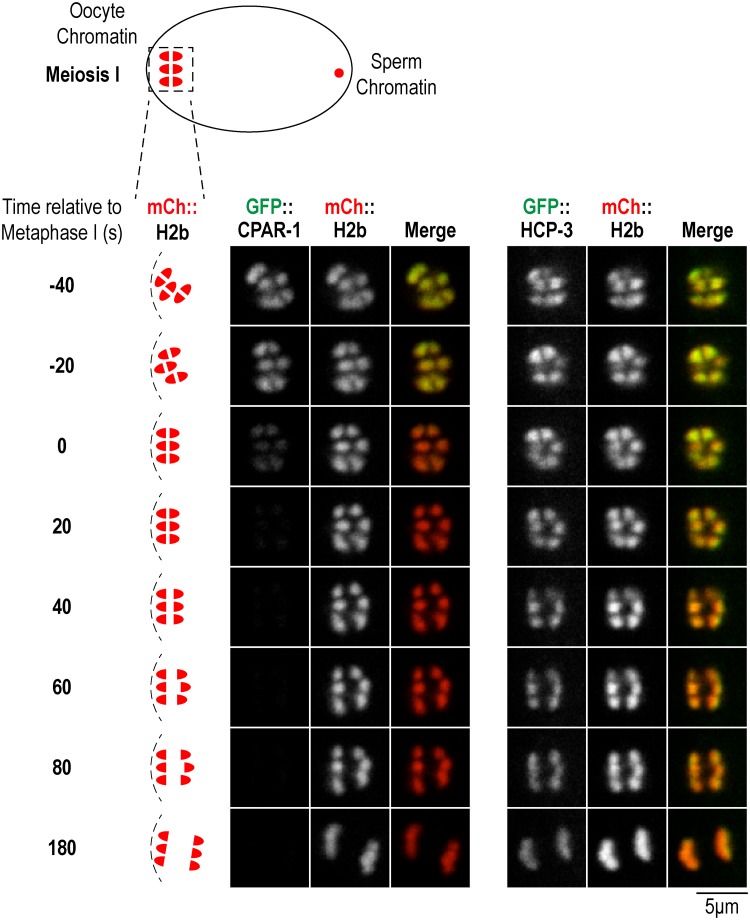
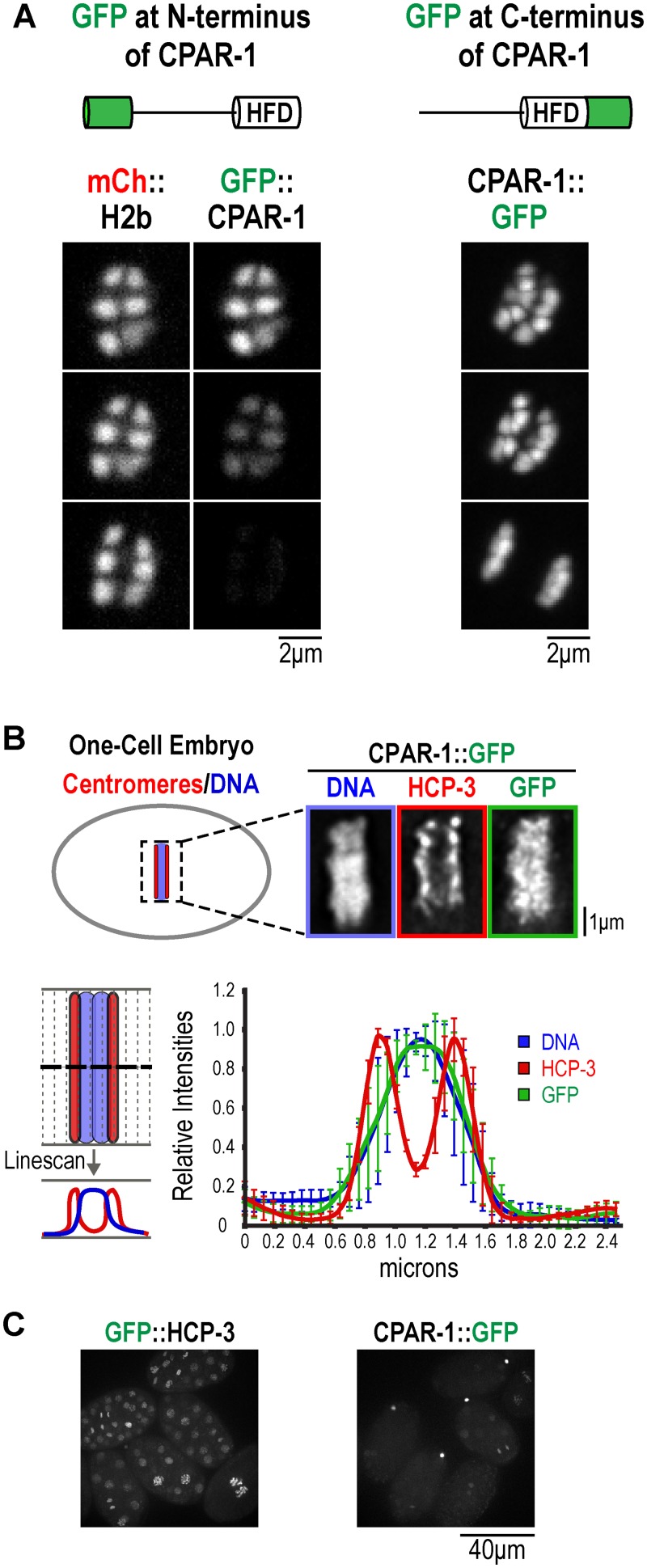
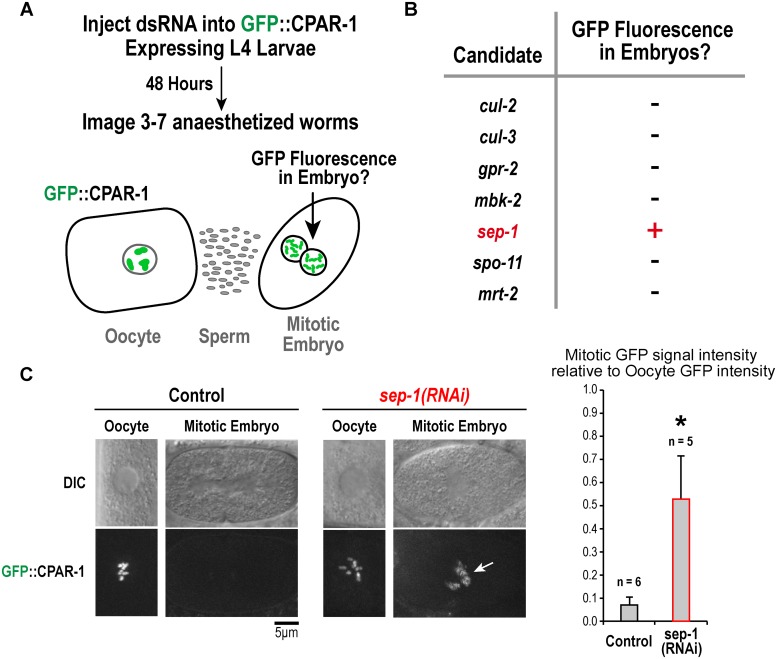
Centromeres are defined epigenetically in the majority of eukaryotes by the presence of chromatin containing the centromeric histone H3 variant CENP-A. Most species have a single gene encoding a centromeric histone variant whereas C. elegans has two: HCP-3 (also known as CeCENP-A) and CPAR-1. Prior RNAi replacement experiments showed that HCP-3 is the functionally dominant isoform, consistent with CPAR-1 not being detectable in embryos. GFP::CPAR-1 is loaded onto meiotic chromosomes in diakinesis and is enriched on bivalents until meiosis I. Here we show that GFP::CPAR-1 signal loss from chromosomes precisely coincides with homolog segregation during anaphase I. This loss of GFP::CPAR-1 signal reflects proteolytic cleavage between GFP and the histone fold of CPAR-1, as CPAR-1::GFP, in which GFP is fused to the C-terminus of CPAR-1, does not exhibit any loss of GFP signal. A focused candidate screen implicated separase, the protease that initiates anaphase by cleaving the kleisin subunit of cohesin, in this cleavage reaction. Examination of the N-terminal tail sequence of CPAR-1 revealed a putative separase cleavage site and mutation of the signature residues in this site eliminated the cleavage reaction, as visualized by retention of GFP::CPAR-1 signal on separating homologous chromosomes at the metaphase-anaphase transition of meiosis I. Neither cleaved nor uncleavable CPAR-1 were centromere-localized in mitosis and instead localized throughout chromatin, indicating that centromere activity has not been retained in CPAR-1. Although the functions of CPAR-1 and of its separase-dependent cleavage remain to be elucidated, this effort reveals a new substrate of separase and provides an in vivo biosensor to monitor separase activity at the onset of meiosis I anaphase.
在大多数真核生物中,着丝粒是通过含有着丝粒组蛋白H3变体CENP-A的染色质在表观遗传上定义的。大多数物种有一个编码着丝粒组蛋白变体的基因,而秀丽隐杆线虫有两个:HCP-3(也称为CeCENP-A)和CPAR-1。先前的RNA干扰替代实验表明,HCP-3是功能上占主导地位的异构体,这与在胚胎中检测不到CPAR-1一致。GFP::CPAR-1在终变期加载到减数分裂染色体上,并在减数分裂I之前在二价体上富集。在这里,我们表明,染色体上GFP::CPAR-1信号的丧失与减数分裂I后期同源染色体的分离精确重合。GFP::CPAR-1信号的这种丧失反映了GFP与CPAR-1组蛋白折叠之间的蛋白水解切割,因为GFP融合到CPAR-1 C末端的CPAR-1::GFP没有表现出任何GFP信号的丧失。一项聚焦的候选筛选表明,在这种切割反应中,分离酶(一种通过切割黏连蛋白的kleisin亚基启动后期的蛋白酶)起作用。对CPAR-1 N末端尾巴序列的检查揭示了一个假定的分离酶切割位点,该位点特征性残基的突变消除了切割反应,这在减数分裂I中期-后期转变时同源染色体分离时GFP::CPAR-1信号的保留中可见一斑。切割的和不可切割的CPAR-1在有丝分裂中都不着丝粒定位,而是定位在整个染色质中,这表明CPAR-1中没有保留着丝粒活性。尽管CPAR-1及其依赖分离酶的切割的功能仍有待阐明,但这项工作揭示了分离酶的一种新底物,并提供了一种体内生物传感器来监测减数分裂I后期开始时的分离酶活性。