Marlow Neil, Morris Timothy, Brocklehurst Peter, Carr Robert, Cowan Frances, Patel Nishma, Petrou Stavros, Redshaw Margaret, Modi Neena, Doré Caroline J
UCL Institute for Women's Health, University College London, London, UK.
MRC Clinical Trials Unit, University College London, London, UK.
Arch Dis Child Fetal Neonatal Ed. 2015 Jul;100(4):F320-6. doi: 10.1136/archdischild-2014-307410. Epub 2015 Apr 28.
We performed a randomised trial in very preterm, small for gestational age (SGA) babies to determine if prophylaxis with granulocyte macrophage colony stimulating factor (GM-CSF) improves outcomes (the PROGRAMS trial). GM-CSF was associated with improved neonatal neutrophil counts, but no change in other neonatal or 2-year outcomes. As subtle benefits in outcome may not be ascertainable until school age we performed an outcome study at 5 years.
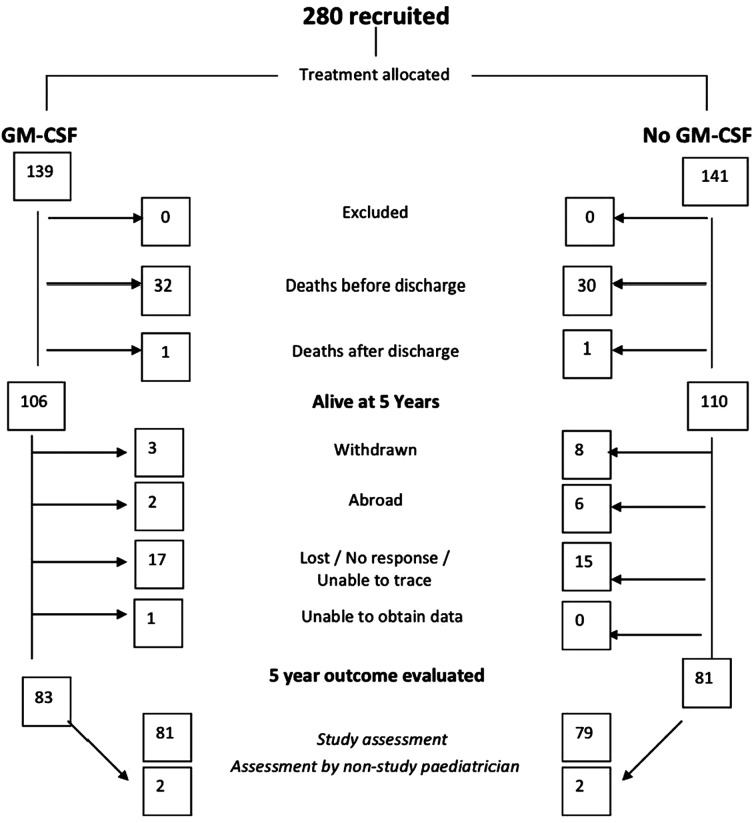
280 babies born at 31 weeks of gestation or less and SGA were entered into the trial. Outcomes were assessed at 5 years to determine neurodevelopmental and general health status and educational attainment.
We found no significant differences in cognitive, general health or educational outcomes between 83 of 106 (78%) surviving children in the GM-CSF arm compared with 81 of 110 (74%) in the control arm. Mean mental processing composite (equivalent to IQ) at 5 years were 94 (SD 16) compared with 95 (SD 15), respectively (difference in means -1 (95%CI -6 to 4), and similar proportions were in receipt of special educational needs support (41% vs 35%; risk ratio 1.2 (95% CI 0.8 to 1.9)). Performance on Kaufmann-ABC subscales and components of NEPSY were similar. The suggestion of worse respiratory outcomes in the GM-CSF group at 2 years was replicated at 5 years.
The administration of GM-CSF to very preterm SGA babies is not associated with improved or more adverse neurodevelopmental, general health or educational outcomes at 5 years.
ISRCTN42553489.
我们对极早产儿、小于胎龄儿(SGA)进行了一项随机试验,以确定使用粒细胞巨噬细胞集落刺激因子(GM-CSF)进行预防是否能改善预后(PROGRAMS试验)。GM-CSF与新生儿中性粒细胞计数改善相关,但其他新生儿或2岁时的预后无变化。由于在学龄期之前可能无法确定预后的细微益处,我们在5岁时进行了一项预后研究。
280名妊娠31周及以下且为SGA的婴儿进入试验。在5岁时评估预后,以确定神经发育、总体健康状况和教育程度。
我们发现,GM-CSF组106名存活儿童中的83名(78%)与对照组110名中的81名(74%)在认知、总体健康或教育预后方面无显著差异。5岁时的平均心理加工综合评分(相当于智商)分别为94(标准差16)和95(标准差15)(平均差异为-1(95%置信区间-6至4)),接受特殊教育需求支持的比例相似(41%对35%;风险比1.2(95%置信区间0.8至1.9))。考夫曼-ABC分量表和NEPSY各部分的表现相似。GM-CSF组在2岁时出现的呼吸预后较差的迹象在5岁时再次出现。
对极早产SGA婴儿使用GM-CSF与5岁时神经发育、总体健康或教育预后的改善或更差无关。
ISRCTN42553489。