Blanchette Christopher M, Liang Caihua, Lubeck Deborah P, Newsome Britt, Rossetti Sandro, Gu Xiangmei, Gutierrez Benjamin, Lin Nancy D
University of North Carolina, Charlotte, NC, USA; ; Otsuka America Pharmaceutical, Inc., Princeton, NJ, USA;
Optum Epidemiology, Waltham, MA, USA;
Drugs Context. 2015 Apr 17;4:212275. doi: 10.7573/dic.212275. eCollection 2015.
Autosomal dominant polycystic kidney disease (ADPKD) is a progressive genetic disorder characterized by the development of numerous kidney cysts that result in kidney failure. Little is known regarding the key patient characteristics and utilization of healthcare resources for ADPKD patients along the continuum of disease progression. This observational study was designed to describe the characteristics of ADPKD patients and compare them with those of patients with other chronic kidney diseases.
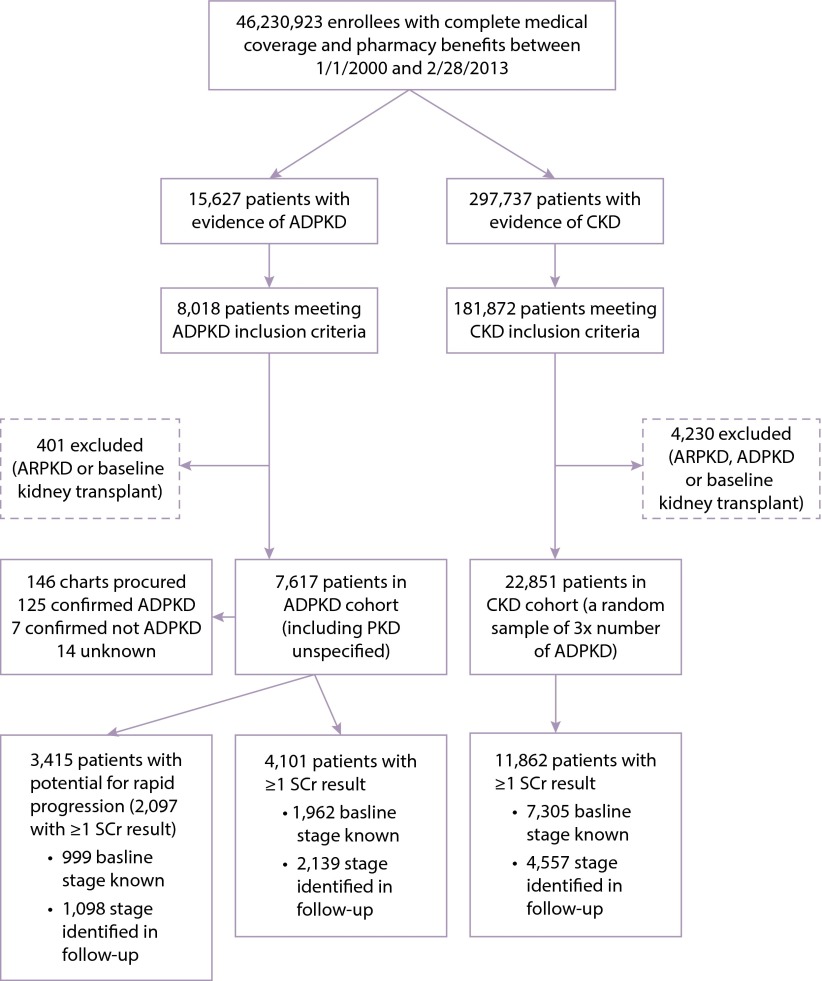
This retrospective cohort study involved patients with a claim for ADPKD or PKD unspecified from 1/1/2000-2/28/2013 and ≥6 months of previous continuous enrollment (baseline) within a large database of administrative claims in the USA. A random sample of chronic kidney disease (CKD) patients served as comparators. For a subset of ADPKD patients who had only a diagnosis code of unspecified PKD, abstraction of medical records was undertaken to estimate the proportion of patients who had medical chart-confirmed ADPKD. In patients with linked electronic laboratory data, the estimated glomerular filtration rate was calculated via serum creatinine values to determine CKD stage at baseline and during follow-up. Proportions of patients transitioning to another stage and the mean age at transition were calculated.
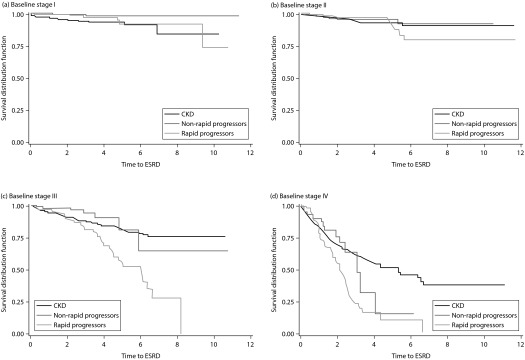
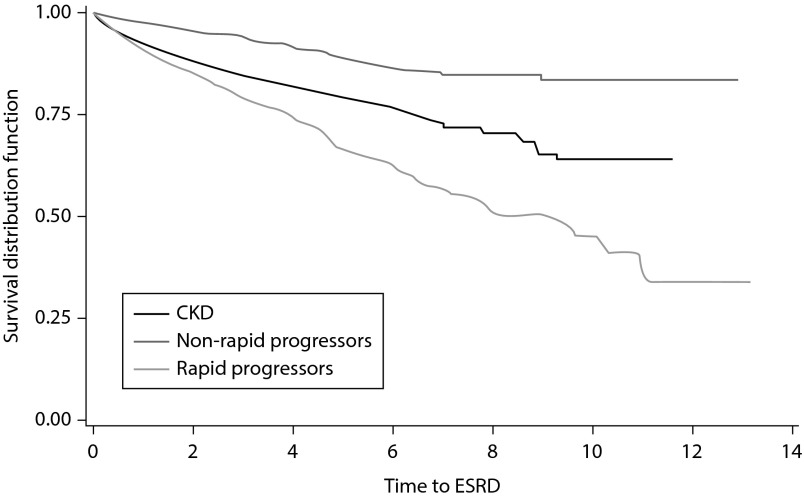
ADPKD patients were, in general, younger and had fewer physician visits, but had more specific comorbidities at observation start compared with CKD patients. ADPKD patients had a longer time in the milder stages and longer duration before recorded transition to a more severe stage compared with CKD patients. Patients with ADPKD at risk of rapid progression had a shorter time-to-end-stage renal disease than patients with CKD and ADPKD patients not at risk, but stage duration was similar between ADPKD patients at risk and those not at risk.
These results suggest that distribution of patients by age at transition to next stage may be useful for identification of ADPKD patients at risk of rapid progression. The results also suggest that medical claims with diagnosis codes for "unspecified PKD", in absence of a diagnosis code for autosomal recessive polycystic kidney disease, may be a good proxy for ADPKD.
常染色体显性多囊肾病(ADPKD)是一种进行性遗传性疾病,其特征是形成大量肾囊肿,最终导致肾衰竭。对于ADPKD患者在疾病进展连续过程中的关键患者特征和医疗资源利用情况,人们了解甚少。这项观察性研究旨在描述ADPKD患者的特征,并将其与其他慢性肾病患者的特征进行比较。
这项回顾性队列研究纳入了2000年1月1日至2013年2月28日期间在美国一个大型行政索赔数据库中有ADPKD或未明确的PKD索赔记录且之前连续参保≥6个月(基线)的患者。随机抽取的慢性肾病(CKD)患者作为对照。对于仅有未明确PKD诊断代码的ADPKD患者子集,进行病历摘要以估计经病历确认的ADPKD患者比例。对于有电子实验室数据关联的患者,通过血清肌酐值计算估计肾小球滤过率,以确定基线和随访期间的CKD分期。计算患者转变至另一分期的比例以及转变时的平均年龄。
总体而言,与CKD患者相比,ADPKD患者更年轻,看医生的次数更少,但在观察开始时具有更多特定的合并症。与CKD患者相比,ADPKD患者处于较轻分期的时间更长,在记录到转变为更严重分期之前的持续时间更长。有快速进展风险的ADPKD患者进入终末期肾病的时间比CKD患者和无风险的ADPKD患者短,但有风险的ADPKD患者与无风险的ADPKD患者之间的分期持续时间相似。
这些结果表明,按转变至下一阶段时的年龄对患者进行分布,可能有助于识别有快速进展风险的ADPKD患者。结果还表明,在没有常染色体隐性多囊肾病诊断代码的情况下,带有“未明确PKD”诊断代码的医疗索赔可能是ADPKD的良好替代指标。