Kalatharan Vinusha, McArthur Eric, Nash Danielle M, Welk Blayne, Sarma Sisira, Garg Amit X, Pei York
Department of Epidemiology and Biostatistics, Western University, London, Ontario, Canada.
ICES, London, Ontario, Canada.
Clin Kidney J. 2020 Jan 20;14(2):612-616. doi: 10.1093/ckj/sfz184. eCollection 2021 Feb.
The ability to identify patients with autosomal dominant polycystic kidney disease (ADPKD) and distinguish them from patients with similar conditions in healthcare administrative databases is uncertain. We aimed to measure the sensitivity and specificity of different ADPKD administrative coding algorithms in a clinic population with non-ADPKD and ADPKD kidney cystic disease.
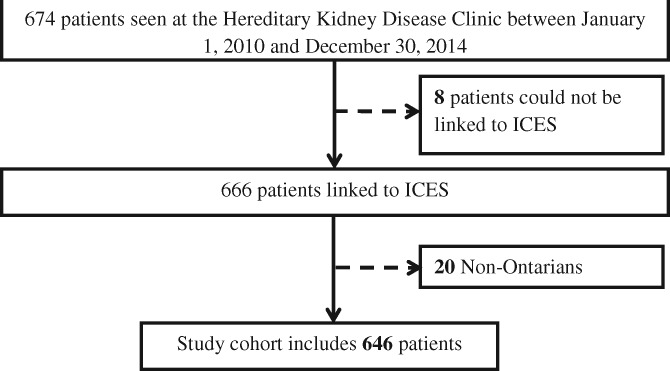
We used a dataset of all patients who attended a hereditary kidney disease clinic in Toronto, Ontario, Canada between 1 January 2010 and 23 December 2014. This dataset included patients who met our reference standard definition of ADPKD or other cystic kidney disease. We linked this dataset to healthcare databases in Ontario. We developed eight algorithms to identify ADPKD using the International Classification of Diseases, 10th Revision (ICD-10) codes and provincial diagnostic billing codes. A patient was considered algorithm positive if any one of the codes in the algorithm appeared at least once between 1 April 2002 and 31 March 2015.
The ICD-10 coding algorithm had a sensitivity of 33.7% [95% confidence interval (CI) 30.0-37.7] and a specificity of 86.2% (95% CI 75.7-92.5) for the identification of ADPKD. The provincial diagnostic billing code had a sensitivity of 91.1% (95% CI 88.5-93.1) and a specificity of 10.8% (95% CI 5.3-20.6).
ICD-10 coding may be useful to identify patients with a high chance of having ADPKD but fail to identify many patients with ADPKD. Provincial diagnosis billing codes identified most patients with ADPKD and also with other types of cystic kidney disease.
在医疗管理数据库中,识别常染色体显性遗传性多囊肾病(ADPKD)患者并将其与患有类似病症的患者区分开来的能力尚不确定。我们旨在衡量不同的ADPKD管理编码算法在患有非ADPKD和ADPKD肾囊性疾病的临床人群中的敏感性和特异性。
我们使用了2010年1月1日至2014年12月23日期间在加拿大多伦多一家遗传性肾病诊所就诊的所有患者的数据集。该数据集包括符合我们ADPKD或其他囊性肾病参考标准定义的患者。我们将此数据集与安大略省的医疗数据库相链接。我们开发了八种算法,使用国际疾病分类第10版(ICD-10)编码和省级诊断计费代码来识别ADPKD。如果算法中的任何一个代码在2002年4月1日至2015年3月31日之间至少出现一次,则该患者被视为算法阳性。
ICD-10编码算法识别ADPKD的敏感性为33.7%[95%置信区间(CI)30.0-37.7],特异性为86.2%(95%CI 75.7-92.5)。省级诊断计费代码的敏感性为91.1%(95%CI 88.5-93.1),特异性为10.8%(95%CI 5.3-20.6)。
ICD-10编码可能有助于识别患有ADPKD可能性较高的患者,但无法识别许多ADPKD患者。省级诊断计费代码识别出了大多数ADPKD患者以及其他类型的囊性肾病患者。