Cromie Meghan M, Gao Weimin
Department of Environmental Toxicology, The Institute of Environmental and Human Health, Texas Tech University, Lubbock, TX, USA.
Oxid Med Cell Longev. 2015;2015:217304. doi: 10.1155/2015/217304. Epub 2015 Apr 1.
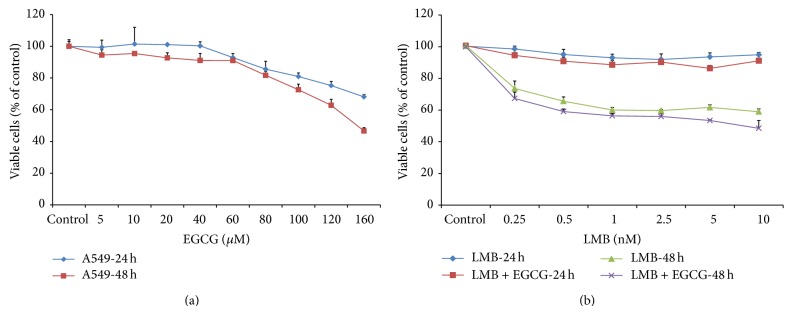
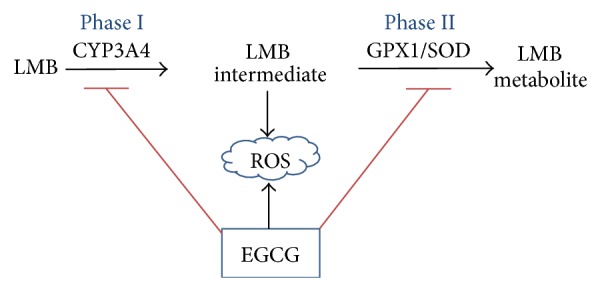
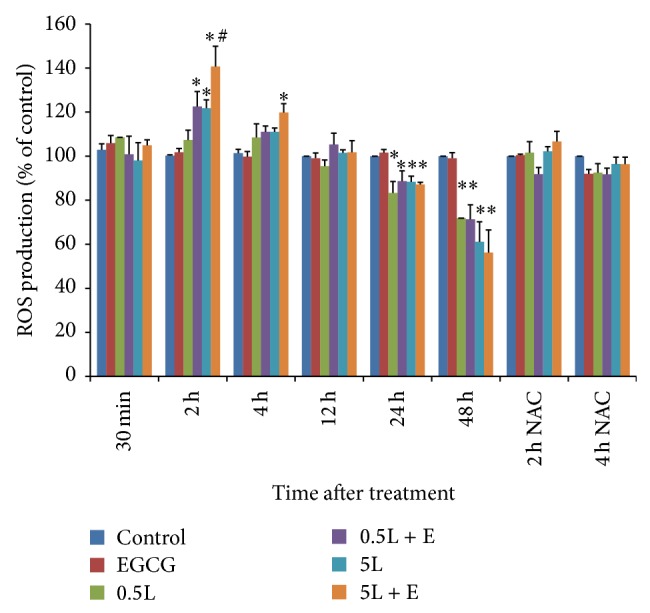
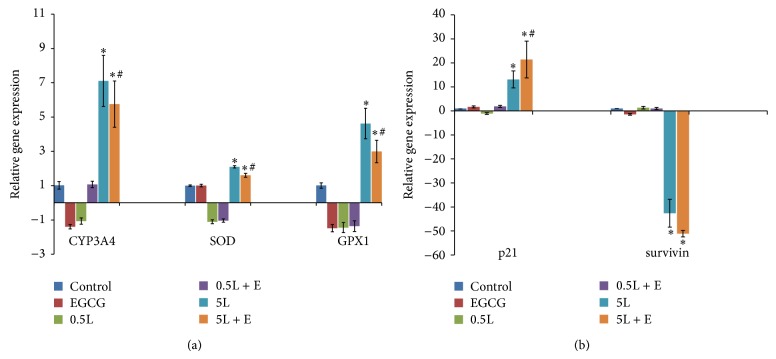
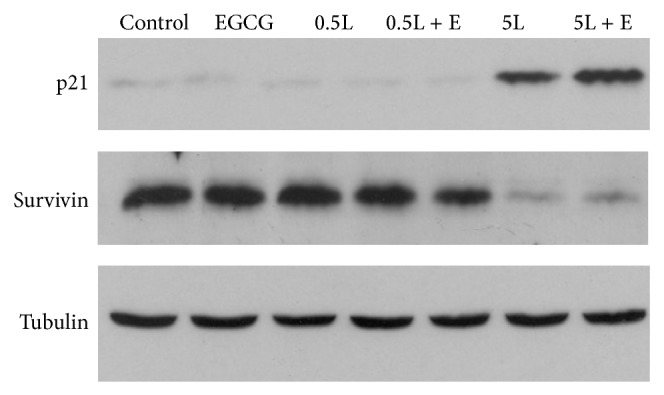
Our previous studies have shown Leptomycin B (LMB) is a promising antilung cancer drug. Epigallocatechin-3-gallate (EGCG) has antitumor properties but a debatable clinical application. The objective of this study is to evaluate the combination therapeutic effect of LMB and EGCG and its molecular mechanisms in human lung cancer A549 cells. Increased cytotoxicity was observed in LMB+EGCG-treated cells compared to LMB-treated cells. Elevated ROS was maximized 2 h after treatment, and LMB+EGCG-treated cells had higher ROS levels compared to LMB. N-Acetyl-L-cysteine (NAC) studies confirmed the oxidative role of LMB and/or EGCG treatment. In comparison to the control, CYP3A4, SOD, GPX1, and p21 mRNA expression levels were increased 7.1-, 2.0-, 4.6-, and 13.1-fold in LMB-treated cells, respectively, while survivin was decreased 42.6-fold. Additionally, these increases of CYP3A4, SOD, and GPX1 were significantly reduced, while p21 was significantly increased in LMB+EGCG-treated cells compared to LMB-treated cells. The qRT-PCR results for p21 and survivin were further confirmed by Western blot. Our study first shows that LMB produces ROS and is possibly metabolized by CYP3A4, GPX1, and SOD in A549 cells, and combination treatment of LMB and EGCG augments LMB-induced cytotoxicity through enhanced ROS production and the modulation of drug metabolism and p21/survivin pathways.
我们之前的研究表明,莱普霉素B(LMB)是一种很有前景的抗肺癌药物。表没食子儿茶素-3-没食子酸酯(EGCG)具有抗肿瘤特性,但临床应用存在争议。本研究的目的是评估LMB与EGCG联合治疗对人肺癌A549细胞的疗效及其分子机制。与LMB处理的细胞相比,LMB + EGCG处理的细胞中观察到细胞毒性增加。处理后2小时ROS升高达到最大值,且LMB + EGCG处理的细胞比LMB处理的细胞具有更高的ROS水平。N-乙酰-L-半胱氨酸(NAC)研究证实了LMB和/或EGCG处理的氧化作用。与对照组相比,LMB处理的细胞中CYP3A4、SOD、GPX1和p21的mRNA表达水平分别增加了7.1倍、2.0倍、4.6倍和13.1倍,而生存素减少了42.6倍。此外,与LMB处理的细胞相比,LMB + EGCG处理的细胞中CYP3A4、SOD和GPX1的这些增加显著降低,而p21显著增加。p21和生存素的qRT-PCR结果通过蛋白质印迹进一步得到证实。我们的研究首次表明,LMB在A549细胞中产生ROS,并可能由CYP3A4、GPX1和SOD进行代谢,LMB与EGCG联合治疗通过增强ROS产生以及调节药物代谢和p21/生存素途径增强了LMB诱导的细胞毒性。