Department of Neurology, Fujian Institute of Geriatrics, The Affiliated Union Hospital of Fujian Medical University, Fuzhou, China.
BMC Complement Altern Med. 2012 Jun 28;12:82. doi: 10.1186/1472-6882-12-82.
Parkinson's disease is a high incidence neurodegenerative disease in elderly people, and oxidative stress plays an important role in the pathogenesis. Oxygen metabolism in the brain is high, which lacks an antioxidative protection mechanism. Recently, it has been found that polyphenols play an important role in antioxidation. (-)-epigallocatechin-3-gallate (EGCG) is an important component of tea polyphenols and its biological effects, such as strong antioxidation, scavenging of free radicals and anti-apoptosis, can pass through the blood brain barrier. The SIRT1/PGC-1α signaling pathway has not been reported in PC12 cells. Therefore, research of the protective mechanism of EGCG in PC12 cells damaged by -methyl-4-phenyl-pyridine (MMP+) may provide a new insight into protect against and treatment of Parkinson's disease.
MPP(+)-treated highly differentiated PC12 cells were used as the in vitro cell model. An MTT assay was used to investigate cell viability after EGCG treatment, a dichlorofluorescin diacetate assay was used to measure reactive oxygen species (ROS) production, western blot analysis was used to observe PGC-1α and SIRT1 protein expression, and real-time PCR to observe PGC-1α, SOD1 and GPX1 mRNA expression.
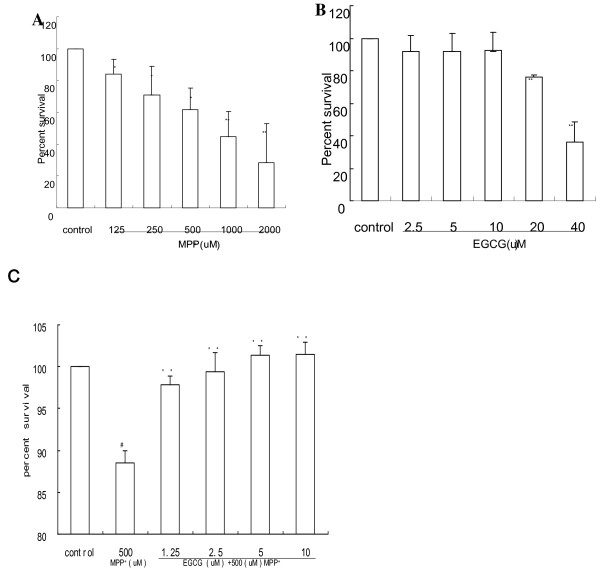
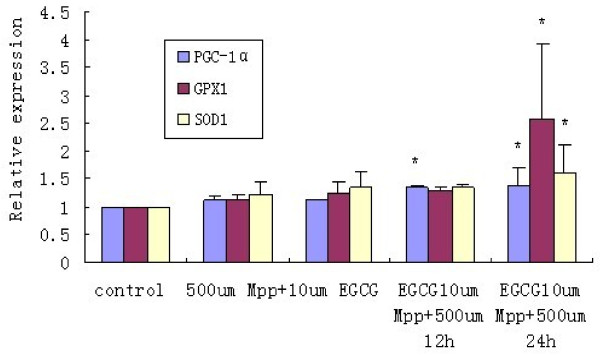
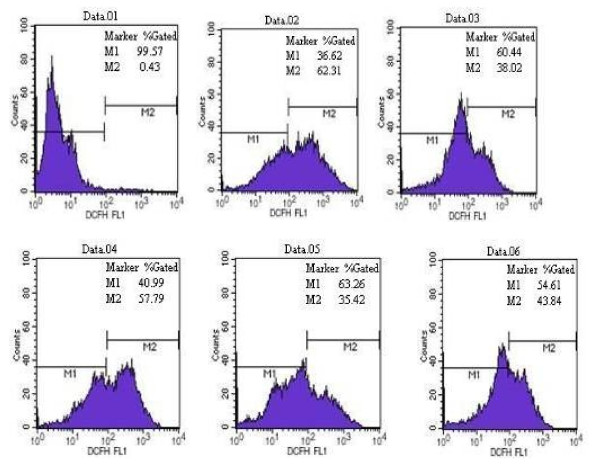
PC12 cell viability was significantly reduced after MPP(+) treatment by 11.46% compared with that of the control (P < 0.05). However, cell viability was unchanged by 10 μmol/L EGCG treatment. In co-treatments with EGCG and MPP(+), cell viability was significantly increased by 12.92% (P < 0.05) and MPP(+)-induced ROS production was markedly decreased. PGC-1α mRNA expression was obviously upregulated by 21.51% (P < 0.05), and SOD1 and GPX1 mRNA expression was slightly increased by 12.94% and 15.63% (P > 0.05), respectively, by treatment with EGCG and then MPP(+) for 12 h. The mRNA expression of PGC-1α, SOD1 and GPX1 was increased by 25.17%, 40% and 146% (all P < 0.05), respectively, by treatment with EGCG and then MPP(+) for 24 h. Such effects were not observed with MPP(+) treatment alone.
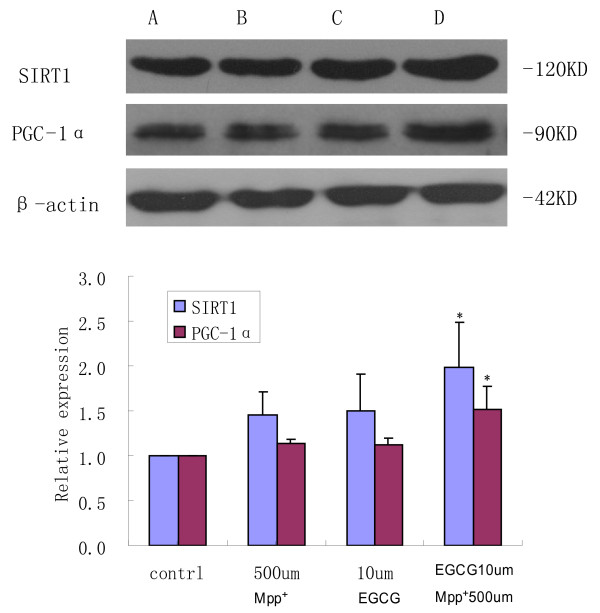
The SIRT1/PGC-1α pathway is one of the mechanisms of EGCG suppression of MPP(+)-induced injury of PC12 cells.
帕金森病是一种在老年人中发病率较高的神经退行性疾病,氧化应激在发病机制中起着重要作用。大脑中的氧气代谢很高,却缺乏抗氧化保护机制。最近发现,多酚在抗氧化中起着重要作用。(-)-表没食子儿茶素-3-没食子酸酯(EGCG)是茶多酚的重要组成部分,其生物效应,如强抗氧化、清除自由基和抗细胞凋亡等,可以穿过血脑屏障。SIRT1/PGC-1α信号通路在 PC12 细胞中尚未被报道。因此,研究 EGCG 对 MPP+(-甲基-4-苯基-1,2,3,6-四氢吡啶)损伤的 PC12 细胞的保护机制可能为帕金森病的防治提供新的思路。
用 MPP+处理高度分化的 PC12 细胞作为体外细胞模型。MTT 法检测 EGCG 处理后细胞活力,二氯荧光素二乙酸酯法检测活性氧(ROS)产生,Western blot 分析观察 PGC-1α和 SIRT1 蛋白表达,实时 PCR 观察 PGC-1α、SOD1 和 GPX1mRNA 表达。
与对照组相比,MPP+(+)处理后 PC12 细胞活力显著降低 11.46%(P<0.05)。然而,10μmol/L EGCG 处理对细胞活力没有影响。在 EGCG 和 MPP+(+)共同处理时,细胞活力显著增加 12.92%(P<0.05),MPP+(+)诱导的 ROS 产生明显减少。PGC-1αmRNA 表达明显上调 21.51%(P<0.05),SOD1 和 GPX1mRNA 表达分别略有增加 12.94%和 15.63%(P>0.05),用 EGCG 处理 12 小时后再用 MPP+(+)处理。用 EGCG 处理 24 小时后,PGC-1α、SOD1 和 GPX1 的 mRNA 表达分别增加 25.17%、40%和 146%(均 P<0.05)。单独用 MPP+(+)处理则没有观察到这种效果。
SIRT1/PGC-1α通路是 EGCG 抑制 MPP+诱导的 PC12 细胞损伤的机制之一。