Wang Jian-Biao, Sun Hai-Li, Song Chun-Yi, Gao Li
Department of Head and Neck Surgery, Institute of Minimally Invasive Surgery of Zhejiang University, Sir Run Run Shaw Hospital, Zhejiang University School of Medicine, Hangzhou, Zhejiang, China (mainland).
Sir Run Run Shaw Hospital, Zhejiang University School of Medicine, Hangzhou, Zhejiang, China (mainland).
Med Sci Monit. 2015 Apr 29;21:1223-31. doi: 10.12659/MSM.892867.
Postoperative hypocalcemia caused by hypoparathyroidism is one of the most common morbidities of total thyroidectomy. The aim of this study was to analyze the kinetics and factors affecting PTH levels after total thyroidectomy and central neck dissection (CND).
MATERIAL/METHODS: We performed a retrospective study in 438 consecutive patients who underwent total thyroidectomy between January 2007 and December 2010. No patient had a history of thyroid or neck surgery. PTH and calcium levels were recorded 1 day before the operation, during the first 5 days, and during follow-up (2 weeks and 2, 6, and 12 months).
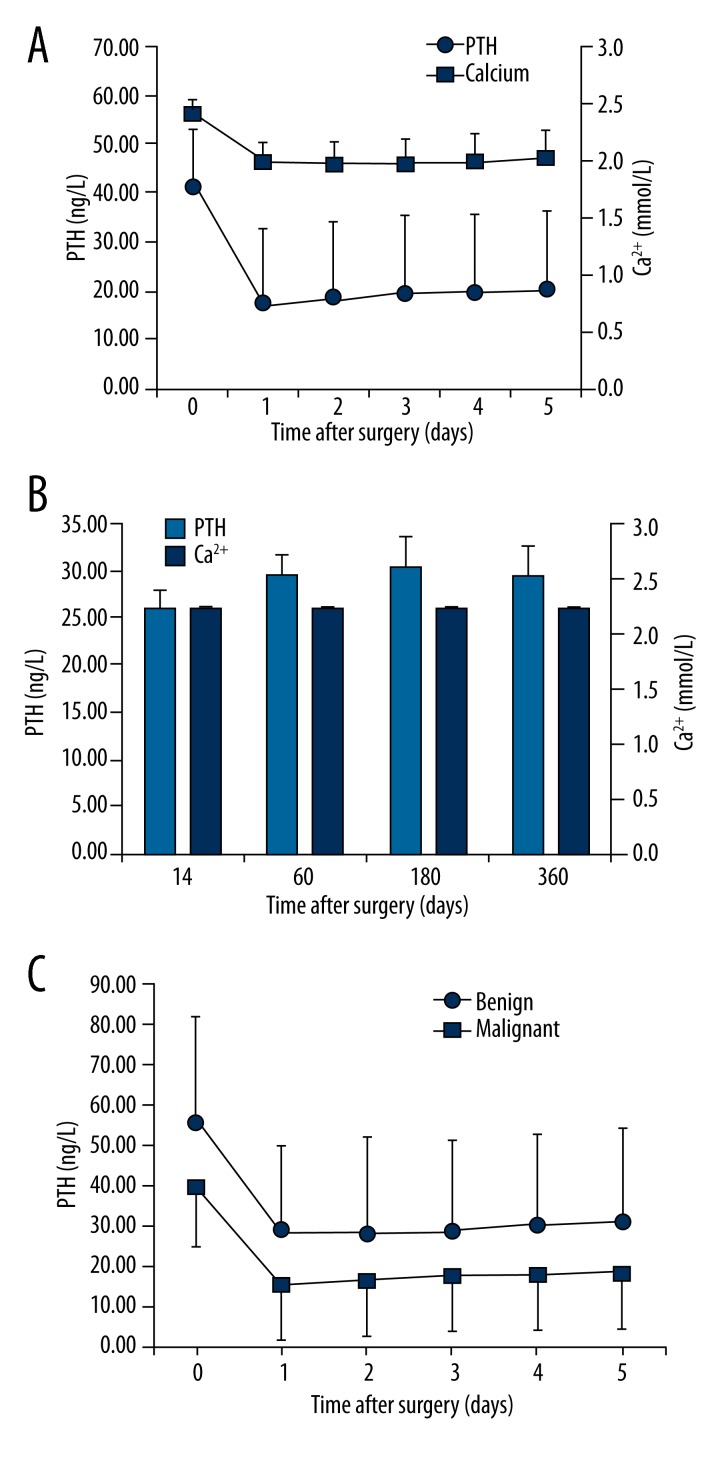
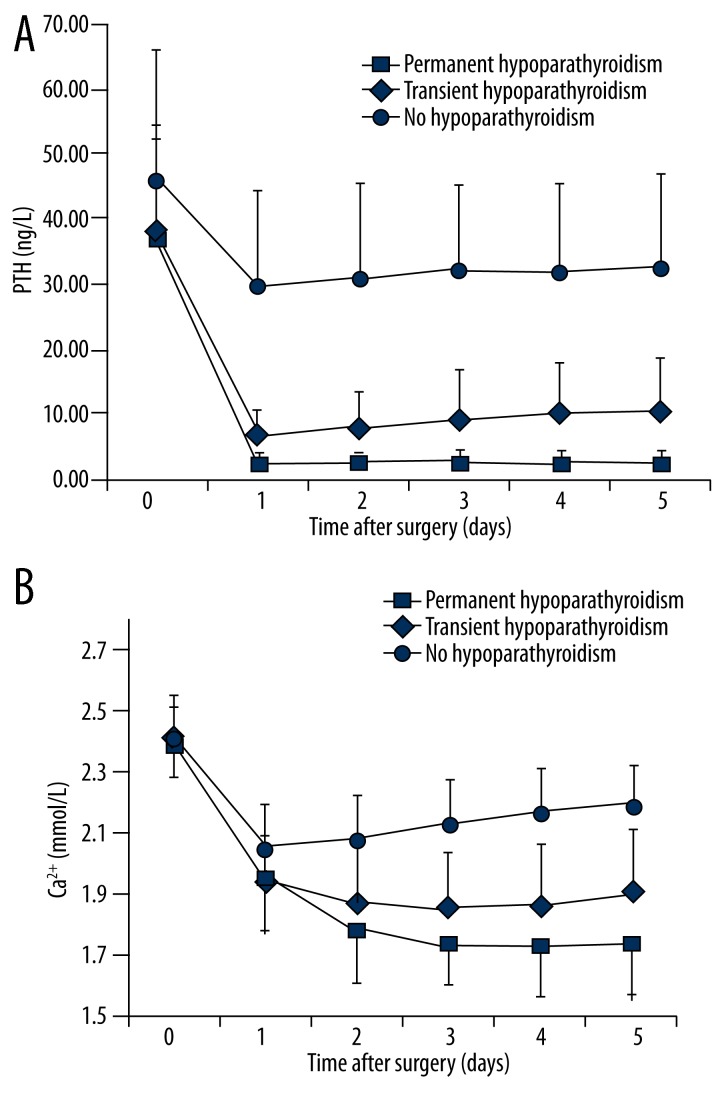
PTH levels declined to 41.90% of its initial value on the first day after the operation. After surgery, PTH was correlated positively with calcium and inversely with phosphate levels from postoperative day 1 to 14. Based on clinical observation, using a PTH threshold of <7 ng/L on postoperative day 1 was predictive of persistent hypoparathyroidism, with sensitivity and negative predictive value 100%, but poor specificity (70.19%). CND increased the risk of transient hypoparathyroidism compared with total thyroidectomy alone. Patients with thyroiditis had an increased risk of permanent hypoparathyroidism compared with those without thyroiditis. Iatrogenic removal of the parathyroid glands increased the risk of permanent hypoparathyroidism compared with those without iatrogenic parathyroidectomy.
PTH declined on the first day after thyroidectomy. PTH levels <7 ng/L on the first day after surgery might be associated with persistent hypoparathyroidism. CND, thyroiditis, and iatrogenic parathyroidectomy increased the risk of hypoparathyroidism.
甲状旁腺功能减退导致的术后低钙血症是全甲状腺切除术后最常见的并发症之一。本研究的目的是分析全甲状腺切除及中央区颈淋巴结清扫术(CND)后甲状旁腺激素(PTH)水平的变化动力学及影响因素。
材料/方法:我们对2007年1月至2010年12月期间连续接受全甲状腺切除术的438例患者进行了一项回顾性研究。所有患者均无甲状腺或颈部手术史。在手术前1天、术后前5天以及随访期间(2周、2个月、6个月和12个月)记录PTH和钙水平。
术后第1天,PTH水平降至初始值的41.90%。术后第1天至第14天,PTH与钙水平呈正相关,与磷水平呈负相关。基于临床观察,术后第1天PTH阈值<7 ng/L可预测持续性甲状旁腺功能减退,敏感性和阴性预测值均为100%,但特异性较差(70.19%)。与单纯全甲状腺切除术相比,CND增加了暂时性甲状旁腺功能减退的风险。与无甲状腺炎的患者相比,甲状腺炎患者发生永久性甲状旁腺功能减退的风险增加。与无医源性甲状旁腺切除的患者相比,医源性甲状旁腺切除增加了永久性甲状旁腺功能减退的风险。
甲状腺切除术后第1天PTH水平下降。术后第1天PTH水平<7 ng/L可能与持续性甲状旁腺功能减退有关。CND、甲状腺炎和医源性甲状旁腺切除增加了甲状旁腺功能减退的风险。