Taanila Henri, Suni Jaana H, Kannus Pekka, Pihlajamäki Harri, Ruohola Juha-Petri, Viskari Jarmo, Parkkari Jari
Research Department, Centre for Military Medicine, Lahti and Helsinki, Finland.
Tampere Research Centre of Sports Medicine, and Injury and Osteoporosis Research Center, UKK Institute, PO Box 30, FIN-33501, Tampere, Finland.
BMC Musculoskelet Disord. 2015 May 1;16:104. doi: 10.1186/s12891-015-0557-7.
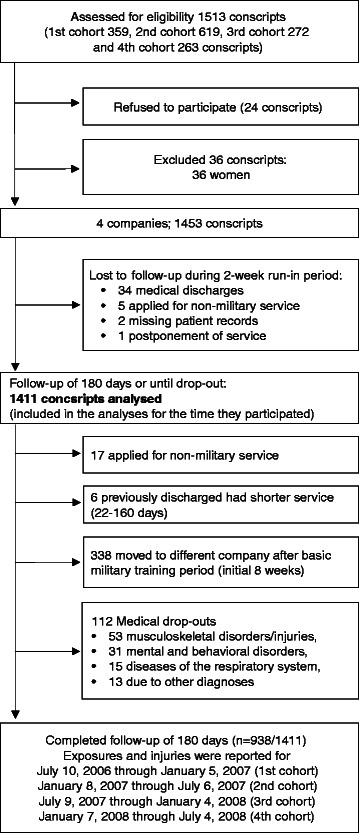
Military service in Finland is compulsory for all male citizens and annually about 80% of 19-year-old men enter into the service. The elevated risk for many chronic diseases and loss of function among those who are inactive and unfit can be often detected already in youth. On the other hand, activity-induced injuries among young are true public health issue. The purpose of the present prospective cohort follow-up study was to evaluate predictive associations between acute or overuse injuries and their various intrinsic risk factors.
Four successive cohorts of conscripts who formed a representative sample of Finnish young men were followed for 6 months. At the beginning of the service, the risk factors of injuries were measured and recorded and then the acute and overuse injuries treated at the garrison clinic were identified. Predictive associations between injuries and their risk factors were examined by multivariate Cox's proportional hazard models.
Of the 1411 participants, 27% sustained an acute injury and 51% suffered from overuse injury. Concerning acute injuries, highest risk for severe injuries were detected among conscripts with low fitness level in both the standing long-jump and push-up tests (hazard rate, HR=5.9; 95% CI: 1.6‒21.3). A history of good degree in school sports was not a protective factor against acute injuries. High waist circumference and, on the other hand, being underweight according to BMI increased the HR for overuse injuries. Brisk leisure time physical activity before military entry was a protective factor against overuse injuries. Poor result in Cooper's test was a warning signal of elevated risk of overuse injuries.
We confirmed previous findings that low level of physical fitness is predictor for musculoskeletal injuries during intensive physical training. The U-shaped relationship between body composition and overuse injuries was noticed indicating that both obesity and underweight are risk factors for overuse injuries. Persons with excellent sports skills according to their earlier degrees in school sports had similar HR for acute injuries than those with poorer degrees. This indicates that school-age sports skills and fitness do not carry far and therefore preventive programmes are needed to prevent activity-induced injuries.
在芬兰,所有男性公民都必须服兵役,每年约80%的19岁男性进入军队服役。许多慢性病风险的增加以及不活动和身体不健康者的功能丧失往往在年轻时就可以被检测到。另一方面,年轻人中因活动导致的损伤是一个真正的公共卫生问题。本前瞻性队列随访研究的目的是评估急性或过度使用损伤与其各种内在风险因素之间的预测关联。
对连续四批构成芬兰年轻男性代表性样本的新兵进行了6个月的随访。在服役开始时,测量并记录损伤的风险因素,然后确定在驻军诊所治疗的急性和过度使用损伤。通过多变量Cox比例风险模型检查损伤与其风险因素之间的预测关联。
在1411名参与者中,27%遭受急性损伤,51%患有过度使用损伤。关于急性损伤,在立定跳远和俯卧撑测试中身体素质水平较低的新兵中,严重损伤的风险最高(风险率,HR = 5.9;95%置信区间:1.6 - 21.3)。学校体育成绩良好的历史并不是预防急性损伤的保护因素。高腰围,另一方面,根据BMI体重过轻会增加过度使用损伤的HR。入伍前休闲时间的剧烈体育活动是预防过度使用损伤的保护因素。库珀测试结果不佳是过度使用损伤风险升高的警示信号。
我们证实了先前的研究结果,即身体素质水平低是高强度体育训练期间肌肉骨骼损伤的预测因素。注意到身体成分与过度使用损伤之间的U形关系,表明肥胖和体重过轻都是过度使用损伤的风险因素。根据他们早期在学校体育的成绩具有优秀运动技能的人与成绩较差的人相比,急性损伤的HR相似。这表明学龄期的运动技能和身体素质并不能长久保持,因此需要预防计划来预防因活动导致的损伤。