Raghunath Arathi, Sambarey Awanti, Sharma Neha, Mahadevan Usha, Chandra Nagasuma
Molecular Connections Private Limited, Bangalore, 560004, India.
Department of Biochemistry, Indian Institute of Science, Bangalore, 560012, India.
BMC Res Notes. 2015 Apr 29;8:170. doi: 10.1186/s13104-015-1128-6.
Ultraviolet radiations (UV) serve as an environmental stress for human skin, and result in melanogenesis, with the pigment melanin having protective effects against UV induced damage. This involves a dynamic and complex regulation of various biological processes that results in the expression of melanin in the outer most layers of the epidermis, where it can exert its protective effect. A comprehensive understanding of the underlying cross talk among different signalling molecules and cell types is only possible through a systems perspective. Increasing incidences of both melanoma and non-melanoma skin cancers necessitate the need to better comprehend UV mediated effects on skin pigmentation at a systems level, so as to ultimately evolve knowledge-based strategies for efficient protection and prevention of skin diseases.
A network model for UV-mediated skin pigmentation in the epidermis was constructed and subjected to shortest path analysis. Virtual knock-outs were carried out to identify essential signalling components.
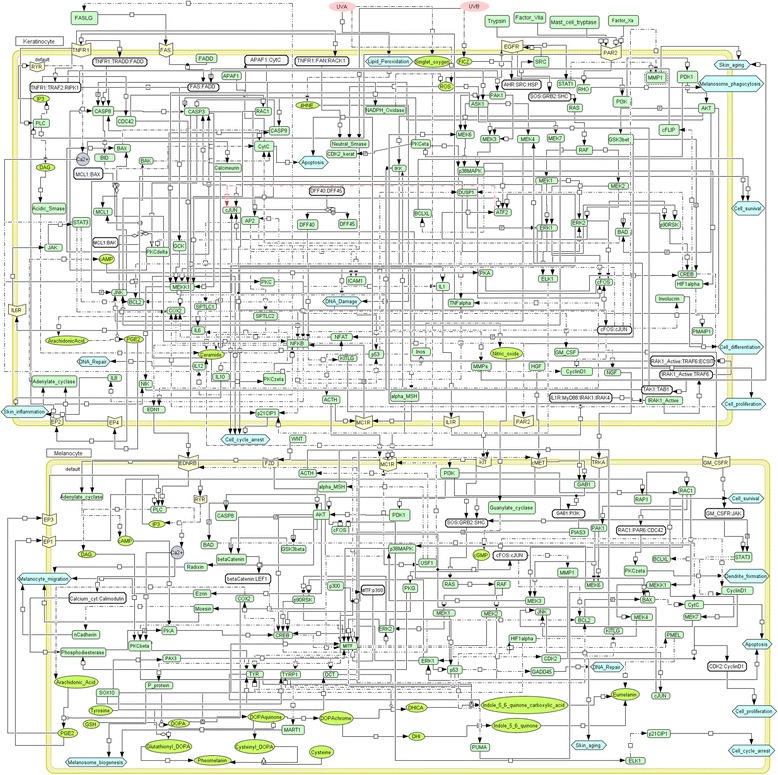
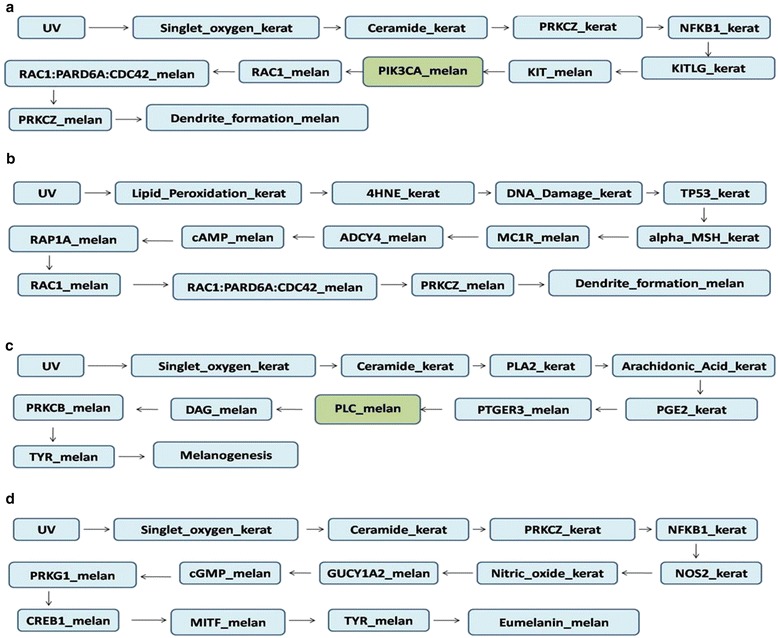
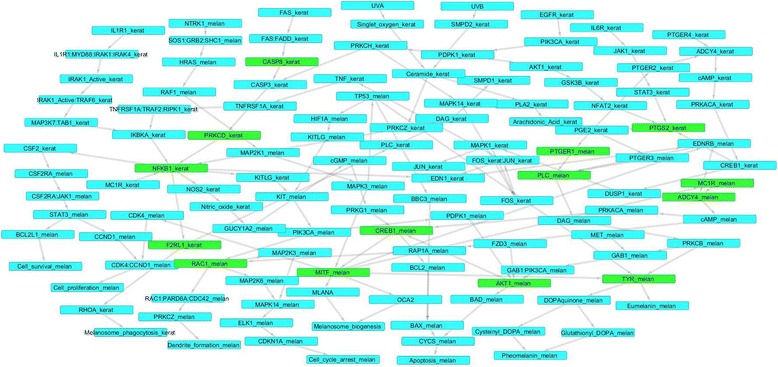
We describe a network model for UV-mediated skin pigmentation in the epidermis. The model consists of 265 components (nodes) and 429 directed interactions among them, capturing the manner in which one component influences the other and channels information. Through shortest path analysis, we identify novel signalling pathways relevant to pigmentation. Virtual knock-outs or perturbations of specific nodes in the network have led to the identification of alternate modes of signalling as well as enabled determining essential nodes in the process.
The model presented provides a comprehensive picture of UV mediated signalling manifesting in human skin pigmentation. A systems perspective helps provide a holistic purview of interconnections and complexity in the processes leading to pigmentation. The model described here is extensive yet amenable to expansion as new data is gathered. Through this study, we provide a list of important proteins essential for pigmentation which can be further explored to better understand normal pigmentation as well as its pathologies including vitiligo and melanoma, and enable therapeutic intervention.
紫外线辐射是人类皮肤面临的一种环境压力,会导致黑色素生成,黑色素对紫外线诱导的损伤具有保护作用。这涉及对各种生物过程的动态复杂调节,从而导致黑色素在表皮最外层表达,在那里发挥其保护作用。只有从系统角度才能全面理解不同信号分子和细胞类型之间潜在的相互作用。黑色素瘤和非黑色素瘤皮肤癌的发病率不断上升,因此有必要在系统层面更好地理解紫外线对皮肤色素沉着的影响,以便最终制定基于知识的策略,有效保护和预防皮肤疾病。
构建了表皮中紫外线介导的皮肤色素沉着网络模型,并进行了最短路径分析。通过虚拟基因敲除来识别关键信号成分。
我们描述了表皮中紫外线介导的皮肤色素沉着网络模型。该模型由265个成分(节点)和它们之间的429个直接相互作用组成,捕捉了一个成分影响另一个成分并传递信息的方式。通过最短路径分析,我们确定了与色素沉着相关的新信号通路。对网络中特定节点的虚拟基因敲除或扰动导致了信号传导替代模式的识别,并有助于确定该过程中的关键节点。
所提出的模型全面展示了紫外线介导的信号在人类皮肤色素沉着中的表现。系统角度有助于全面了解色素沉着过程中的相互联系和复杂性。这里描述的模型虽然广泛,但随着新数据的收集易于扩展。通过这项研究,我们提供了一份色素沉着所需重要蛋白质的清单,可进一步探索以更好地理解正常色素沉着及其包括白癜风和黑色素瘤在内的病理情况,并实现治疗干预。