Lee Ho-Sung, Goh Myeong-Jin, Kim Junil, Choi Tae-Jun, Kwang Lee Hae, Joo Na Yong, Cho Kwang-Hyun
1] Laboratory for Systems Biology and Bio-Inspired Engineering, Department of Bio and Brain Engineering, Korea Advanced Institute of Science and Technology, Daejeon, 305-701, Republic of Korea [2] Graduate School of Medical Science and Engineering, Korea Advanced Institute of Science and Technology, Daejeon, 305-701, Republic of Korea.
Skin Research Institute, Amorepacific R&D center, Gyeonggi-do, 446-729, Republic of Korea.
Sci Rep. 2015 May 18;5:10305. doi: 10.1038/srep10305.
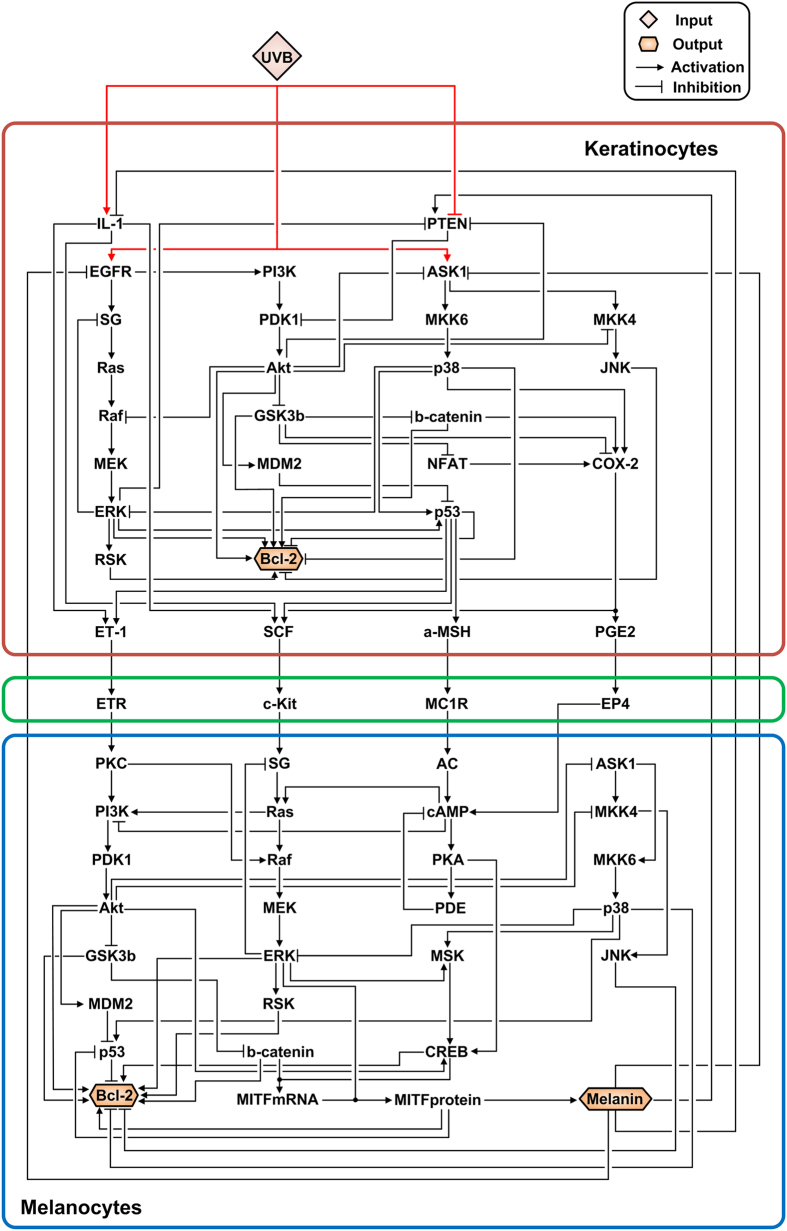
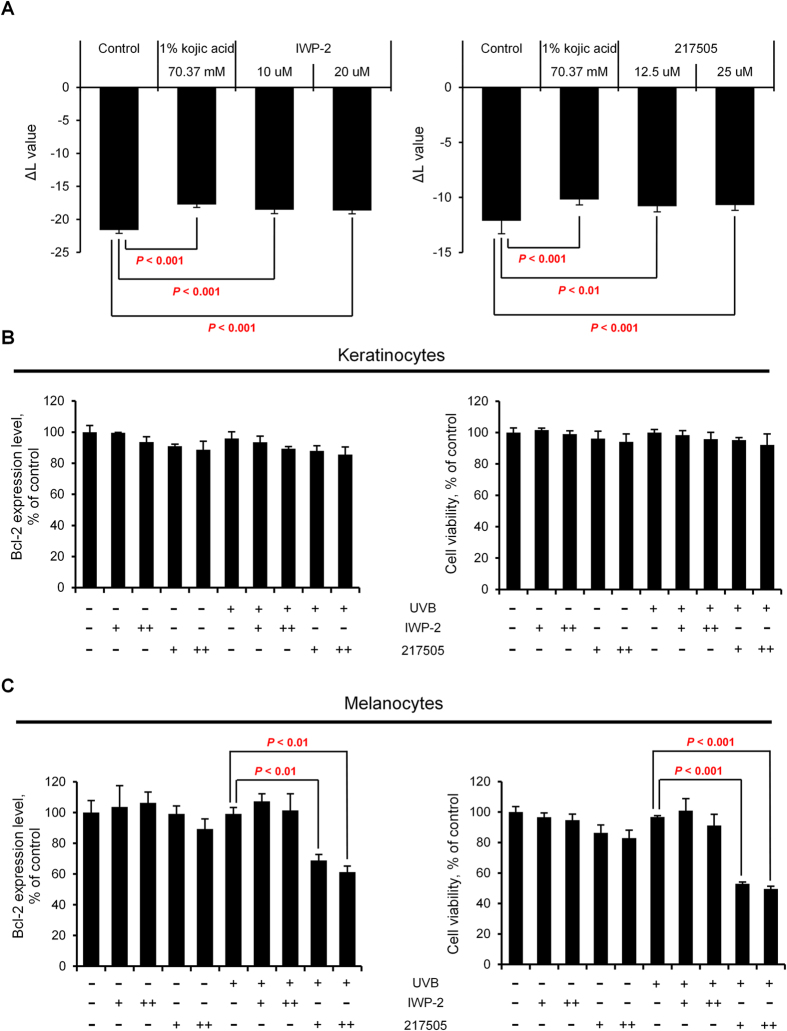
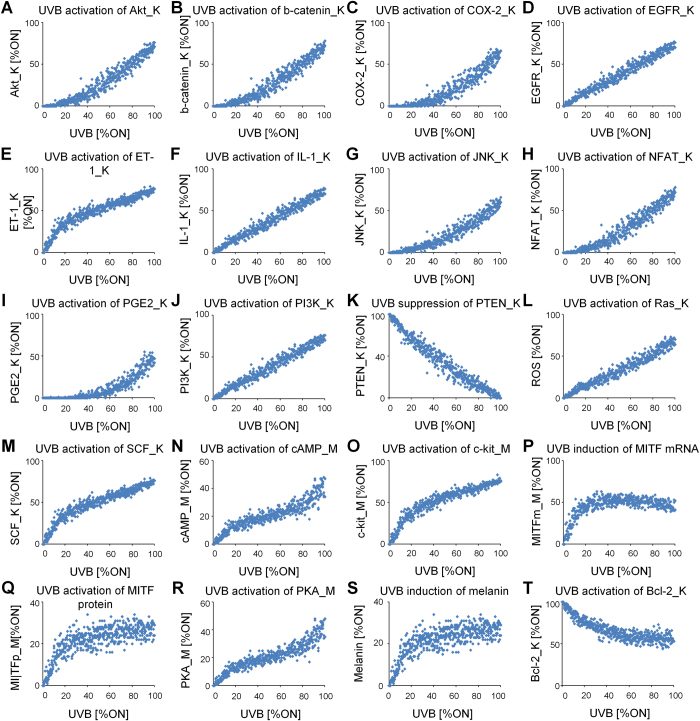
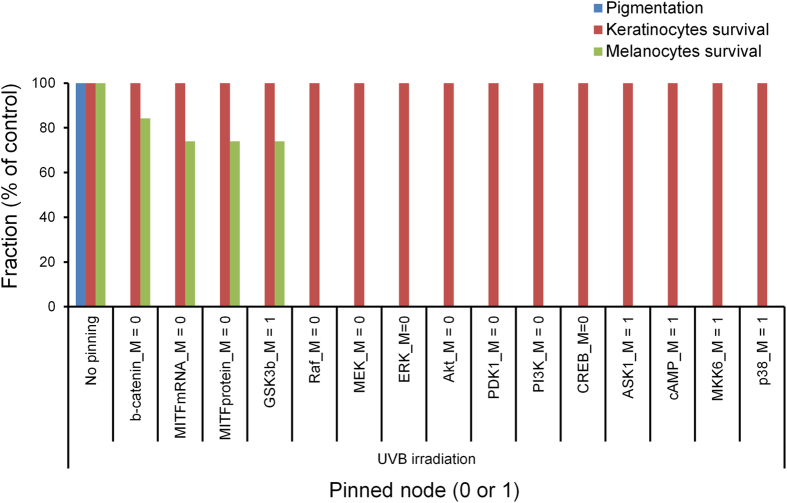
Melanogenesis is the process of melanin synthesis through keratinocytes-melanocytes interaction, which is triggered by the damaging effect of ultraviolet-B (UVB) rays. It is known that melanogenesis influences diverse cellular responses, including cell survival and apoptosis, via complex mechanisms of feedback and crosstalk. Therefore, an attempt to suppress melanin production by modulating the melanogenesis pathway may induce perturbations in the apoptotic balance of the cells in response to UVB irradiation, which results in various skin diseases such as melasma, vitiligo, and skin cancer. To identify such appropriate target strategies for the reduction of UVB-induced melanin synthesis, we reconstructed the melanogenesis signaling network and developed a Boolean network model. Mathematical simulations of the melanogenesis network model revealed that the inhibition of beta-catenin in the melanocytes effectively reduce melanin production while having minimal influence on the apoptotic balance of the cells. Exposing cells to a beta-catenin inhibitor decreased pigmentation but did not significantly change the B-cell Chronic lymphocytic leukemia/lymphoma 2 expression, a potent regulator of apoptotic balance. Thus, our systems analysis suggests that the inhibition of beta-catenin may be the most appropriate target strategy for the reduction of UVB-induced skin pigmentation.
黑色素生成是通过角质形成细胞 - 黑素细胞相互作用进行黑色素合成的过程,该过程由紫外线B(UVB)射线的损伤作用触发。已知黑色素生成通过复杂的反馈和串扰机制影响多种细胞反应,包括细胞存活和凋亡。因此,试图通过调节黑色素生成途径来抑制黑色素生成可能会在细胞对UVB照射的凋亡平衡中引发扰动,从而导致各种皮肤疾病,如黄褐斑、白癜风和皮肤癌。为了确定减少UVB诱导的黑色素合成的合适靶向策略,我们重建了黑色素生成信号网络并开发了一个布尔网络模型。黑色素生成网络模型的数学模拟表明,抑制黑素细胞中的β-连环蛋白可有效减少黑色素生成,同时对细胞的凋亡平衡影响最小。将细胞暴露于β-连环蛋白抑制剂可减少色素沉着,但不会显著改变凋亡平衡的有效调节因子B细胞淋巴瘤/白血病-2的表达。因此,我们的系统分析表明,抑制β-连环蛋白可能是减少UVB诱导的皮肤色素沉着的最合适靶向策略。