Cappelleri Joseph C, Koduru Vijaya, Bienen E Jay, Sadosky Alesia
Pfizer Inc, Groton, CT, USA.
Eliassen Group, New London, CT, USA.
J Pain Res. 2015 Apr 15;8:159-67. doi: 10.2147/JPR.S80046. eCollection 2015.
Similarities and differences on the nine-item and seven-item versions of painDETECT, a patient-reported screener to identify neuropathic pain (NeP), have not been psychometrically explored across NeP conditions.
Scores on the nine-item painDETECT (seven pain symptom items, one pain course pattern item, one pain radiation item) range from -1 to 38; scores ≥19 indicate NeP is likely (>90% probability). The seven-item version (only pain symptoms) score range is 0 to 35. painDETECT was administered to subjects with confirmed diagnoses of human immunodeficiency virus-related peripheral NeP (HIVP) (n=103), spinal cord injury-related NeP (SCI) (n=103), small fiber neuropathy (n=100), painful diabetic peripheral neuropathy (n=112), posttrauma/postsurgical NeP (n=100), and NeP in chronic low back pain (n=106) identified during office visits to US community-based physicians. Analysis of covariance compared mean scores (adjusted for age, sex, race, ethnicity, time since NeP diagnosis, and number of comorbidities) on the nine-item and seven-item versions of painDETECT. Cronbach's alpha assessed internal consistency reliability, and corrected item-to-total correlations assessed item-level discrimination.
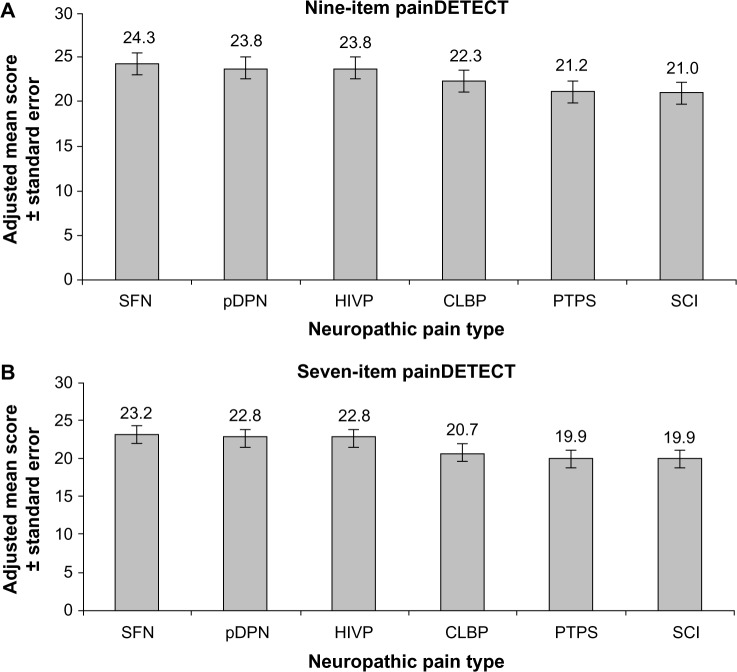
The adjusted mean nine-item scores ranged from 21.0 (SCI) to 24.3 (small fiber neuropathy). Differences between conditions were either trivial or small-to-medium in magnitude. Cronbach's alpha gave overall internal consistency reliability of 0.76, with a range of 0.63 (SCI) to 0.82 (HIVP). Mean scores and Cronbach's alphas for the seven-item version were generally similar to the nine-item version. Corrected item-to-total correlations adequately discriminated all pain symptom items on both painDETECT versions for each condition (0.3-0.7), but the two nonsensory items on the nine-item version showed lackluster discrimination (<0.3).
painDETECT scores were within the range indicating high probability of NeP. Differences between conditions were generally modest or not large. Both versions showed evidence of internal consistency reliability and item-level discrimination, suggesting that painDETECT is a useful screening measure for identifying NeP across NeP conditions.
疼痛检测量表(painDETECT)有九项版和七项版,这两个版本用于识别神经性疼痛(NeP),是一种由患者报告的筛查工具,目前尚未在各种NeP情况下对它们的异同进行心理测量学探索。
九项版疼痛检测量表(七个疼痛症状项目、一个疼痛病程模式项目、一个疼痛放射项目)的得分范围为-1至38分;得分≥19分表明可能患有NeP(概率>90%)。七项版(仅疼痛症状)的得分范围是0至35分。疼痛检测量表应用于确诊为人类免疫缺陷病毒相关周围神经病变(HIVP)(n = 103)、脊髓损伤相关神经病变(SCI)(n = 103)、小纤维神经病变(n = 100)、疼痛性糖尿病周围神经病变(n = 112)、创伤后/手术后神经病变(n = 100)以及在美国社区医生门诊中确诊的慢性下腰痛相关神经病变(n = 106)的受试者。协方差分析比较了疼痛检测量表九项版和七项版的平均得分(根据年龄、性别、种族、民族、NeP诊断后的时间以及合并症数量进行调整)。克朗巴哈系数(Cronbach's alpha)评估内部一致性信度,校正后的项目与总分相关性评估项目层面的区分度。
调整后的九项版平均得分范围为21.0(SCI)至24.3(小纤维神经病变)。不同情况之间的差异要么微不足道,要么幅度为小到中等。克朗巴哈系数得出总体内部一致性信度为0.76,范围从0.63(SCI)至0.82(HIVP)。七项版的平均得分和克朗巴哈系数通常与九项版相似。校正后的项目与总分相关性在每种情况下对疼痛检测量表两个版本的所有疼痛症状项目都有充分的区分度(0.3 - 0.7),但九项版的两个非感觉项目的区分度不足(<0.3)。
疼痛检测量表得分处于表明NeP高概率的范围内。不同情况之间的差异通常较小或不大。两个版本都显示出内部一致性信度和项目层面区分度的证据,表明疼痛检测量表是一种用于在各种NeP情况下识别NeP的有用筛查工具。