Abbasi-Kenarsari Hajar, Shafaghat Farzaneh, Baradaran Behzad, Movassaghpour Ali Akbar, Shanehbandi Dariush, Kazemi Tohid
Immunology Research Center, Tabriz University of Medical Sciences, Tabriz, Iran ; Department of Immunology, School of Medicine, Tabriz University of Medical Sciences, Tabriz, Iran ; Students Research Committee, Tabriz University of Medical Sciences, Tabriz, Iran.
Department of Immunology, International Branch of Aras, Tabriz University of Medical Sciences, Tabriz, Iran.
Avicenna J Med Biotechnol. 2015 Jan-Mar;7(1):39-44.
CD19 is a pan B cell marker that is recognized as an attractive target for antibody-based therapy of B-cell disorders including autoimmune disease and hematological malignancies. The object of this study was to stably express the human CD19 antigen in the murine NIH-3T3 cell line aimed to be used as an immunogen in our future study.
Total RNA was extracted from Raji cells in which high expression of CD19 was confirmed by flow cytometry. Synthesized cDNA was used for CD19 gene amplification by conventional PCR method using Pfu DNA polymerase. PCR product was ligated to pGEM-T Easy vector and ligation mixture was transformed to DH5α competent bacteria. After blue/white selection, one positive white colony was subjected to plasmid extraction and direct sequencing. Then, CD19 cDNA was sub-cloned into pCMV6-Neo expression vector by double digestion using KpnI and HindIII enzymes. NIH-3T3 mouse fibroblast cell line was subsequently transfected by the construct using Jet-PEI transfection reagent. After 48 hours, surface expression of CD19 was confirmed by flow cytometry and stably transfected cells were selected by G418 antibiotic.
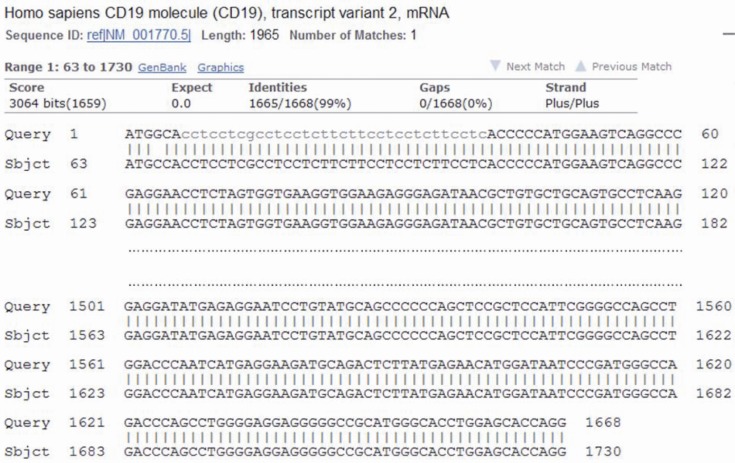
Amplification of CD19 cDNA gave rise to 1701 bp amplicon confirmed by alignment to reference sequence in NCBI database. Flow cytometric analysis showed successful transient and stable expression of CD19 on NIH-3T3 cells (29 and 93%, respectively).
Stable cell surface expression of human CD19 antigen in a murine NIH-3T3 cell line may develop a proper immunogene which raises specific anti-CD19 antibody production in the mice immunized sera.
CD19是一种泛B细胞标志物,被认为是基于抗体治疗包括自身免疫性疾病和血液系统恶性肿瘤在内的B细胞疾病的有吸引力的靶点。本研究的目的是在小鼠NIH-3T3细胞系中稳定表达人CD19抗原,以便在我们未来的研究中用作免疫原。
从经流式细胞术证实CD19高表达的Raji细胞中提取总RNA。合成的cDNA用于通过使用Pfu DNA聚合酶的常规PCR方法扩增CD19基因。PCR产物与pGEM-T Easy载体连接,连接混合物转化至DH5α感受态细菌。经过蓝/白筛选后,对一个阳性白色菌落进行质粒提取和直接测序。然后,使用KpnI和HindIII酶通过双酶切将CD19 cDNA亚克隆到pCMV6-Neo表达载体中。随后使用Jet-PEI转染试剂用构建体转染NIH-3T3小鼠成纤维细胞系。48小时后,通过流式细胞术确认CD19的表面表达,并通过G418抗生素选择稳定转染的细胞。
CD19 cDNA的扩增产生了1701 bp的扩增子,经与NCBI数据库中的参考序列比对得到证实。流式细胞术分析显示CD19在NIH-3T3细胞上成功瞬时和稳定表达(分别为29%和93%)。
人CD19抗原在小鼠NIH-3T3细胞系中的稳定细胞表面表达可能产生一种合适的免疫原,该免疫原可在免疫小鼠血清中产生特异性抗CD19抗体。