Vermeer Joop E M, Geldner Niko
Department of Plant Molecular Biology, Biophore Building, UNIL-Sorge, University of Lausanne 1015 Lausanne Switzerland.
F1000Prime Rep. 2015 Mar 3;7:32. doi: 10.12703/P7-32. eCollection 2015.
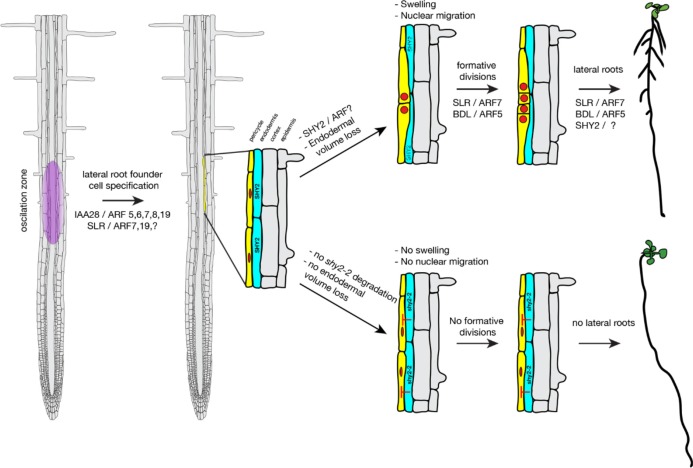
Osmotically driven turgor pressure of plant cells can be higher than that of a car tire. It puts tremendous forces onto cell walls and drives cell growth and changes in cell shape. This has given rise to unique mechanisms to control organ formation compared to metazoans. The fascinating interplay between forces and local cellular reorganization is still poorly understood. Growth of lateral roots is a prominent example of a developmental process in which mechanical forces between neighboring cells are generated and must be dealt with. Lateral roots initiate from a single cell layer that resides deep within the primary root. On their way out, lateral roots grow through the overlying endodermal, cortical, and epidermal cell layers. It was recently demonstrated that endodermal cells actively accommodate lateral root formation. Interfering genetically with these accommodating responses in the endodermis completely blocks cell proliferation in the pericycle. The lateral root system provides a unique opportunity to elucidate the molecular and cellular mechanisms whereby mechanical forces and intercellular communication regulate spatial accommodation during plant development.
植物细胞的渗透驱动膨压可能高于汽车轮胎的气压。它会对细胞壁施加巨大的力,推动细胞生长和细胞形状的改变。与后生动物相比,这产生了控制器官形成的独特机制。力与局部细胞重组之间迷人的相互作用仍知之甚少。侧根生长是一个突出的发育过程实例,在此过程中,相邻细胞之间会产生机械力且必须加以应对。侧根从位于主根深处的单个细胞层开始发育。在穿出主根的过程中,侧根会穿过覆盖其上的内皮层、皮层和表皮细胞层。最近有研究表明,内皮层细胞会积极适应侧根的形成。通过基因干扰内皮层的这些适应性反应,会完全阻断中柱鞘中的细胞增殖。侧根系统为阐明机械力和细胞间通讯在植物发育过程中调节空间适应性的分子和细胞机制提供了独特的机会。