Nellist Mark, Brouwer Rutger W W, Kockx Christel E M, van Veghel-Plandsoen Monique, Withagen-Hermans Caroline, Prins-Bakker Lida, Hoogeveen-Westerveld Marianne, Mrsic Alan, van den Berg Mike M P, Koopmans Anna E, de Wit Marie-Claire, Jansen Floor E, Maat-Kievit Anneke J A, van den Ouweland Ans, Halley Dicky, de Klein Annelies, van IJcken Wilfred F J
Department of Clinical Genetics, Ee-2426, Erasmus Medical Center, Wytemaweg 80, 3015, Rotterdam, CN, The Netherlands.
Center for Biomics, Erasmus Medical Center, Wytemaweg 80, 3015, Rotterdam, CN, The Netherlands.
BMC Med Genet. 2015 Feb 25;16:10. doi: 10.1186/s12881-015-0155-4.
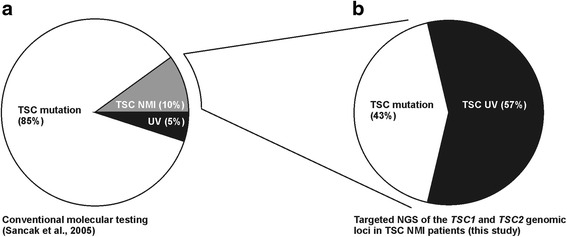
Tuberous sclerosis complex (TSC) is an autosomal dominant disorder caused by mutations in TSC1 and TSC2. Conventional DNA diagnostic screens identify a TSC1 or TSC2 mutation in 75 - 90% of individuals categorised with definite TSC. The remaining individuals either have a mutation that is undetectable using conventional methods, or possibly a mutation in another as yet unidentified gene.
Here we apply a targeted Next Generation Sequencing (NGS) approach to screen the complete TSC1 and TSC2 genomic loci in 7 individuals fulfilling the clinical diagnostic criteria for definite TSC in whom no TSC1 or TSC2 mutations were identified using conventional screening methods.
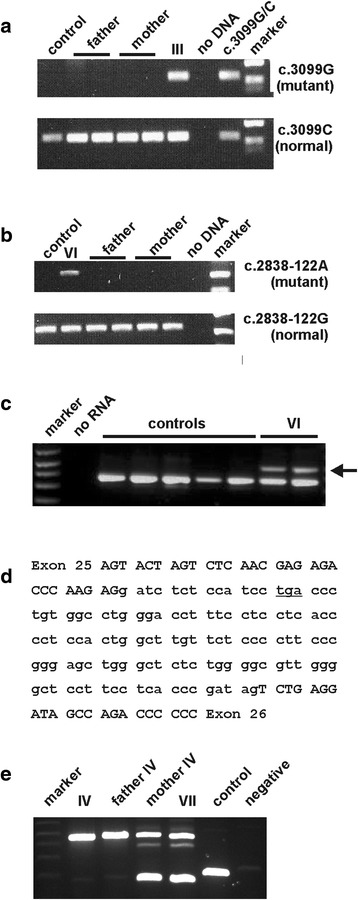
We identified and confirmed pathogenic mutations in 3 individuals. In the remaining individuals we identified variants of uncertain clinical significance. The identified variants included mosaic changes, changes located deep in intronic sequences and changes affecting promoter regions that would not have been identified using exon-only based analyses.
Targeted NGS of the TSC1 and TSC2 loci is a suitable method to increase the yield of mutations identified in the TSC patient population.
结节性硬化症(TSC)是一种常染色体显性疾病,由TSC1和TSC2基因突变引起。传统的DNA诊断筛查在75%-90%被明确诊断为TSC的个体中发现TSC1或TSC2突变。其余个体要么有使用传统方法无法检测到的突变,要么可能存在另一个尚未鉴定的基因中的突变。
在此,我们应用靶向新一代测序(NGS)方法,对7名符合明确TSC临床诊断标准且使用传统筛查方法未发现TSC1或TSC2突变的个体的TSC1和TSC2基因组位点进行全面筛查。
我们在3名个体中鉴定并确认了致病突变。在其余个体中,我们鉴定出了临床意义不确定的变异。所鉴定的变异包括嵌合变化、位于内含子序列深处的变化以及影响启动子区域的变化,这些变化是基于仅外显子的分析无法鉴定出来的。
对TSC1和TSC2位点进行靶向NGS是一种提高TSC患者群体中鉴定出的突变率的合适方法。