Goodfellow Nicola A, Hawwa Ahmed F, Reid Alastair Jm, Horne Rob, Shields Michael D, McElnay James C
School of Pharmacy, Queen's University Belfast, Medical Biology Centre, 97 Lisburn Road, Belfast, BT9 7BL, UK.
Aston Pharmacy School, Aston University, Birmingham, B4 7ET, UK.
BMC Pulm Med. 2015 Apr 26;15:43. doi: 10.1186/s12890-015-0038-7.
Adherence to treatment is often reported to be low in children with cystic fibrosis. Adherence in cystic fibrosis is an important research area and more research is needed to better understand family barriers to adherence in order for clinicians to provide appropriate intervention. The aim of this study was to evaluate adherence to enzyme supplements, vitamins and chest physiotherapy in children with cystic fibrosis and to determine if any modifiable risk factors are associated with adherence.
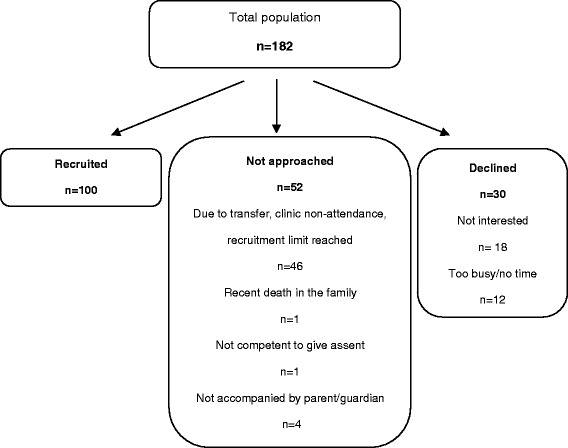
A sample of 100 children (≤18 years) with cystic fibrosis (44 male; median [range] 10.1 [0.2-18.6] years) and their parents were recruited to the study from the Northern Ireland Paediatric Cystic Fibrosis Centre. Adherence to enzyme supplements, vitamins and chest physiotherapy was assessed using a multi-method approach including; Medication Adherence Report Scale, pharmacy prescription refill data and general practitioner prescription issue data. Beliefs about treatments were assessed using refined versions of the Beliefs about Medicines Questionnaire-specific. Parental depressive symptoms were assessed using the Center for Epidemiologic Studies Depression Scale.
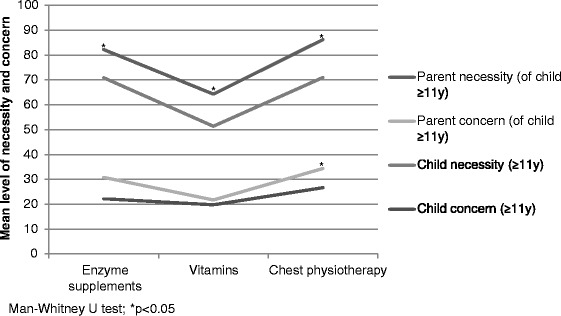
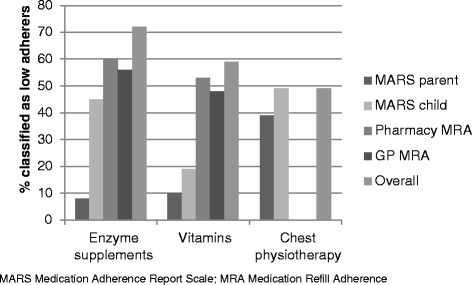
Using the multi-method approach 72% of children were classified as low-adherers to enzyme supplements, 59% low-adherers to vitamins and 49% low-adherers to chest physiotherapy. Variations in adherence were observed between measurement methods, treatments and respondents. Parental necessity beliefs and child age were significant independent predictors of child adherence to enzyme supplements and chest physiotherapy, but parental depressive symptoms were not found to be predictive of adherence.
Child age and parental beliefs about treatments should be taken into account by clinicians when addressing adherence at routine clinic appointments. Low adherence is more likely to occur in older children, whereas, better adherence to cystic fibrosis therapies is more likely in children whose parents strongly believe the treatments are necessary. The necessity of treatments should be reinforced regularly to both parents and children.
据报道,囊性纤维化患儿的治疗依从性通常较低。囊性纤维化的依从性是一个重要的研究领域,需要更多研究来更好地了解影响依从性的家庭障碍,以便临床医生提供适当的干预措施。本研究的目的是评估囊性纤维化患儿对酶补充剂、维生素和胸部物理治疗的依从性,并确定是否有任何可改变的风险因素与依从性相关。
从北爱尔兰儿科囊性纤维化中心招募了100名年龄≤18岁的囊性纤维化患儿(44名男性;中位数[范围]为10.1[0.2 - 18.6]岁)及其父母参与本研究。使用多种方法评估对酶补充剂、维生素和胸部物理治疗的依从性,包括:药物依从性报告量表、药房处方 refill 数据和全科医生处方开具数据。使用特定的药物信念问卷的改进版本评估对治疗的信念。使用流行病学研究中心抑郁量表评估父母的抑郁症状。
采用多种方法评估发现,72%的患儿被归类为酶补充剂低依从者,59%为维生素低依从者,49%为胸部物理治疗低依从者。在测量方法、治疗和受访者之间观察到依从性的差异。父母的必要性信念和患儿年龄是患儿对酶补充剂和胸部物理治疗依从性的重要独立预测因素,但未发现父母的抑郁症状可预测依从性。
临床医生在常规门诊就诊时处理依从性问题时,应考虑患儿年龄和父母对治疗的信念。年龄较大的患儿更可能出现低依从性,而父母坚信治疗必要的患儿对囊性纤维化治疗的依从性可能更好。应定期向父母和患儿强化治疗的必要性。