Nagpal Seema, Recht Cathy Kahn, Bertrand Sophie, Thomas Reena Parada, Ajlan Abdulrazag, Pena Justine, Gershon Megan, Coffey Gwen, Kunz Pamela L, Li Gordon, Recht Lawrence D
Division of Neuro-Oncology, Department of Neurology, Stanford University, 875 Blake Wilbur Drive CC2221, Stanford, CA, 94305, USA,
J Neurooncol. 2015 Jun;123(2):277-82. doi: 10.1007/s11060-015-1795-0. Epub 2015 May 3.
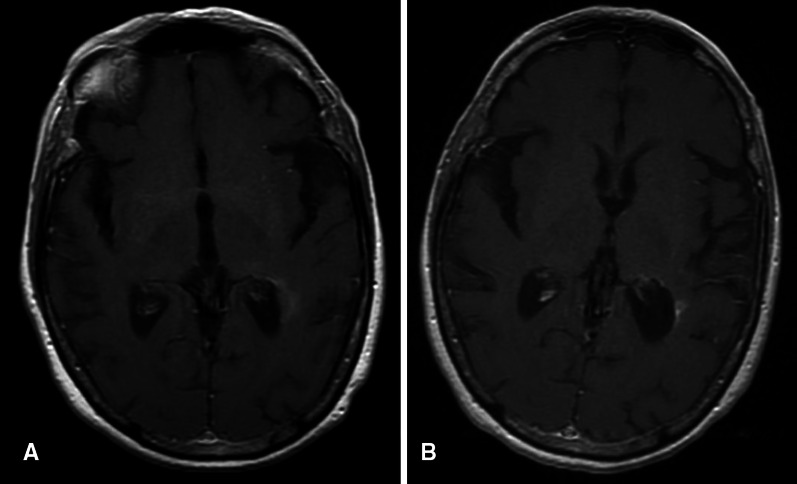
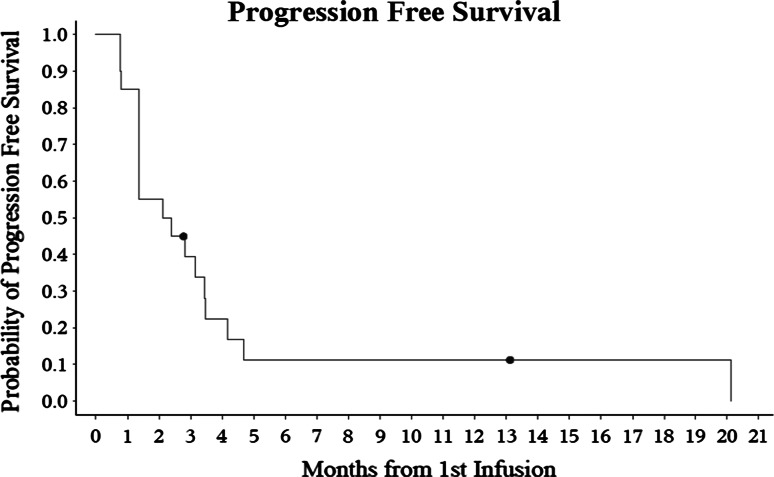
Patients with recurrence of high-grade glioma (HGG) after bevacizumab (BEV) have an extremely poor prognosis. Etirinotecan pegol (EP) is the first long-acting topoisomerase-I inhibitor designed to concentrate in and provide continuous tumor exposure throughout the entire chemotherapy cycle. Here we report results of a Phase 2, single arm, open-label trial evaluating EP in HGG patients who progressed after BEV. Patients age >18 with histologically proven anaplastic astrocytoma or glioblastoma (GB) who previously received standard chemo-radiation and recurred after BEV were eligible. A predicted life expectancy >6 weeks and KPS ≥ 50 were required. The primary endpoint was PFS at 6-weeks. Secondary endpoint was overall survival from first EP infusion. Response was assessed by RANO criteria. Single agent EP was administered IV every 3 weeks at 145 mg/m2. Patients did not receive BEV while on EP. 20 patients (90 % GB) were enrolled with a median age of 50 and median KPS of 70. Three patients with GB (16.7 % of GB) had partial MRI responses. 6-week PFS was 55 %. Median and 6-month PFS were 2.2 months (95 % CI 1.4-3.4 months) and 11.2 % (95 % CI 1.9-28.9 %) respectively. Median overall survival from first EP infusion was 4.5 months (95 % CI 2.4-5.9). Only one patient had grade 3 toxicity (diarrhea with dehydration) attributable to EP. Hematologic toxicity was mild. Three patients had confirmed partial responses according to RANO criteria. These clinical data combined with a favorable safety profile warrant further clinical investigation of this agent in HGG.
贝伐单抗(BEV)治疗后复发的高级别胶质瘤(HGG)患者预后极差。聚乙二醇依立替康(EP)是首个长效拓扑异构酶-I抑制剂,旨在在整个化疗周期内聚集于肿瘤并持续暴露于肿瘤。在此,我们报告一项2期单臂开放标签试验的结果,该试验评估EP用于BEV治疗后病情进展的HGG患者。年龄>18岁、组织学确诊为间变性星形细胞瘤或胶质母细胞瘤(GB)、先前接受过标准放化疗且在BEV治疗后复发的患者符合条件。要求预期寿命>6周且KPS≥50。主要终点是6周时的无进展生存期(PFS)。次要终点是首次输注EP后的总生存期。根据RANO标准评估反应。单药EP每3周静脉注射一次,剂量为145mg/m²。患者在接受EP治疗期间未接受BEV。入组20例患者(90%为GB),中位年龄50岁,中位KPS为70。3例GB患者(占GB患者的16.7%)MRI显示部分缓解。6周时的PFS为55%。中位PFS和6个月PFS分别为2.2个月(95%CI 1.4 - 3.4个月)和11.2%(95%CI 1.9 - 28.9%)。首次输注EP后的中位总生存期为4.5个月(95%CI 2.4 - 5.9)。仅1例患者出现3级毒性(腹泻伴脱水),归因于EP。血液学毒性较轻。根据RANO标准,3例患者确认部分缓解。这些临床数据以及良好的安全性表明该药物在HGG中值得进一步临床研究。