Cortés Javier, Rugo Hope S, Awada Ahmad, Twelves Chris, Perez Edith A, Im Seock-Ah, Gómez-Pardo Patricia, Schwartzberg Lee S, Diéras Veronique, Yardley Denise A, Potter David A, Mailliez Audrey, Moreno-Aspitia Alvaro, Ahn Jin-Seok, Zhao Carol, Hoch Ute, Tagliaferri Mary, Hannah Alison L, O'Shaughnessy Joyce
Ramon y Cajal University Hospital, Madrid, Spain, and Vall d'Hebron Institute of Oncology (VHIO), Barcelona, Spain.
University of California, San Francisco, CA, USA.
Breast Cancer Res Treat. 2017 Sep;165(2):329-341. doi: 10.1007/s10549-017-4304-7. Epub 2017 Jun 13.
Conventional chemotherapy has limited activity in patients with breast cancer and brain metastases (BCBM). Etirinotecan pegol (EP), a novel long-acting topoisomerase-1 inhibitor, was designed using advanced polymer technology to preferentially accumulate in tumor tissue including brain metastases, providing sustained cytotoxic SN38 levels.
The phase 3 BEACON trial enrolled 852 women with heavily pretreated locally recurrent or metastatic breast cancer between 2011 and 2013. BEACON compared EP with treatment of physician's choice (TPC; eribulin, vinorelbine, gemcitabine, nab-paclitaxel, paclitaxel, ixabepilone, or docetaxel) in patients previously treated with anthracycline, taxane, and capecitabine, including those with treated, stable brain metastases. The primary endpoint, overall survival (OS), was assessed in a pre-defined subgroup of BCBM patients; an exploratory post hoc analysis adjusting for the diagnosis-specific graded prognostic assessment (GPA) index was also conducted.
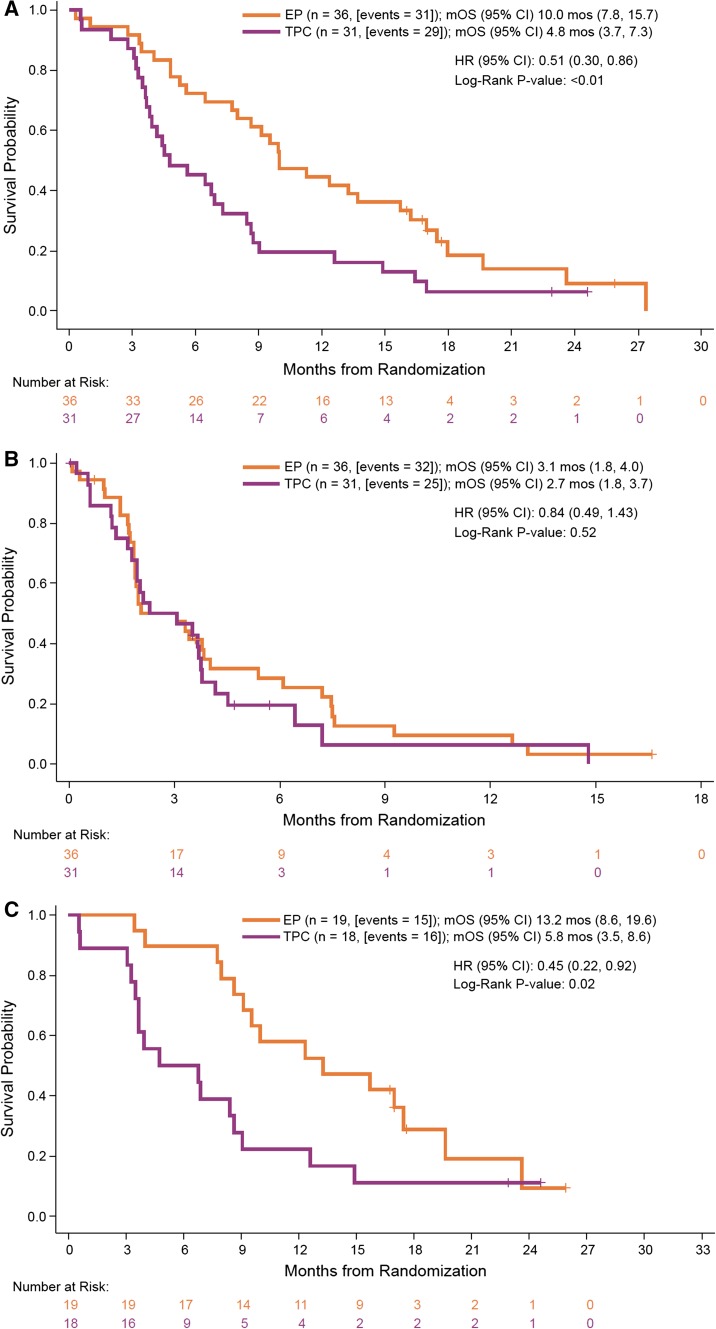
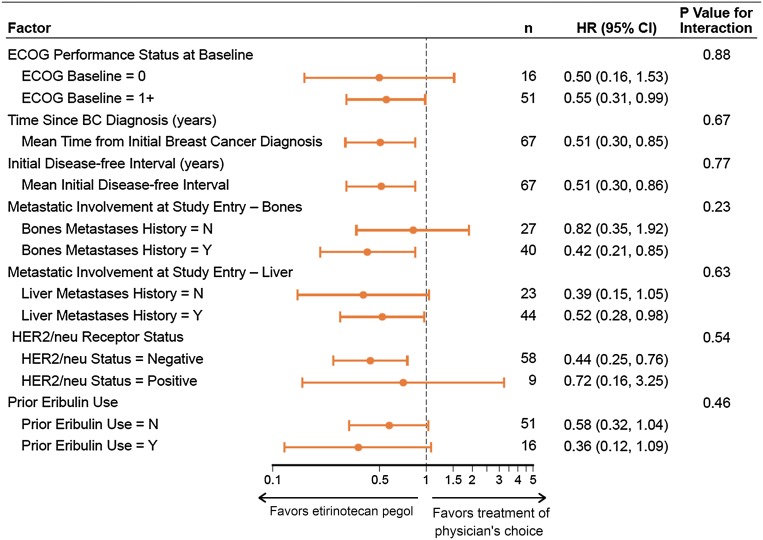
In the trial, 67 BCBM patients were randomized (EP, n = 36; TPC, n = 31). Treatment subgroups were balanced for baseline characteristics and GPA indices. EP was associated with a significant reduction in the risk of death (HR 0.51; P < 0.01) versus TPC; median OS was 10.0 and 4.8 months, respectively. Improvement in OS was observed in both poorer and better GPA prognostic groups. Survival rates at 12 months were 44.4% for EP versus 19.4% for TPC. Consistent with the overall BEACON population, fewer patients on EP experienced grade ≥3 toxicity (50 vs. 70%).
The significant improvement in survival in BCBM patients provides encouraging data for EP in this difficult-to-treat subgroup of patients. A phase three trial of EP in BCBM patients is underway (ClinicalTrials.gov NCT02915744).
传统化疗对患有乳腺癌和脑转移瘤(BCBM)的患者疗效有限。艾替立康聚乙二醇(EP)是一种新型长效拓扑异构酶-1抑制剂,采用先进的聚合物技术设计而成,可优先在包括脑转移瘤在内的肿瘤组织中蓄积,从而维持细胞毒性SN38水平。
3期BEACON试验在2011年至2013年期间纳入了852例局部复发或转移性乳腺癌的女性患者,这些患者此前接受过大量治疗。BEACON将EP与医生选择的治疗方案(TPC;艾瑞布林、长春瑞滨、吉西他滨、白蛋白结合型紫杉醇、紫杉醇、伊沙匹隆或多西他赛)进行比较,受试患者此前接受过蒽环类、紫杉烷类和卡培他滨治疗,包括脑转移瘤已得到治疗且病情稳定的患者。主要终点为总生存期(OS),在一个预先定义的BCBM患者亚组中进行评估;还进行了一项探索性事后分析,对诊断特异性分级预后评估(GPA)指数进行了校正。
在该试验中,67例BCBM患者被随机分组(EP组,n = 36;TPC组,n = 31)。各治疗亚组的基线特征和GPA指数均衡。与TPC相比,EP与死亡风险显著降低相关(HR 0.51;P < 0.01);中位OS分别为10.0个月和4.8个月。在GPA预后较差和较好的组中均观察到OS有所改善。EP组12个月时的生存率为44.4%,TPC组为19.4%。与整个BEACON人群一致,接受EP治疗的患者发生≥3级毒性的较少(50%对70%)。
BCBM患者生存率的显著提高为EP在这一难以治疗的患者亚组中提供了令人鼓舞的数据。一项针对BCBM患者的EP 3期试验正在进行中(ClinicalTrials.gov NCT02915744)。