Departments of Allergy and Respirology, National Hospital Organization Sagamihara National Hospital, 18-1 Sakuradai, Minami-ku Sagamihara, Kanagawa, 252-0392 Japan.
Clinical Research Center for Allergy and Rheumatology, National Hospital Organization Sagamihara National Hospital, 18-1 Sakuradai, Minami-ku Sagamihara, Kanagawa, 252-0392 Japan.
Clin Transl Allergy. 2014 Dec 12;4:38. doi: 10.1186/2045-7022-4-38. eCollection 2014.
Regulatory T (Treg) cells are implicated in the development and progression of eosinophilic granulomatosis with polyangiitis (EGPA). We previously showed beneficial effects of intravenous immunoglobulin (IVIG) therapy combined with corticosteroid and immunosuppressant treatment on clinical symptoms, including mononeuritis multiplex and cardiac dysfunction, and Treg cell frequency, during EGPA. Whether the timing of administration (during initial treatment or at relapse after remission) or previous treatment affects the clinical and immunologic efficacy of IVIG is unknown. We evaluated whether the frequency of Treg cells varied depending on when IVIG was provided relative to the start of conventional therapy for EGPA.
The patient population for this retrospective analysis comprised 17 patients with severe mononeuritis multiplex or heart failure whose EGPA did not respond to corticosteroids combined with immunosuppressant therapy. Ten patients first received IVIG during initial treatment, whereas the remaining 7 patients first received IVIG on relapse after remission. We measured the percentage of Treg cells, defined as FOXP3(+)CD4(+) T cells, present before the first round of IVIG and at 1 month after the last IVIG treatment.
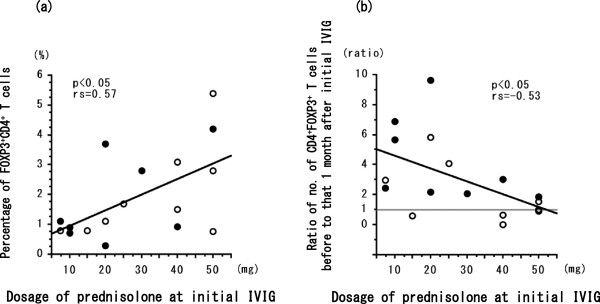
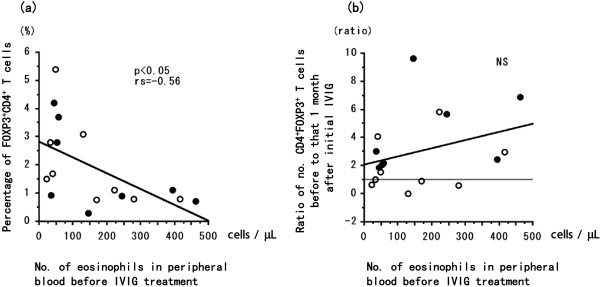
FOXP3(+)CD4(+) T cells were increased in patients who required only a single course of IVIG to achieve remission compared with those who needed two or more courses. The dosage of prednisolone at initial IVIG was inversely correlated with the ratio of the number of FOXP3(+)CD4(+) T cells before IVIG and that at 1 month thereafter.
Patients with severe EGPA who receive IVIG after nonresponse to high-dose prednisolone during initial treatment may need multiple courses of IVIG to achieve remission. An increase in the frequency of Treg cells after IVIG may predict the need for additional IVIG in EGPA.
调节性 T(Treg)细胞与嗜酸性肉芽肿伴多血管炎(EGPA)的发生和进展有关。我们之前的研究表明,静脉注射免疫球蛋白(IVIG)联合皮质类固醇和免疫抑制剂治疗对 EGPA 患者的临床症状(包括多发性单神经病和心功能障碍)和 Treg 细胞频率有有益的影响。IVIG 治疗的时机(在初始治疗时或缓解后复发时)或既往治疗是否会影响 IVIG 的临床和免疫疗效尚不清楚。我们评估了 Treg 细胞的频率是否取决于 IVIG 相对于 EGPA 常规治疗的开始时间而有所不同。
本回顾性分析的患者人群包括 17 名患有严重多发性单神经病或心力衰竭的患者,他们对皮质类固醇联合免疫抑制剂治疗没有反应。10 名患者在初始治疗时首先接受 IVIG,而其余 7 名患者在缓解后复发时首先接受 IVIG。我们测量了在接受第一轮 IVIG 治疗之前和最后一次 IVIG 治疗后 1 个月时,FOXP3+CD4+T 细胞(定义为 Treg 细胞)的百分比。
与需要两个或更多疗程 IVIG 才能达到缓解的患者相比,仅需一个疗程 IVIG 即可达到缓解的患者中 FOXP3+CD4+T 细胞增加。初始 IVIG 时泼尼松龙的剂量与 IVIG 前和之后 1 个月时 FOXP3+CD4+T 细胞数量的比值呈负相关。
在初始治疗时对大剂量泼尼松龙无反应的严重 EGPA 患者可能需要多次 IVIG 治疗才能达到缓解。IVIG 后 Treg 细胞频率的增加可能预示着 EGPA 需要额外的 IVIG。