Rivera Io-Guané, Ordoñez Marta, Presa Natalia, Gomez-Larrauri Ana, Simón Jorge, Trueba Miguel, Gomez-Muñoz Antonio
Department of Biochemistry and Molecular Biology, Faculty of Science and Technology, University of the Basque Country (UPV/EHU), 48080 Bilbao, Spain.
Toxins (Basel). 2015 Apr 29;7(5):1457-66. doi: 10.3390/toxins7051457.
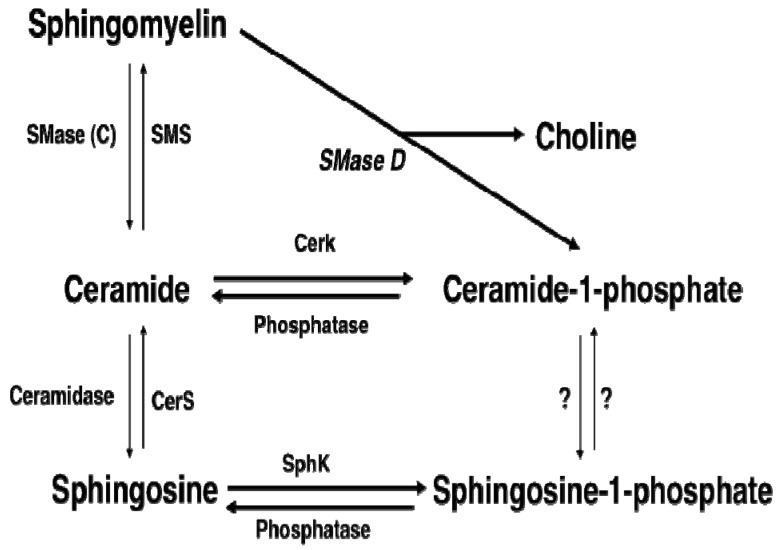
Sphingolipids are major constituents of biological membranes of eukaryotic cells. Many studies have shown that sphingomyelin (SM) is a major phospholipid in cell bilayers and is mainly localized to the plasma membrane of cells, where it serves both as a building block for cell architecture and as a precursor of bioactive sphingolipids. In particular, upregulation of (C-type) sphingomyelinases will produce ceramide, which regulates many physiological functions including apoptosis, senescence, or cell differentiation. Interestingly, the venom of some arthropodes including spiders of the genus Loxosceles, or the toxins of some bacteria such as Corynebacterium tuberculosis, or Vibrio damsela possess high levels of D-type sphingomyelinase (SMase D). This enzyme catalyzes the hydrolysis of SM to yield ceramide 1-phosphate (C1P), which promotes cell growth and survival and is a potent pro-inflammatory agent in different cell types. In particular, C1P stimulates cytosolic phospholipase A2 leading to arachidonic acid release and the subsequent formation of eicosanoids, actions that are all associated to the promotion of inflammation. In addition, C1P potently stimulates macrophage migration, which has also been associated to inflammatory responses. Interestingly, this action required the interaction of C1P with a specific plasma membrane receptor, whereas accumulation of intracellular C1P failed to stimulate chemotaxis. The C1P receptor is coupled to Gi proteins and activates of the PI3K/Akt and MEK/ERK1-2 pathways upon ligation with C1P. The proposed review will address novel aspects on the control of inflammatory responses by C1P and will highlight the molecular mechanisms whereby C1P exerts these actions.
鞘脂是真核细胞生物膜的主要成分。许多研究表明,鞘磷脂(SM)是细胞双层膜中的主要磷脂,主要定位于细胞膜,在那里它既是细胞结构的组成部分,又是生物活性鞘脂的前体。特别是,(C型)鞘磷脂酶的上调会产生神经酰胺,它调节许多生理功能,包括细胞凋亡、衰老或细胞分化。有趣的是,一些节肢动物的毒液,包括洛氏蝎属蜘蛛的毒液,或一些细菌的毒素,如结核分枝杆菌或美人鱼弧菌,都含有高水平的D型鞘磷脂酶(SMase D)。这种酶催化SM水解产生神经酰胺1-磷酸(C1P),它促进细胞生长和存活,并且在不同细胞类型中是一种有效的促炎剂。特别是,C1P刺激胞质磷脂酶A2,导致花生四烯酸释放以及随后类花生酸的形成,这些作用都与炎症的促进有关。此外,C1P强烈刺激巨噬细胞迁移,这也与炎症反应有关。有趣的是,这种作用需要C1P与特定的质膜受体相互作用,而细胞内C1P的积累未能刺激趋化性。C1P受体与Gi蛋白偶联,并在与C1P结合后激活PI3K/Akt和MEK/ERK1-2途径。本综述将探讨C1P控制炎症反应的新方面,并将突出C1P发挥这些作用的分子机制。