Taylor Mark J, Gregory Alice M, Freeman Daniel, Ronald Angelica
Genes Environment Lifespan Laboratory, Centre for Brain and Cognitive Development, Birkbeck, University of London.
Department of Psychology, Goldsmiths, University of London.
J Abnorm Psychol. 2015 Aug;124(3):674-684. doi: 10.1037/abn0000057.
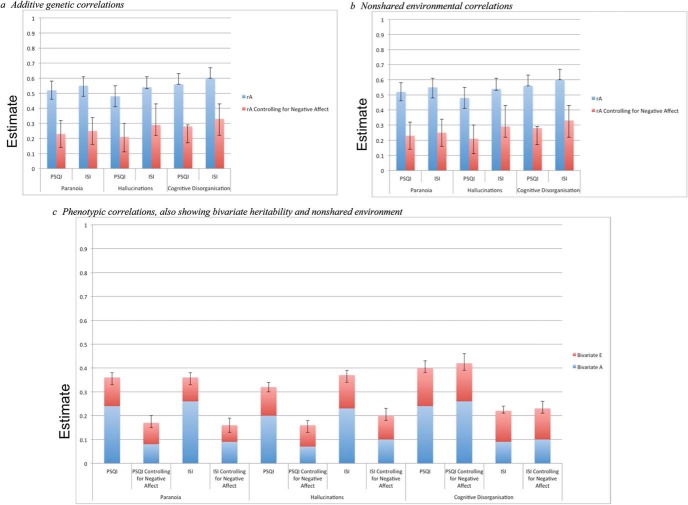
Sleep disturbances regularly co-occur with clinical psychotic disorders and dimensions of psychotic-like experiences (PLEs). One possible explanation for this, which has yet to be tested, is that similar genetic or environmental influences underlie sleep disturbances and vulnerability to PLEs. We conducted a twin study to test this possibility in relation to sleep disturbances and six specific PLEs in adolescence in the general population. Approximately 5,000 16-year-old twin pairs completed the Pittsburgh Sleep Quality Index and Insomnia Severity Index. PLEs were assessed using the Specific PLEs Questionnaire, comprising five self-report subscales (Paranoia, Hallucinations, Cognitive Disorganization, Grandiosity, and Anhedonia) and one parent-report subscale (Negative Symptoms). The associations between these measures were tested using structural equation twin model fitting. Paranoia, Hallucinations, and Cognitive Disorganization displayed moderate and significant correlations with both sleep measures (0.32-.42), while Negative Symptoms, Anhedonia, and Grandiosity showed lower correlations (0.01-0.17). Genetic and environmental influences significantly overlapped across PLEs (Paranoia, Hallucinations, Cognitive Disorganization) and both types of sleep disturbance (mean genetic and nonshared environmental correlations = 0.54 and 0.24, respectively). These estimates reduced, yet remained significant, after controlling for negative affect. The association between PLEs with sleep disturbances in adolescence is partly due to genetic and environmental influences that are common to them both. These findings indicate that the known neurobiology of sleep disturbance may provide clues regarding the causes of PLEs in adolescence.
睡眠障碍经常与临床精神障碍以及类精神病体验(PLEs)的维度同时出现。对此,一个尚未得到验证的可能解释是,睡眠障碍和对PLEs的易感性背后存在相似的遗传或环境影响。我们进行了一项双生子研究,以检验在普通人群中青少年的睡眠障碍与六种特定PLEs之间的这种可能性。大约5000对16岁的双胞胎完成了匹兹堡睡眠质量指数和失眠严重程度指数的测评。使用特定PLEs问卷对PLEs进行评估,该问卷包括五个自我报告子量表(偏执、幻觉、认知紊乱、夸大观念和快感缺失)和一个家长报告子量表(阴性症状)。使用结构方程双生子模型拟合来检验这些测量之间的关联。偏执、幻觉和认知紊乱与两种睡眠测量均显示出中等程度的显著相关性(0.32 - 0.42),而阴性症状、快感缺失和夸大观念的相关性较低(0.01 - 0.17)。遗传和环境影响在PLEs(偏执、幻觉、认知紊乱)和两种睡眠障碍类型之间存在显著重叠(平均遗传和非共享环境相关性分别为0.54和0.24)。在控制了消极情绪后,这些估计值有所降低,但仍然显著。青少年中PLEs与睡眠障碍之间的关联部分归因于两者共有的遗传和环境影响。这些发现表明,已知的睡眠障碍神经生物学可能为青少年PLEs的病因提供线索。