Swaroop Meyha N, Ferguson Chantal M, Horick Nora K, Skolny Melissa N, Miller Cynthia L, Jammallo Lauren S, Brunelle Cheryl L, O'Toole Jean A, Isakoff Steven J, Specht Michelle C, Taghian Alphonse G
Department of Radiation Oncology, Massachusetts General Hospital, 100 Blossom Street, Boston, MA, 02114, USA.
Breast Cancer Res Treat. 2015 Jun;151(2):393-403. doi: 10.1007/s10549-015-3408-1. Epub 2015 May 5.
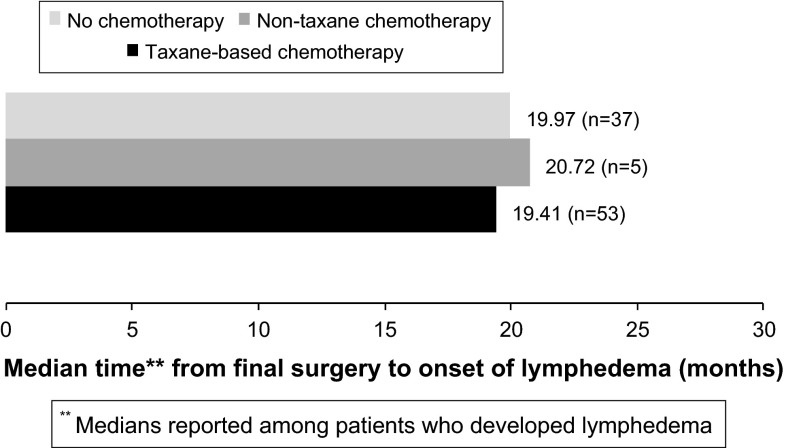
Taxane-based chemotherapy for the treatment of breast cancer is associated with fluid retention in the extremities; however, its association with development of breast cancer-related lymphedema is unclear. We sought to determine if adjuvant taxane-based chemotherapy increased risk of lymphedema or mild swelling of the upper extremity. 1121 patients with unilateral breast cancer were prospectively screened for lymphedema with perometer measurements. Lymphedema was defined as a relative volume change (RVC) of ≥10 % from preoperative baseline. Mild swelling was defined as RVC 5- <10 %. Clinicopathologic characteristics were obtained via medical record review. Kaplan-Meier and Cox proportional hazard analyses were performed to determine lymphedema rates and risk factors. 29 % (324/1121) of patients were treated with adjuvant taxane-based chemotherapy. The 2-year cumulative incidence of lymphedema in the overall cohort was 5.27 %. By multivariate analysis, axillary lymph node dissection (ALND) (p < 0.0001), higher body mass index (p = 0.0007), and older age at surgery (p = 0.04) were significantly associated with increased risk of lymphedema; however, taxane chemotherapy was not significant when compared to no chemotherapy and non-taxane chemotherapy (HR 1.14, p = 0.62; HR 1.56, p = 0.40, respectively). Chemotherapy with docetaxel was significantly associated with mild swelling on multivariate analysis in comparison to both no chemotherapy and non-taxane chemotherapy groups (HR 1.63, p = 0.0098; HR 2.15, p = 0.02, respectively). Patients who receive taxane-based chemotherapy are not at an increased risk of lymphedema compared to patients receiving no chemotherapy or non-taxane adjuvant chemotherapy. Those treated with docetaxel may experience mild swelling, but this does not translate into subsequent lymphedema.
基于紫杉烷的化疗用于治疗乳腺癌时与肢体液体潴留有关;然而,其与乳腺癌相关淋巴水肿发生的关联尚不清楚。我们试图确定辅助性基于紫杉烷的化疗是否会增加上肢淋巴水肿或轻度肿胀的风险。对1121例单侧乳腺癌患者进行前瞻性筛查,采用周径仪测量淋巴水肿情况。淋巴水肿定义为相对于术前基线的相对体积变化(RVC)≥10%。轻度肿胀定义为RVC为5% - <10%。通过病历回顾获取临床病理特征。进行Kaplan-Meier和Cox比例风险分析以确定淋巴水肿发生率和风险因素。29%(324/1121)的患者接受了辅助性基于紫杉烷的化疗。整个队列中淋巴水肿的2年累积发生率为5.27%。通过多变量分析,腋窝淋巴结清扫术(ALND)(p < 0.0001)、较高的体重指数(p = 0.0007)和手术时年龄较大(p = 0.04)与淋巴水肿风险增加显著相关;然而,与未化疗和非紫杉烷化疗相比,紫杉烷化疗无显著差异(风险比分别为1.14,p = 0.62;1.56,p = 0.40)。与未化疗组和非紫杉烷化疗组相比,多西他赛化疗在多变量分析中与轻度肿胀显著相关(风险比分别为1.63,p = 0.0098;2.15,p = 0.02)。与接受未化疗或非紫杉烷辅助化疗的患者相比,接受基于紫杉烷化疗的患者发生淋巴水肿的风险并未增加。接受多西他赛治疗的患者可能会出现轻度肿胀,但这并不会转化为后续的淋巴水肿。