Leone Robert D, Lo Ying-Chun, Powell Jonathan D
Sidney Kimmel Comprehensive Cancer Research Center, Department of Oncology, Johns Hopkins University School of Medicine, Baltimore, MD 21287, USA.
Comput Struct Biotechnol J. 2015 Apr 8;13:265-72. doi: 10.1016/j.csbj.2015.03.008. eCollection 2015.
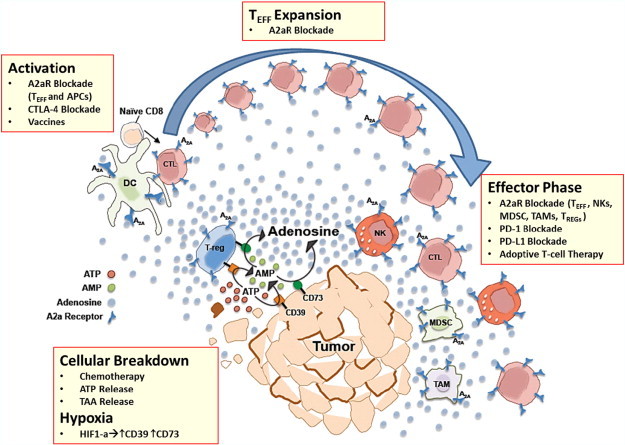
The last several years have witnessed exciting progress in the development of immunotherapy for the treatment of cancer. This has been due in great part to the development of so-called checkpoint blockade. That is, antibodies that block inhibitory receptors such as CTLA-4 and PD-1 and thus unleash antigen-specific immune responses against tumors. It is clear that tumors evade the immune response by usurping pathways that play a role in negatively regulating normal immune responses. In this regard, adenosine in the immune microenvironment leading to the activation of the A2a receptor has been shown to represent one such negative feedback loop. Indeed, the tumor microenvironment has relatively high concentrations of adenosine. To this end, blocking A2a receptor activation has the potential to markedly enhance anti-tumor immunity in mouse models. This review will present data demonstrating the ability of A2a receptor blockade to enhance tumor vaccines, checkpoint blockade and adoptive T cell therapy. Also, as several recent studies have demonstrated that under certain conditions A2a receptor blockade can enhance tumor progression, we will also explore the complexities of adenosine signaling in the immune response. Despite important nuances to the A2a receptor pathway that require further elucidation, studies to date strongly support the development of A2a receptor antagonists (some of which have already been tested in phase III clinical trials for Parkinson Disease) as novel modalities in the immunotherapy armamentarium.
在过去几年中,癌症免疫治疗的发展取得了令人振奋的进展。这在很大程度上归功于所谓的检查点阻断的发展。也就是说,抗体阻断诸如CTLA - 4和PD - 1等抑制性受体,从而释放针对肿瘤的抗原特异性免疫反应。很明显,肿瘤通过篡夺在负向调节正常免疫反应中起作用的途径来逃避免疫反应。在这方面,免疫微环境中导致A2a受体激活的腺苷已被证明代表这样一种负反馈回路。事实上,肿瘤微环境中腺苷浓度相对较高。为此,在小鼠模型中阻断A2a受体激活有可能显著增强抗肿瘤免疫力。本综述将展示数据,证明A2a受体阻断增强肿瘤疫苗、检查点阻断和过继性T细胞疗法的能力。此外,由于最近的几项研究表明,在某些条件下A2a受体阻断可增强肿瘤进展,我们还将探讨免疫反应中腺苷信号传导的复杂性。尽管A2a受体途径存在需要进一步阐明的重要细微差别,但迄今为止的研究有力地支持开发A2a受体拮抗剂(其中一些已在帕金森病的III期临床试验中进行了测试)作为免疫治疗武器库中的新方法。