Ma Si-Rui, Deng Wei-Wei, Liu Jian-Feng, Mao Liang, Yu Guang-Tao, Bu Lin-Lin, Kulkarni Ashok B, Zhang Wen-Feng, Sun Zhi-Jun
The State Key Laboratory Breeding Base of Basic Science of Stomatology (Hubei-MOST) & Key Laboratory of Oral Biomedicine Ministry of Education, School and Hospital of Stomatology, Wuhan University, 237 Luoyu Road, Wuhan, Hubei Province, People's Republic of China, 430079.
Department of Oral Maxillofacial-Head Neck Oncology, School and Hospital of Stomatology, Wuhan University, 237 Luoyu Road, Wuhan, 430079, People's Republic of China.
Mol Cancer. 2017 Jun 7;16(1):99. doi: 10.1186/s12943-017-0665-0.
Cancer immunotherapy offers a promising approach in cancer treatment. The adenosine A2A receptor (A2AR) could protect cancerous tissues from immune clearance via inhibiting T cells response. To date, the role of A2AR in head and neck squamous cell carcinoma (HNSCC) has not been investigated. Here, we sought to explore the expression and immunotherapeutic value of A2AR blockade in HNSCC.
The expression of A2AR was evaluated by immunostaining in 43 normal mucosae, 48 dysplasia and 165 primary HNSCC tissues. The immunotherapeutic value of A2AR blockade was assessed in vivo in genetically defined immunocompetent HNSCC mouse model.
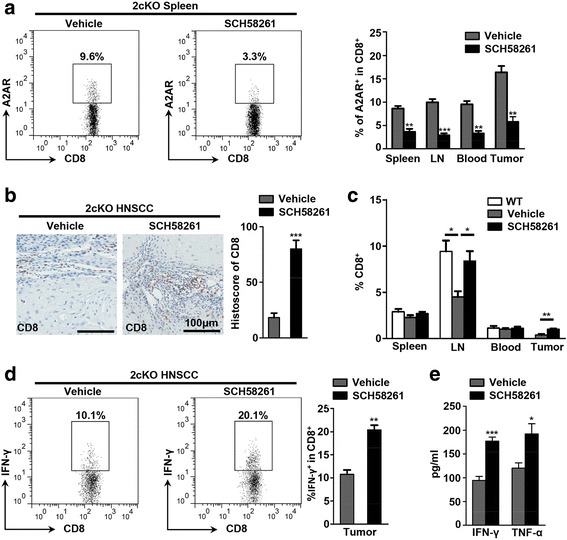
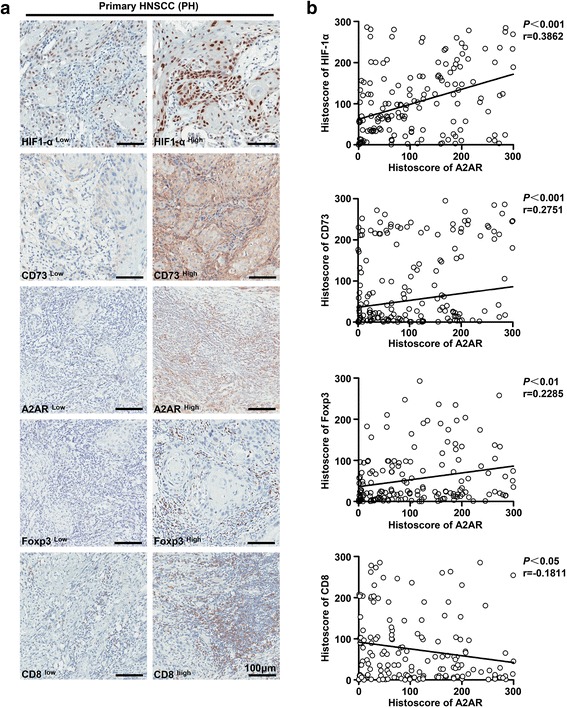
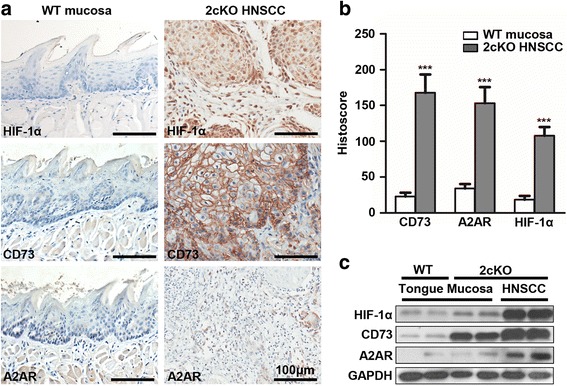
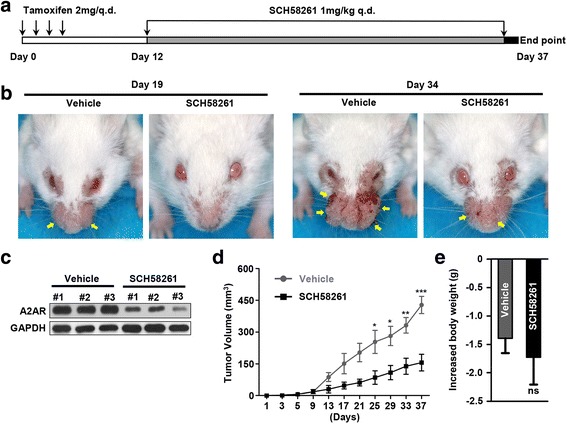
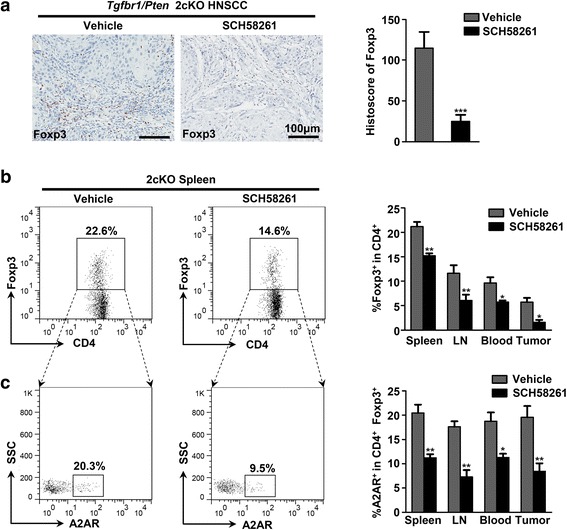
Immunostaining of HNSCC tissue samples revealed that increased expression of A2AR on tumor infiltrating immune cells correlated with advanced pathological grade, larger tumor size and positive lymph node status. Elevated A2AR expression was also detected in recurrent HNSCC and HNSCC tissues with induction chemotherapy. The expression of A2AR was found to be significantly correlated with HIF-1α, CD73, CD8 and Foxp3. Furthermore, the increased population of CD4Foxp3 regulatory T cells (Tregs), which partially expressed A2AR, was observed in an immunocompetent mouse model that spontaneously develops HNSCC. Pharmacological blockade of A2AR by SCH58261 delayed the tumor growth in the HNSCC mouse model. Meanwhile, A2AR blockade significantly reduced the population of CD4 Foxp3 Tregs and enhanced the anti-tumor response of CD8 T cells.
These results offer a preclinical proof for the administration of A2AR inhibitor on prophylactic experimental therapy of HNSCC and suggest that A2AR blockade can be a potential novel strategy for HNSCC immunotherapy.
癌症免疫疗法为癌症治疗提供了一种有前景的方法。腺苷A2A受体(A2AR)可通过抑制T细胞反应来保护癌组织免受免疫清除。迄今为止,A2AR在头颈部鳞状细胞癌(HNSCC)中的作用尚未得到研究。在此,我们试图探究A2AR阻断在HNSCC中的表达及免疫治疗价值。
通过免疫染色评估43例正常黏膜、48例发育异常组织和165例原发性HNSCC组织中A2AR的表达。在基因定义的具有免疫活性的HNSCC小鼠模型中,对A2AR阻断的免疫治疗价值进行体内评估。
HNSCC组织样本的免疫染色显示,肿瘤浸润免疫细胞上A2AR表达增加与病理分级高、肿瘤体积大及淋巴结阳性状态相关。在复发性HNSCC及接受诱导化疗的HNSCC组织中也检测到A2AR表达升高。发现A2AR的表达与HIF-1α、CD73、CD8和Foxp3显著相关。此外,在自发发生HNSCC的具有免疫活性的小鼠模型中,观察到部分表达A2AR的CD4Foxp3调节性T细胞(Tregs)数量增加。SCH58261对A2AR的药理学阻断延缓了HNSCC小鼠模型中的肿瘤生长。同时,A2AR阻断显著减少了CD4 Foxp3 Tregs的数量,并增强了CD8 T细胞的抗肿瘤反应。
这些结果为A2AR抑制剂用于HNSCC预防性实验治疗提供了临床前证据,并表明A2AR阻断可能是HNSCC免疫治疗的一种潜在新策略。