Krishnan Ananthanarayan, Gandour Jackson T, Suresh Chandan H
Department of Speech Language Hearing Sciences, Purdue University, Lyles-Porter Hall, 715 Clinic Drive, West Lafayette, IN, 47907, USA.
Eur J Neurosci. 2015 May;41(11):1496-504. doi: 10.1111/ejn.12903. Epub 2015 May 6.
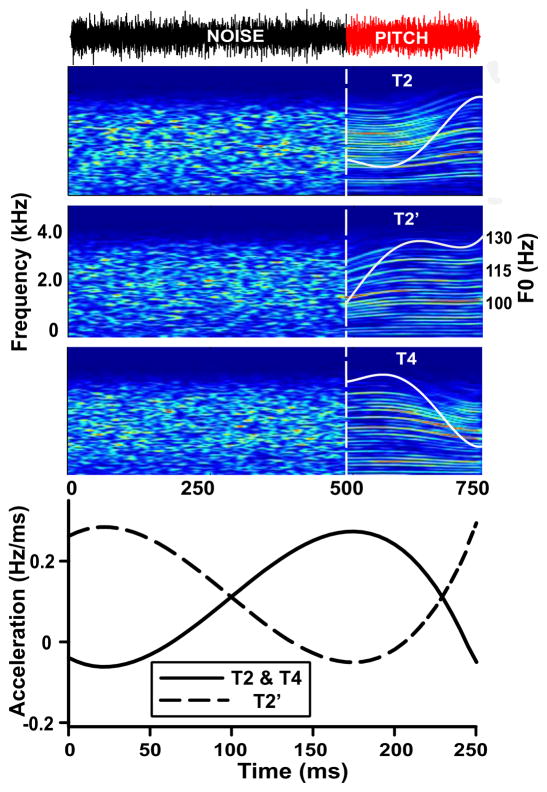
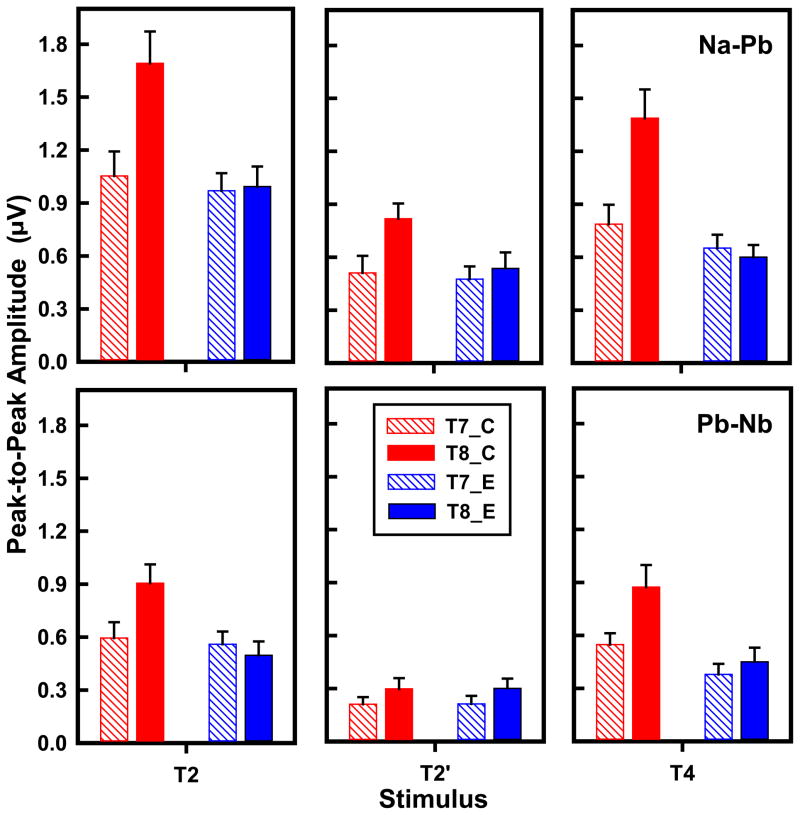
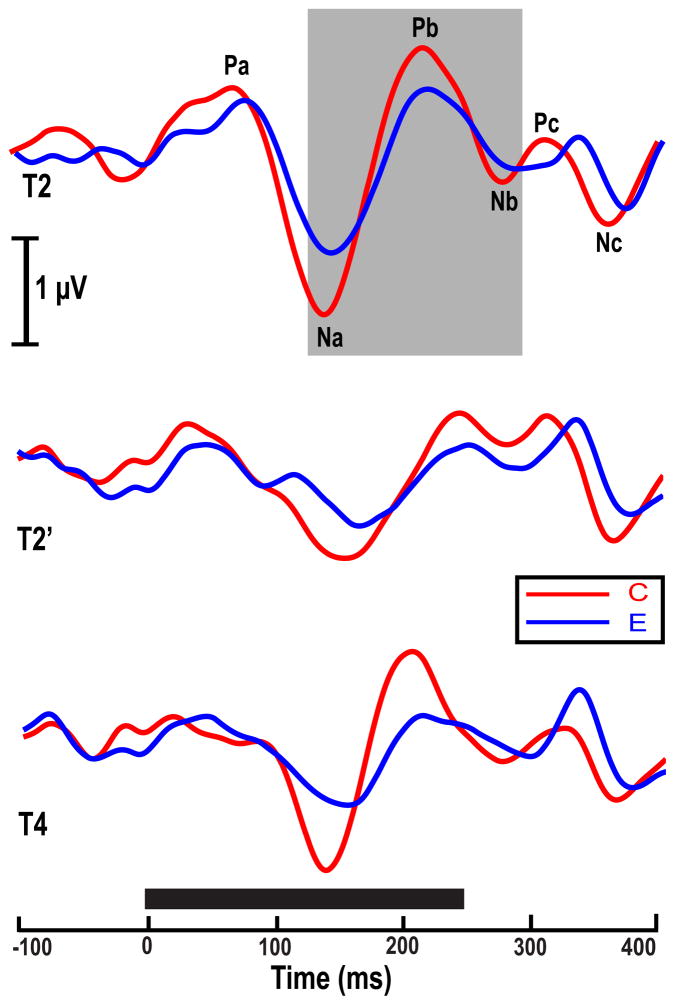
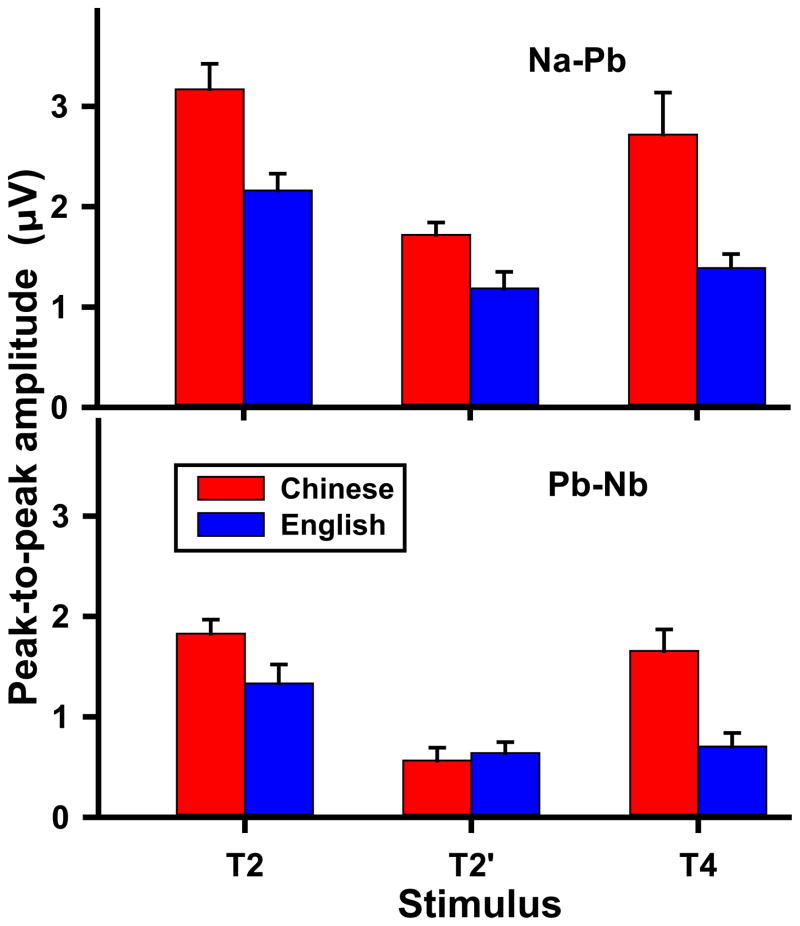
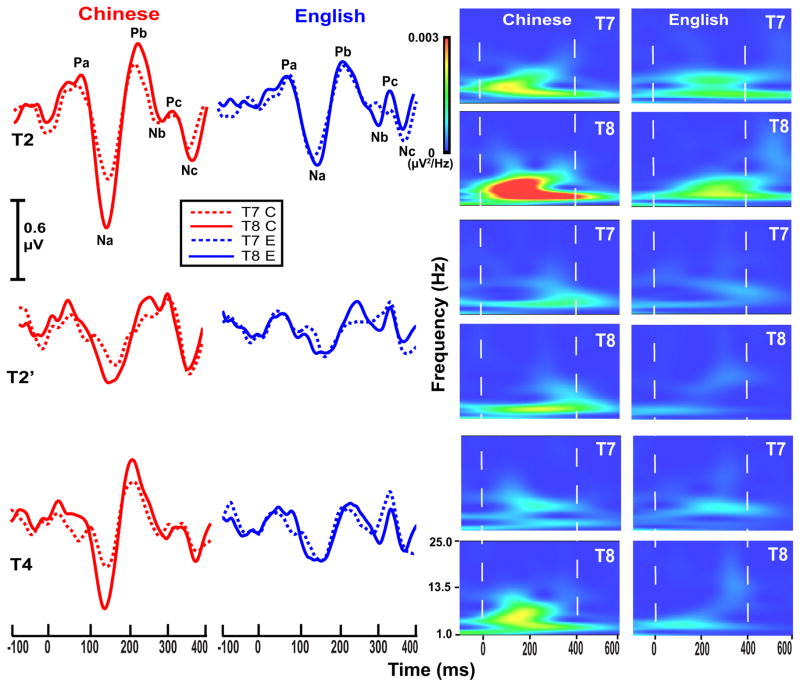
The aim is to evaluate how language experience (Chinese, English) shapes processing of pitch contours as reflected in the amplitude of cortical pitch response components. Responses were elicited from three dynamic curvilinear nonspeech stimuli varying in pitch direction and location of peak acceleration: Mandarin lexical Tone 2 (rising) and Tone 4 (falling), and a flipped variant of Tone 2, Tone 2' (nonnative). At temporal sites (T7/T8), Chinese listeners' Na-Pb response amplitudes to Tones 2 and 4 were greater than those of English listeners in the right hemisphere only; a rightward asymmetry for Tones 2 and 4 was restricted to the Chinese group. In common to both Fz-to-linked T7/T8 and T7/T8 electrode sites, the stimulus pattern (Tones 2 and 4 > Tone 2') was found in the Chinese group only. As reflected by Pb-Nb at Fz, Chinese subjects' amplitudes were larger than those of English subjects in response to Tones 2 and 4, and Tones 2 and 4 were larger than Tone 2', whereas for English subjects, Tone 2 was larger than Tone 2' and Tone 4. At frontal electrode sites (F3/F4), regardless of component or hemisphere, Chinese subjects' responses were larger in amplitude than those of English subjects across stimuli. For either group, responses to Tones 2 and 4 were larger than Tone 2'. No hemispheric asymmetry was observed at the frontal electrode sites. These findings demonstrate that cortical pitch response components are differentially modulated by experience-dependent, temporally distinct but functionally overlapping, weighting of sensory and extrasensory effects on pitch processing of lexical tones in the right temporal lobe and, more broadly, are consistent with a distributed hierarchical predictive coding process.
目的是评估语言经验(中文、英文)如何塑造对音高轮廓的处理,这在皮质音高反应成分的幅度中有所体现。通过三种动态曲线非语音刺激引发反应,这些刺激在音高方向和峰值加速度位置上有所不同:汉语词汇第二声(上升)和第四声(下降),以及第二声的翻转变体,即第二声'(非母语)。在颞部位点(T7/T8),中国听众对第二声和第四声的Na-Pb反应幅度仅在右半球大于英国听众;第二声和第四声的向右不对称仅限于中国组。在Fz到相连的T7/T8和T7/T8电极位点中,仅在中国组中发现了刺激模式(第二声和第四声>第二声')。如Fz处的Pb-Nb所反映,中国受试者对第二声和第四声的反应幅度大于英国受试者,且第二声和第四声大于第二声',而对于英国受试者,第二声大于第二声'和第四声。在额部电极位点(F3/F4),无论成分或半球如何,中国受试者在所有刺激下的反应幅度都大于英国受试者。对于任何一组,对第二声和第四声的反应都大于第二声'。在额部电极位点未观察到半球不对称。这些发现表明,皮质音高反应成分受到经验依赖的、时间上不同但功能上重叠的、对右颞叶词汇声调音高处理的感觉和超感觉效应加权的差异调节,更广泛地说,与分布式分层预测编码过程一致。