Olivares-Navarrete Rene, Hyzy Sharon L, Boyan Barbara D, Schwartz Zvi
Department of Biomedical Engineering, School of Engineering, Virginia Commonwealth University, 601 W. Main Street, Richmond, VA 23284, USA.
Department of Biomedical Engineering, School of Engineering, Virginia Commonwealth University, 601 W. Main Street, Richmond, VA 23284, USA ; Department of Biomedical Engineering, Georgia Institute of Technology, 313 Ferst Drive NW, Atlanta, GA 30332, USA.
Biomed Res Int. 2015;2015:365014. doi: 10.1155/2015/365014. Epub 2015 Apr 6.
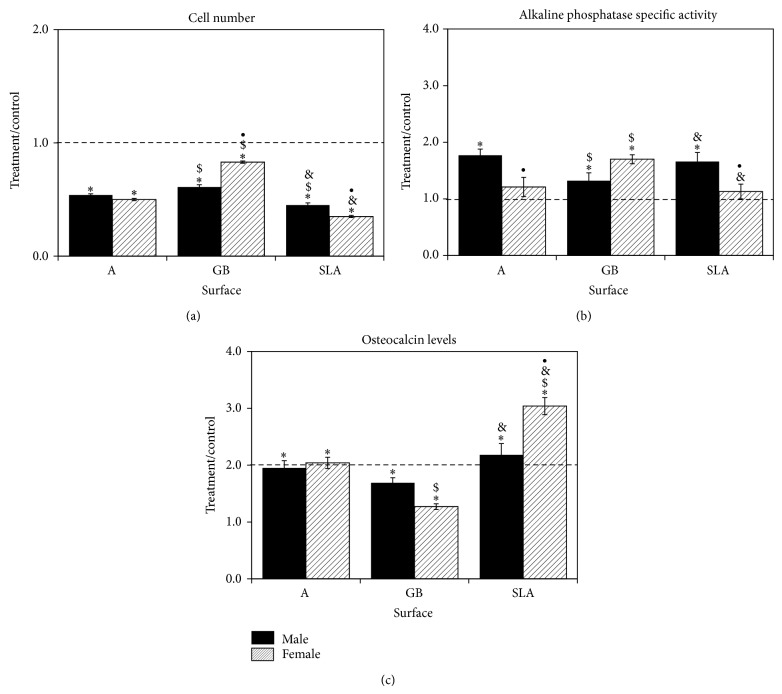
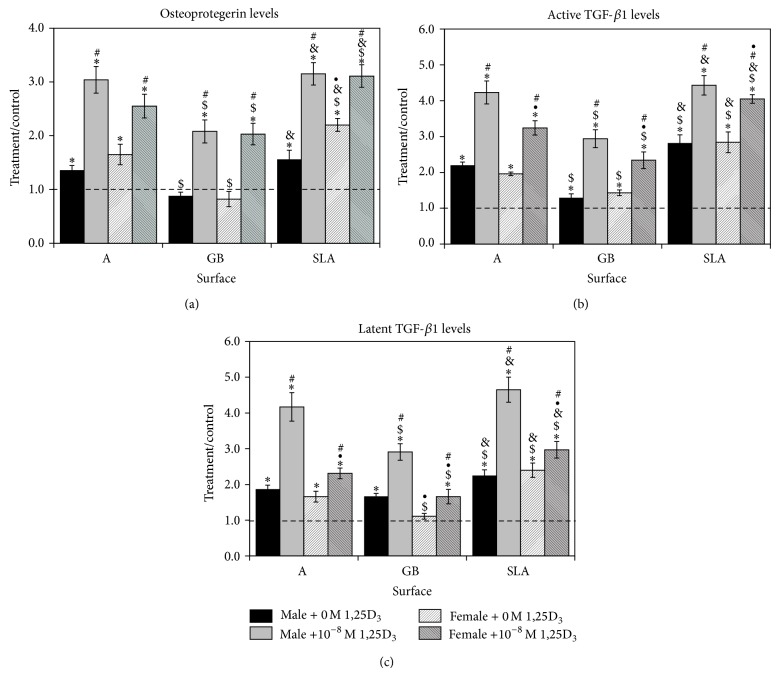
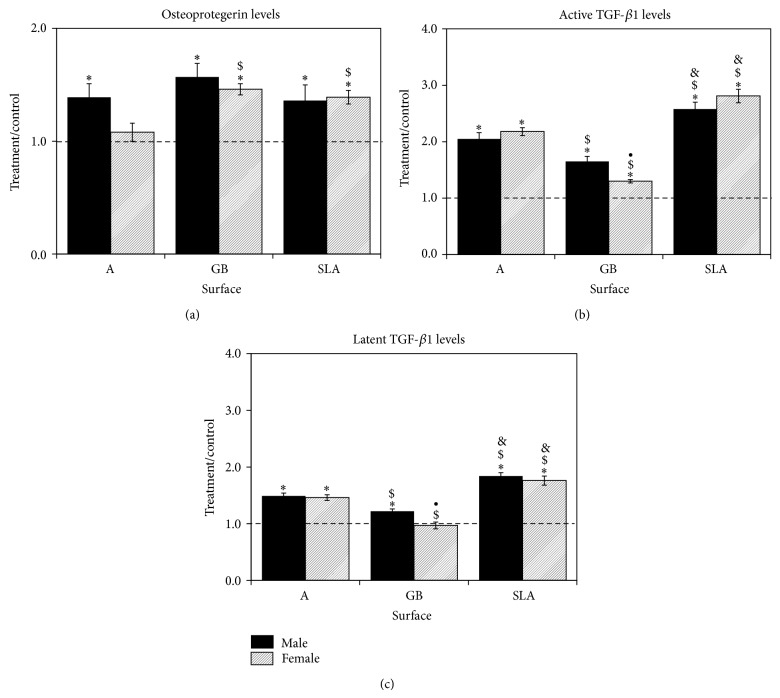
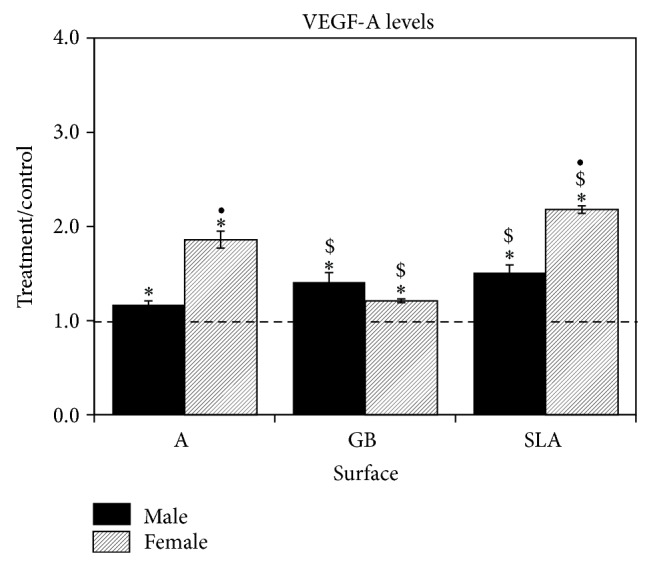
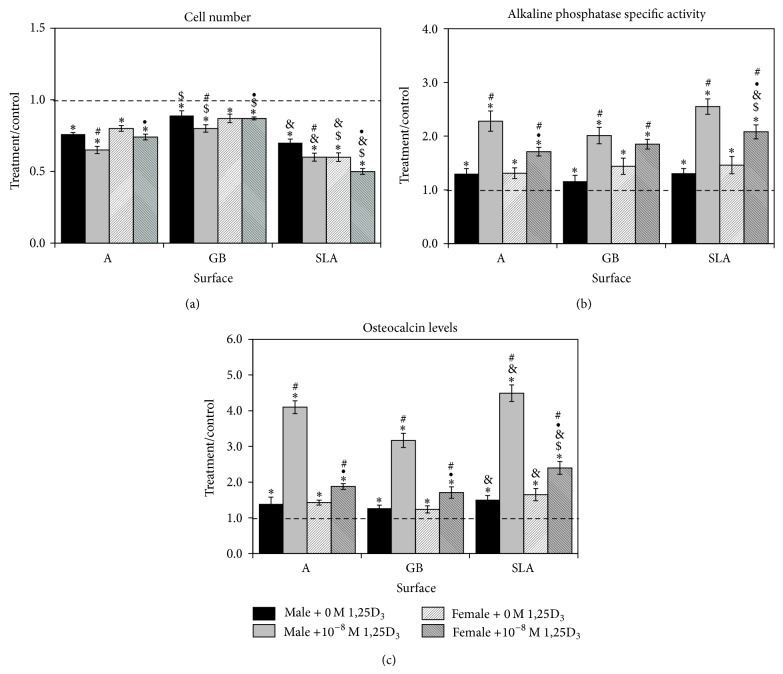
This study assessed contributions of micron-scale topography on clinically relevant titanium (Ti) to differentiation of osteoprogenitor cells and osteoblasts; the interaction of this effect with 1α,25-dihydroxyvitamin D3 (1α,25(OH)2D3); and if the effects are sex-dependent. Male and female rat bone marrow cells (BMCs) were cultured on acid-etched (A, R a = 0.87 μm), grit-blasted (GB, R a = 3.90 μm), or grit-blasted/acid-etched (SLA, R a = 3.22 μm) Ti. BMCs were sensitive to surface topography and underwent osteoblast differentiation. This was greatest on SLA; acid etching and grit blasting contributed additively. Primary osteoblasts were also sensitive to SLA, with less effect from individual structural components, demonstrated by enhanced local factor production. Sex-dependent responses of BMCs to topography varied with parameter whereas male and female osteoblasts responded similarly to surface treatment. 1α,25(OH)2D3 enhanced cell responses on all surfaces similarly. Effects were sex-dependent and male cells grown on a complex microstructured surface were much more sensitive than female cells. These results indicate that effects of the complex SLA topography are greater than acid etching or grit blasting alone on multipotent BMCs and committed osteoblasts and that individual parameters are sex-specific. The effect of 1α,25(OH)2D3 was sex dependent. The results also suggest that levels of 1α,25(OH)2D3 in the patient may be important in osseointegration.
本研究评估了微米级表面形貌对临床相关钛(Ti)上骨祖细胞和成骨细胞分化的作用;这种作用与1α,25-二羟基维生素D3(1α,25(OH)2D3)的相互作用;以及这些作用是否存在性别差异。将雄性和雌性大鼠骨髓细胞(BMCs)培养在酸蚀(A,粗糙度Ra = 0.87μm)、喷砂(GB,粗糙度Ra = 3.90μm)或喷砂/酸蚀(SLA,粗糙度Ra = 3.22μm)的钛表面。BMCs对表面形貌敏感并发生成骨细胞分化。这在SLA表面最为明显;酸蚀和喷砂具有累加作用。原代成骨细胞对SLA也敏感,单个结构成分的影响较小,局部因子产生增加证明了这一点。BMCs对形貌的性别依赖性反应因参数而异,而雄性和雌性成骨细胞对表面处理的反应相似。1α,25(OH)2D3同样增强了所有表面上的细胞反应。这些作用存在性别差异,在复杂微结构表面上生长的雄性细胞比雌性细胞更敏感。这些结果表明,复杂的SLA表面形貌对多能BMCs和定向成骨细胞的作用大于单独的酸蚀或喷砂,且各个参数具有性别特异性。1α,25(OH)2D3的作用存在性别差异。结果还表明,患者体内1α,25(OH)2D3的水平在骨整合中可能很重要。