
青藏高原高寒草原土壤有机碳两种量化方法的比较
A comparison of two methods for quantifying soil organic carbon of alpine grasslands on the Tibetan Plateau.
作者信息
Chen Litong, Flynn Dan F B, Jing Xin, Kühn Peter, Scholten Thomas, He Jin-Sheng
机构信息
Key Laboratory of Adaptation and Evolution of Plateau Biota, Northwest Institute of Plateau Biology, Chinese Academy of Sciences, Xining, Qinghai, People's Republic of China.
Department of Ecology, College of Urban and Environmental Sciences, and Key Laboratory for Earth Surface Processes of the Ministry of Education, Peking University, Beijing, People's Republic of China.
出版信息
PLoS One. 2015 May 6;10(5):e0126372. doi: 10.1371/journal.pone.0126372. eCollection 2015.
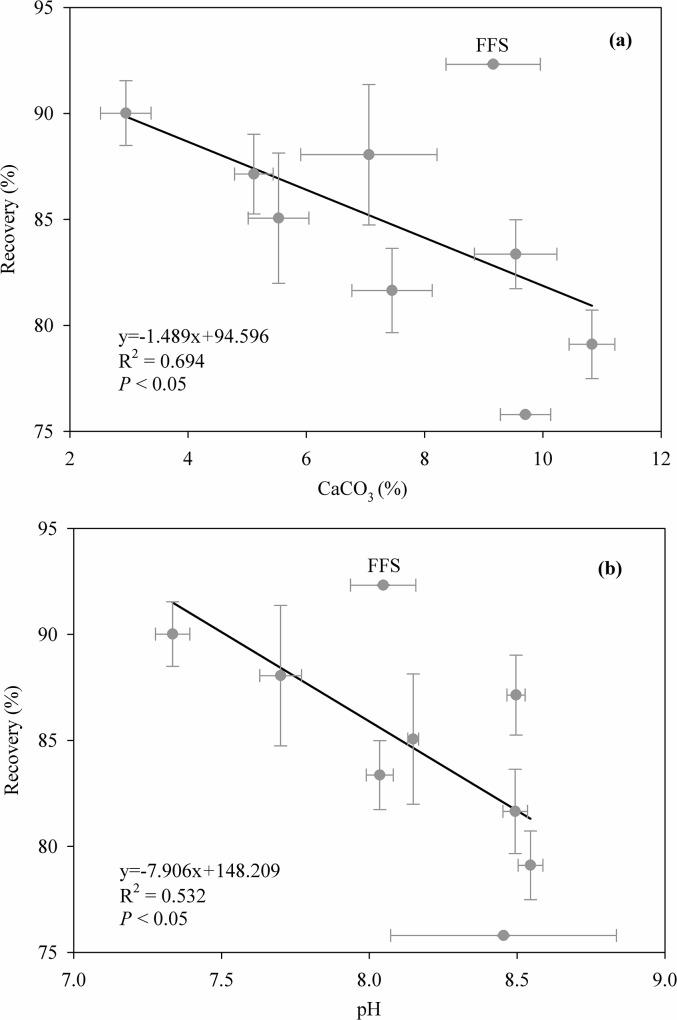
As CO2 concentrations continue to rise and drive global climate change, much effort has been put into estimating soil carbon (C) stocks and dynamics over time. However, the inconsistent methods employed by researchers hamper the comparability of such works, creating a pressing need to standardize the methods for soil organic C (SOC) quantification by the various methods. Here, we collected 712 soil samples from 36 sites of alpine grasslands on the Tibetan Plateau covering different soil depths and vegetation and soil types. We used an elemental analyzer for soil total C (STC) and an inorganic carbon analyzer for soil inorganic C (SIC), and then defined the difference between STC and SIC as SOCCNS. In addition, we employed the modified Walkley-Black (MWB) method, hereafter SOCMWB. Our results showed that there was a strong correlation between SOCCNS and SOCMWB across the data set, given the application of a correction factor of 1.103. Soil depth and soil type significantly influenced on the recovery, defined as the ratio of SOCMWB to SOCCNS, and the recovery was closely associated with soil carbonate content and pH value as well. The differences of recovery between alpine meadow and steppe were largely driven by soil pH. In addition, statistically, a relatively strong correlation between SOCCNS and STC was also found, suggesting that it is feasible to estimate SOCCNS stocks through the STC data across the Tibetan grasslands. Therefore, our results suggest that in order to accurately estimate the absolute SOC stocks and its change in the Tibetan alpine grasslands, adequate correction of the modified WB measurements is essential with correct consideration of the effects of soil types, vegetation, soil pH and soil depth.
随着二氧化碳浓度持续上升并推动全球气候变化,人们已投入大量精力来估算土壤碳(C)储量及其随时间的动态变化。然而,研究人员采用的方法不一致,妨碍了此类研究成果的可比性,因此迫切需要规范各种方法对土壤有机碳(SOC)进行量化的方法。在此,我们从青藏高原36个高山草原站点采集了712个土壤样本,涵盖不同土壤深度以及植被和土壤类型。我们使用元素分析仪测定土壤总碳(STC),使用无机碳分析仪测定土壤无机碳(SIC),然后将STC与SIC的差值定义为SOCCNS。此外,我们采用了改进的沃克利 - 布莱克(MWB)方法,即此后的SOCMWB。我们的结果表明,在应用校正因子1.103的情况下,整个数据集内SOCCNS与SOCMWB之间存在很强的相关性。土壤深度和土壤类型对回收率(定义为SOCMWB与SOCCNS的比值)有显著影响,回收率还与土壤碳酸盐含量和pH值密切相关。高山草甸和草原之间回收率的差异在很大程度上受土壤pH值驱动。此外,从统计学角度来看,还发现SOCCNS与STC之间存在相对较强的相关性,这表明通过整个藏区草原的STC数据估算SOCCNS储量是可行的。因此,我们的结果表明,为了准确估算藏区高山草原SOC的绝对储量及其变化,必须对改进的WB测量值进行适当校正,并正确考虑土壤类型、植被、土壤pH值和土壤深度的影响。


 Zotero 插件