Sugiyama A, Kume A, Nemoto K, Lee S Y, Asami Y, Nemoto F, Nishimura S, Kuchino Y
Biophysics Division, National Cancer Center Research Institute, Tokyo, Japan.
Proc Natl Acad Sci U S A. 1989 Dec;86(23):9144-8. doi: 10.1073/pnas.86.23.9144.
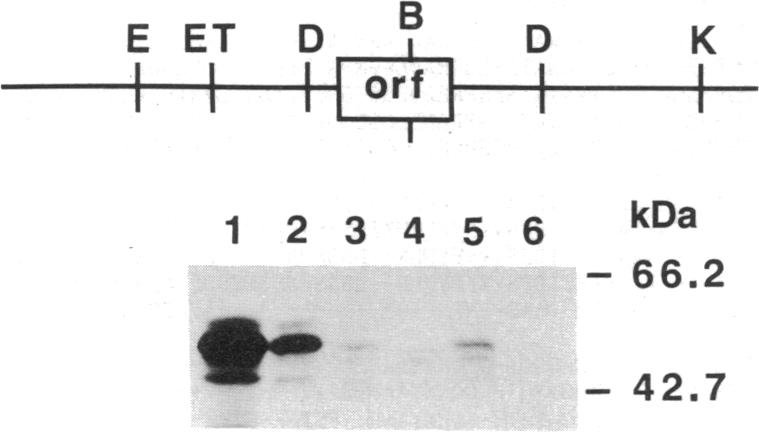
A 9-kilobase-pair clone containing a myc-related gene that we have designated s-myc was isolated from a rat genomic library. The entire nucleotide sequence of the cloned DNA was determined, showing that the s-myc gene contains an open reading frame consisting of 1287 base pairs without introns. In vitro transcription-translation analysis of s-myc indicated that this gene produces a protein of approximately 50 kDa. The amino acid sequence predicted from the DNA sequence showed that the s-Myc protein is closely related to the murine N-Myc protein but lacks an acidic amino acid-rich sequence commonly present in the Myc-family proteins. Studies on transfection of s-myc into rat RT4-AC tumor cells revealed that the gene produces a polyadenylylated transcript of approximately 4.7 kilobases and that its high-level expression suppresses the tumor-igenicity of RT4-AC tumor cells in nude mice.
从大鼠基因组文库中分离出一个包含我们命名为s-myc的与myc相关基因的9千碱基对克隆。测定了克隆DNA的完整核苷酸序列,结果表明s-myc基因包含一个由1287个碱基对组成的无内含子的开放阅读框。对s-myc的体外转录-翻译分析表明,该基因产生一种约50 kDa的蛋白质。从DNA序列预测的氨基酸序列显示,s-Myc蛋白与鼠N-Myc蛋白密切相关,但缺乏Myc家族蛋白中常见的富含酸性氨基酸的序列。将s-myc转染到大鼠RT4-AC肿瘤细胞中的研究表明,该基因产生一个约4.7千碱基的多聚腺苷酸化转录本,其高水平表达可抑制RT4-AC肿瘤细胞在裸鼠中的致瘤性。