Twerenbold Raphael, Wildi Karin, Jaeger Cedric, Gimenez Maria Rubini, Reiter Miriam, Reichlin Tobias, Walukiewicz Astrid, Gugala Mathias, Krivoshei Lian, Marti Nadine, Moreno Weidmann Zoraida, Hillinger Petra, Puelacher Christian, Rentsch Katharina, Honegger Ursina, Schumacher Carmela, Zurbriggen Felicitas, Freese Michael, Stelzig Claudia, Campodarve Isabel, Bassetti Stefano, Osswald Stefan, Mueller Christian
From Department of Cardiology and Cardiovascular Research Institute Basel (R.T., K.W., C.J., M.R.G., M.R., T.R., A.W., M.G., L.K., N.M., Z.M.W., P.H., C.P., U.H., C.S., F.Z., M.F., C.S., S.O., C.M.), Department of Internal Medicine (K.W., C.J., M.R.G., P.H., S.B.), and Department of Laboratory Medicine (K.R.), University Hospital Basel, Switzerland; Servicio de Urgencias y Pneumologia, CIBERES ISC III, Hospital del Mar-Institut Municipal d'Investigació Mèdica, Barcelona, Spain (M.R.G., I.C.); and Department of Medicine, Brigham and Women's Hospital, Harvard Medical School, Boston, MA (T.R.).
Circulation. 2015 Jun 9;131(23):2041-50. doi: 10.1161/CIRCULATIONAHA.114.014245. Epub 2015 May 6.
It is unknown whether more sensitive cardiac troponin (cTn) assays maintain their clinical utility in patients with renal dysfunction. Moreover, their optimal cutoff levels in this vulnerable patient population have not previously been defined.
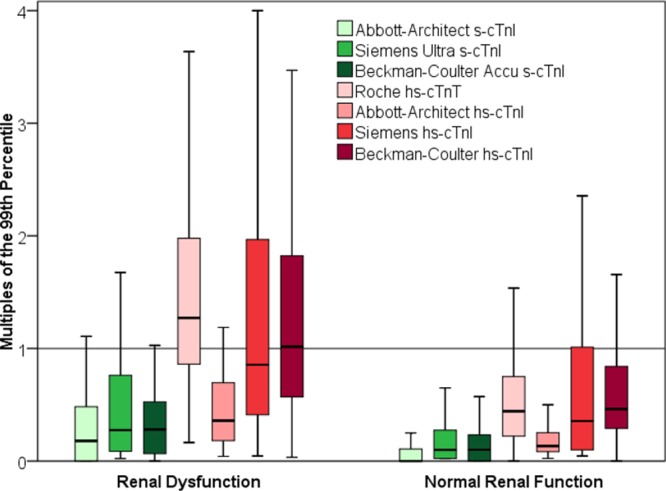
In this multicenter study, we examined the clinical utility of 7 more sensitive cTn assays (3 sensitive and 4 high-sensitivity cTn assays) in patients presenting with symptoms suggestive of acute myocardial infarction. Among 2813 unselected patients, 447 (16%) had renal dysfunction (defined as Modification of Diet in Renal Disease-estimated glomerular filtration rate <60 mL·min(-1)·1.73 m(-2)). The final diagnosis was centrally adjudicated by 2 independent cardiologists using all available information, including coronary angiography and serial levels of high-sensitivity cTnT. Acute myocardial infarction was the final diagnosis in 36% of all patients with renal dysfunction. Among patients with renal dysfunction and elevated baseline cTn levels (≥99th percentile), acute myocardial infarction was the most common diagnosis for all assays (range, 45%-80%). In patients with renal dysfunction, diagnostic accuracy at presentation, quantified by the area under the receiver-operator characteristic curve, was 0.87 to 0.89 with no significant differences between the 7 more sensitive cTn assays and further increased to 0.91 to 0.95 at 3 hours. Overall, the area under the receiver-operator characteristic curve in patients with renal dysfunction was only slightly lower than in patients with normal renal function. The optimal receiver-operator characteristic curve-derived cTn cutoff levels in patients with renal dysfunction were significantly higher compared with those in patients with normal renal function (factor, 1.9-3.4).
More sensitive cTn assays maintain high diagnostic accuracy in patients with renal dysfunction. To ensure the best possible clinical use, assay-specific optimal cutoff levels, which are higher in patients with renal dysfunction, should be considered.
URL: http://www.clinicaltrials.gov. Unique identifier: NCT00470587.
尚不清楚更敏感的心肌肌钙蛋白(cTn)检测在肾功能不全患者中是否仍保持其临床实用性。此外,此前尚未确定该脆弱患者群体中的最佳临界值水平。
在这项多中心研究中,我们检测了7种更敏感的cTn检测方法(3种敏感检测方法和4种高敏cTn检测方法)在出现提示急性心肌梗死症状患者中的临床实用性。在2813例未经选择的患者中,447例(16%)存在肾功能不全(定义为根据肾脏病饮食改良法估算的肾小球滤过率<60 mL·min⁻¹·1.73 m⁻²)。最终诊断由2名独立心脏病专家根据所有可用信息进行集中判定,包括冠状动脉造影和高敏cTnT的系列检测值。急性心肌梗死是所有肾功能不全患者中36%的最终诊断结果。在肾功能不全且基线cTn水平升高(≥第99百分位数)的患者中,急性心肌梗死是所有检测方法中最常见的诊断结果(范围为45% - 80%)。在肾功能不全患者中,用受试者工作特征曲线下面积量化的就诊时诊断准确性在7种更敏感的cTn检测方法之间无显著差异,为0.87至0.89,3小时时进一步提高至0.91至0.95。总体而言,肾功能不全患者的受试者工作特征曲线下面积仅略低于肾功能正常患者。与肾功能正常患者相比,肾功能不全患者中由受试者工作特征曲线得出的最佳cTn临界值水平显著更高(系数为1.9 - 3.4)。
更敏感的cTn检测方法在肾功能不全患者中保持较高的诊断准确性。为确保最佳临床应用,应考虑检测方法特异性的最佳临界值水平,肾功能不全患者的该临界值水平更高。