Bonney Kevin M
Liberal Studies, Faculty of Arts and Sciences, New York University, New York, NY 10003.
J Microbiol Biol Educ. 2015 May 1;16(1):21-8. doi: 10.1128/jmbe.v16i1.846. eCollection 2015 May.
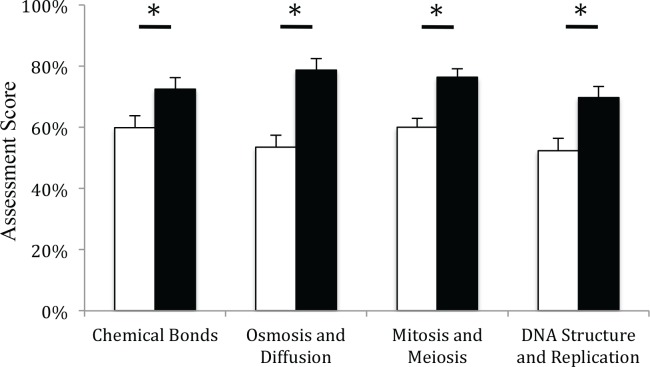
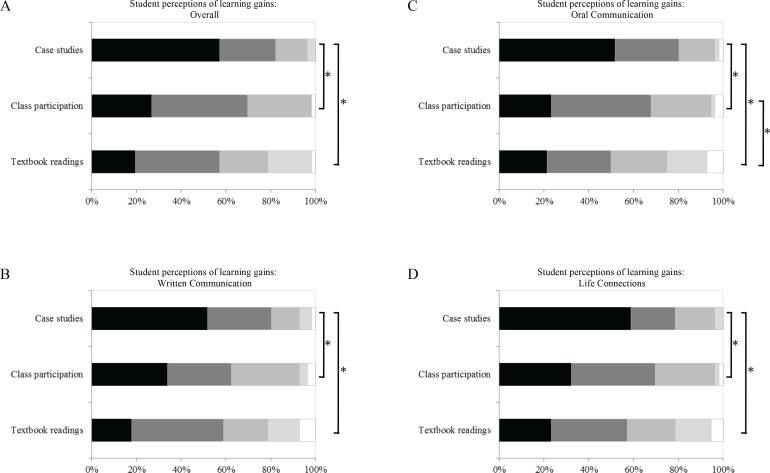
Following years of widespread use in business and medical education, the case study teaching method is becoming an increasingly common teaching strategy in science education. However, the current body of research provides limited evidence that the use of published case studies effectively promotes the fulfillment of specific learning objectives integral to many biology courses. This study tested the hypothesis that case studies are more effective than classroom discussions and textbook reading at promoting learning of key biological concepts, development of written and oral communication skills, and comprehension of the relevance of biological concepts to everyday life. This study also tested the hypothesis that case studies produced by the instructor of a course are more effective at promoting learning than those produced by unaffiliated instructors. Additionally, performance on quantitative learning assessments and student perceptions of learning gains were analyzed to determine whether reported perceptions of learning gains accurately reflect academic performance. The results reported here suggest that case studies, regardless of the source, are significantly more effective than other methods of content delivery at increasing performance on examination questions related to chemical bonds, osmosis and diffusion, mitosis and meiosis, and DNA structure and replication. This finding was positively correlated to increased student perceptions of learning gains associated with oral and written communication skills and the ability to recognize connections between biological concepts and other aspects of life. Based on these findings, case studies should be considered as a preferred method for teaching about a variety of concepts in science courses.
在商业和医学教育中广泛应用多年之后,案例研究教学法在科学教育中日益成为一种常见的教学策略。然而,目前的研究成果提供的证据有限,表明使用已发表的案例研究能有效促进实现许多生物学课程不可或缺的特定学习目标。本研究检验了以下假设:在促进关键生物学概念的学习、书面和口头沟通技能的培养以及理解生物学概念与日常生活的相关性方面,案例研究比课堂讨论和课本阅读更有效。本研究还检验了以下假设:课程教师编写的案例研究在促进学习方面比非相关教师编写的案例研究更有效。此外,分析了定量学习评估的表现以及学生对学习收获的看法,以确定所报告的学习收获看法是否准确反映学业成绩。此处报告的结果表明,无论来源如何,案例研究在提高与化学键、渗透与扩散、有丝分裂与减数分裂以及DNA结构与复制相关的考试问题的成绩方面,都比其他内容传授方法显著更有效。这一发现与学生对与口头和书面沟通技能相关的学习收获以及认识生物学概念与生活其他方面之间联系的能力的看法增加呈正相关。基于这些发现,案例研究应被视为科学课程中教授各种概念的首选方法。