Tao Fei, Yang Peng
Key Laboratory of Applied Surface and Colloid Chemistry, Ministry of Education, School of Chemistry and Chemical Engineering, Shaanxi Normal University, Xi'an 710062, China.
Sci Rep. 2015 May 7;5:9839. doi: 10.1038/srep09839.
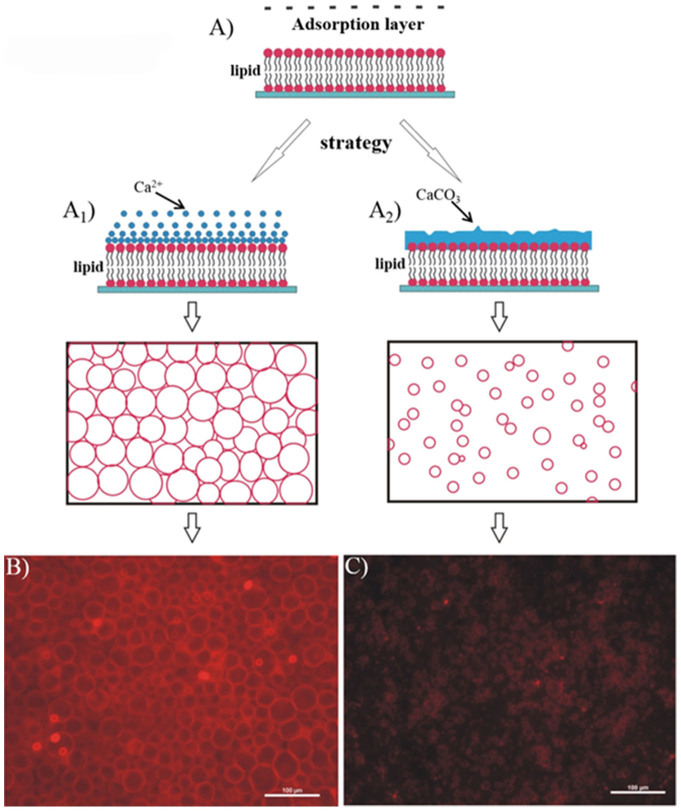
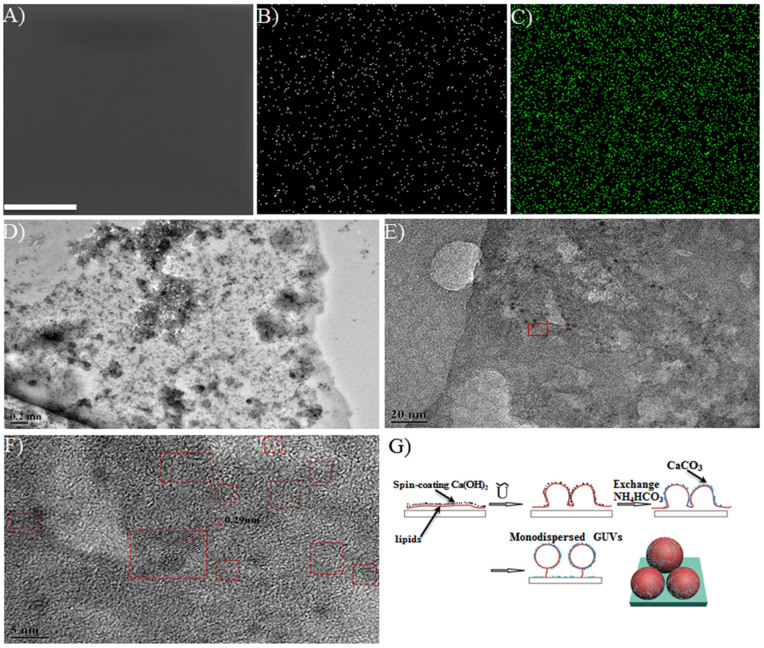
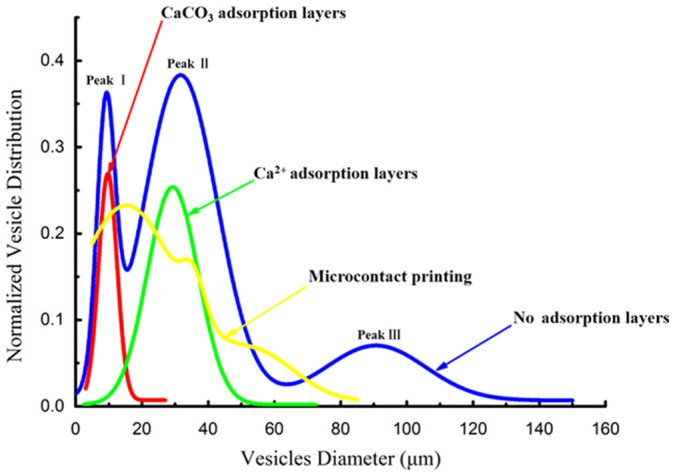
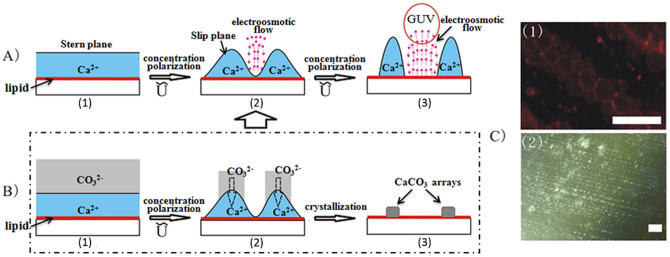
Cell-sized lipid giant unilamellar vesicles (GUVs) are formed when lipid molecules self-assemble to construct a single bilayer compartment with similar morphology to living cells. The physics of self-assembly process is only generally understood and the size distribution of GUVs tends to be very polydisperse. Herein we report a strategy for the production of controlled size distributions of GUVs by a novel mechanism dissecting the mediation ability of calcium (Ca) on the conventional electroformation of GUVs. We finely construct both of the calcium ion (Ca(2+)) and calcium carbonate (CaCO3) mineral adsorption layers on a lipid film surface respectively during the electroformation of GUVs. It is found that Ca(2+) Slip plane polarized by alternating electric field could induce a pattern of electroosmotic flow across the surface, and thus confine the fusion and growth of GUVs to facilitate the formation of uniform GUVs. The model is further improved by directly using CaCO3 that is in situ formed on a lipid film surface, providing a GUV population with narrow polydispersity. The two models deciphers the new biological function of calcium on the birth of cell-like lipid vesicles, and thus might be potentially relevant to the construction of new model to elucidate the cellular development process.
当脂质分子自组装形成一个与活细胞形态相似的单双层隔室时,就会形成细胞大小的脂质巨型单层囊泡(GUVs)。自组装过程的物理学原理仅得到了大致的理解,并且GUVs的尺寸分布往往非常多分散。在此,我们报告了一种通过一种新机制来生产尺寸分布可控的GUVs 的策略,该机制剖析了钙(Ca)对GUVs传统电形成过程的介导能力。在GUVs电形成过程中,我们分别在脂质膜表面精细构建了钙离子(Ca(2+))和碳酸钙(CaCO3)矿物吸附层。研究发现,交变电场极化的Ca(2+)滑移面可诱导表面的电渗流模式,从而限制GUVs的融合和生长,促进均匀GUVs的形成。通过直接使用在脂质膜表面原位形成的CaCO3进一步改进了该模型,得到了多分散性窄的GUV群体。这两种模型揭示了钙在类细胞脂质囊泡形成过程中的新生物学功能,因此可能与构建阐明细胞发育过程的新模型潜在相关。