Kido Kohei, Suga Tadashi, Tanaka Daichi, Honjo Toyoyuki, Homma Toshiyuki, Fujita Satoshi, Hamaoka Takafumi, Isaka Tadao
Faculty of Sport and Health Science, Ritsumeikan University, Kusatsu, Shiga, Japan.
Faculty of Sport and Health Science, Ritsumeikan University, Kusatsu, Shiga, Japan
Physiol Rep. 2015 May;3(5). doi: 10.14814/phy2.12395.
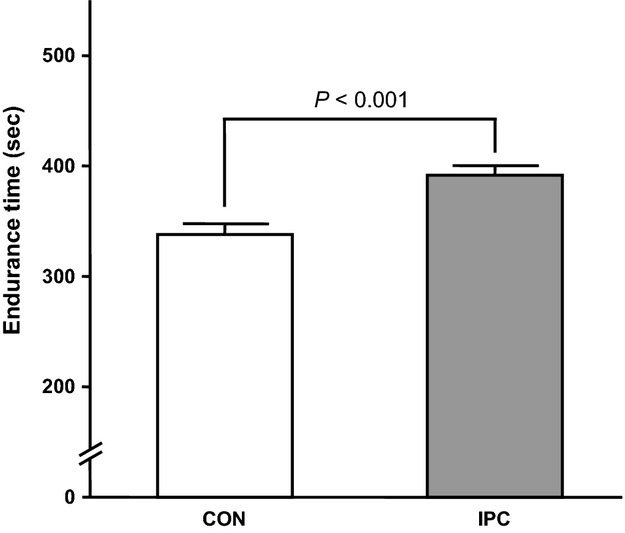
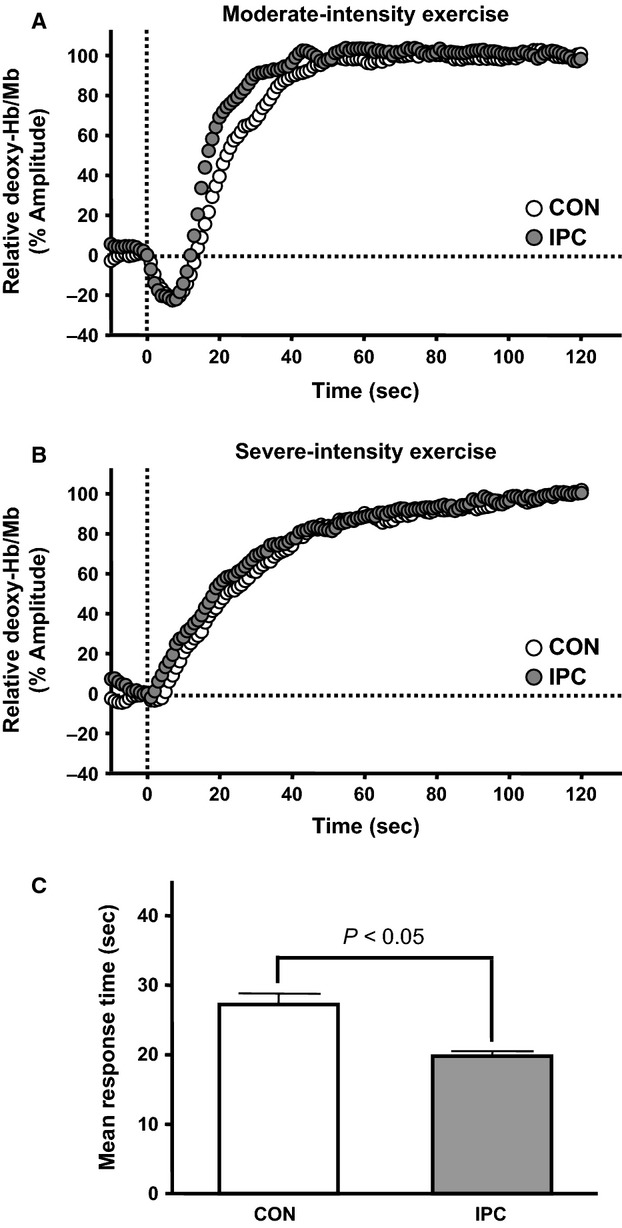
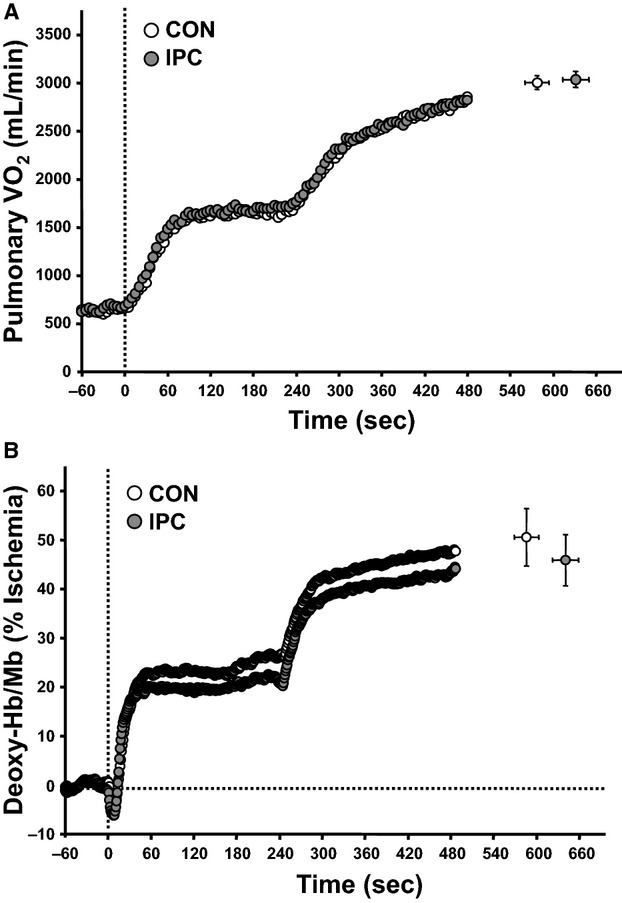
Ischemic preconditioning (IPC) improves maximal exercise performance. However, the potential mechanism(s) underlying the beneficial effects of IPC remain unknown. The dynamics of pulmonary oxygen uptake (VO2) and muscle deoxygenation during exercise is frequently used for assessing O2 supply and extraction. Thus, this study examined the effects of IPC on systemic and local O2 dynamics during the incremental step transitions from low- to moderate- and from moderate- to severe-intensity exercise. Fifteen healthy, male subjects were instructed to perform the work-to-work cycling exercise test, which was preceded by the control (no occlusion) or IPC (3 × 5 min, bilateral leg occlusion at >300 mmHg) treatments. The work-to-work test was performed by gradually increasing the exercise intensity as follows: low intensity at 30 W for 3 min, moderate intensity at 90% of the gas exchange threshold (GET) for 4 min, and severe intensity at 70% of the difference between the GET and VO2 peak until exhaustion. During the exercise test, the breath-by-breath pulmonary VO2 and near-infrared spectroscopy-derived muscle deoxygenation were continuously recorded. Exercise endurance during severe-intensity exercise was significantly enhanced by IPC. There were no significant differences in pulmonary VO2 dynamics between treatments. In contrast, muscle deoxygenation dynamics in the step transition from low- to moderate-intensity was significantly faster in IPC than in CON (27.2 ± 2.9 vs. 19.8 ± 0.9 sec, P < 0.05). The present findings showed that IPC accelerated muscle deoxygenation dynamics in moderate-intensity exercise and enhanced severe-intensity exercise endurance during work-to-work test. The IPC-induced effects may result from mitochondrial activation in skeletal muscle, as indicated by the accelerated O2 extraction.
缺血预处理(IPC)可改善最大运动表现。然而,IPC有益作用的潜在机制仍不清楚。运动期间肺摄氧量(VO2)和肌肉去氧的动态变化常被用于评估氧气供应和摄取。因此,本研究考察了IPC对从低强度到中等强度以及从中等强度到高强度运动的递增阶段转换过程中全身和局部氧气动态变化的影响。15名健康男性受试者被要求进行逐阶段递增的骑行运动测试,测试前分别接受对照(无阻断)或IPC(3×5分钟,双侧腿部阻断压力>300mmHg)处理。逐阶段递增测试通过如下方式逐渐增加运动强度进行:低强度30W持续3分钟,中等强度为气体交换阈值(GET)的90%持续4分钟,高强度为GET与VO2峰值差值的70%直至力竭。在运动测试期间,连续记录每一次呼吸的肺VO2以及近红外光谱法测定的肌肉去氧情况。IPC显著提高了高强度运动期间的运动耐力。两种处理之间肺VO2动态变化无显著差异。相比之下,在从低强度到中等强度的阶段转换中,IPC组的肌肉去氧动态变化显著快于对照组(27.2±2.9秒对19.8±0.9秒,P<0.05)。本研究结果表明,在逐阶段递增测试中,IPC加速了中等强度运动时的肌肉去氧动态变化,并提高了高强度运动耐力。IPC诱导的这些效应可能是由于骨骼肌线粒体激活所致,这表现为氧气摄取加速。