Lepley Lindsey K, Wojtys Edward M, Palmieri-Smith Riann M
Department of Rehabilitation, University of Kentucky, Lexington, KY, USA; School of Kinesiology, University of Michigan, Ann Arbor, MI, USA.
Department of Orthopedic Surgery, University of Michigan, Ann Arbor, MI, USA.
Clin Biomech (Bristol). 2015 Aug;30(7):738-47. doi: 10.1016/j.clinbiomech.2015.04.011. Epub 2015 Apr 29.
We have previously reported that an eccentrically-based rehabilitation protocol post-ACLr induced greater quadriceps activation and strength than a neuromuscular electrical stimulation (NMES) intervention and was just as effective as a combined NMES and eccentric intervention. However, the effect an eccentrically-based intervention has on restoring normal knee mechanics during a single-legged landing task remains unknown.
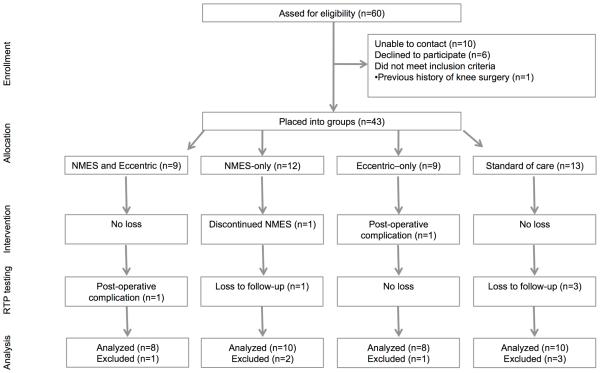
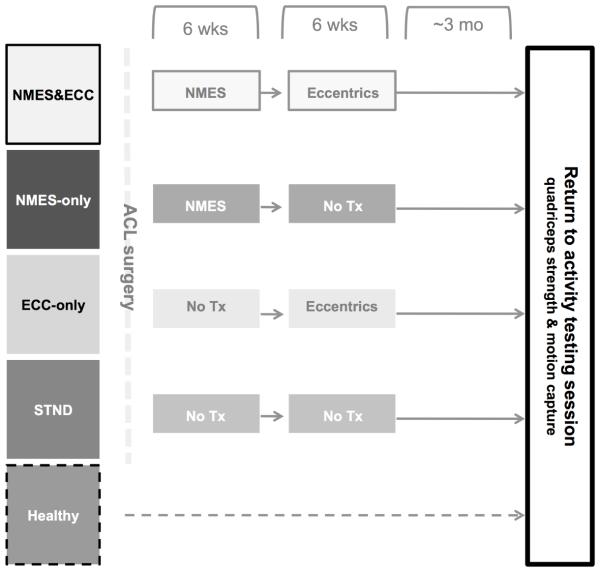
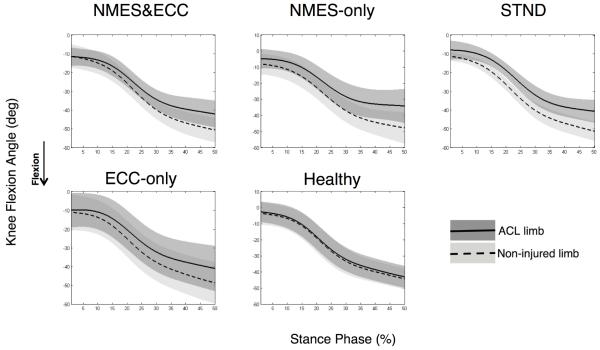
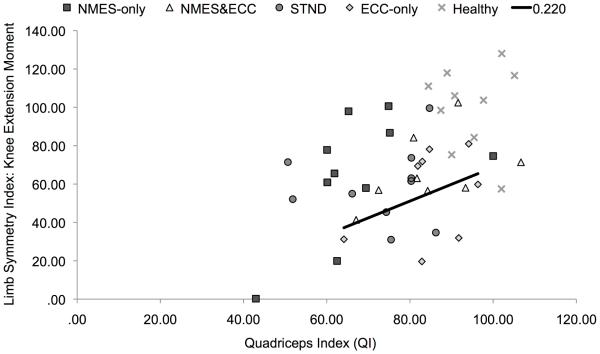
Thirty-six individuals post-injury were placed into four treatment groups: NMES and eccentrics, eccentrics-only, NMES-only, standard of care, and healthy controls participated. NMES and eccentrics received a combined NMES and eccentric protocol post-reconstruction (each treatment 2× per week for 6 weeks), whereas groups NMES-only and eccentric-only received only the NMES or eccentric therapy, respectively. To evaluate knee mechanics limb symmetry, the area under the curve for knee flexion angle and extension moment was derived and then normalized to the contralateral limb. Quadriceps strength was evaluated using the quadriceps index.
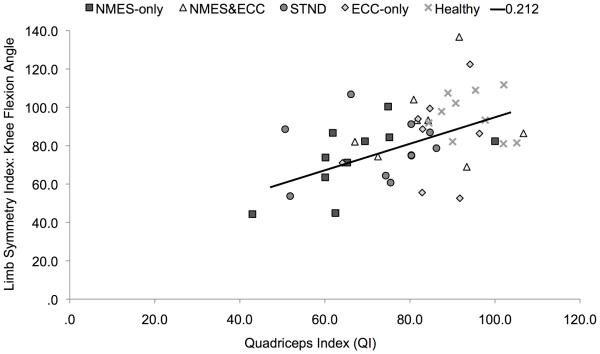
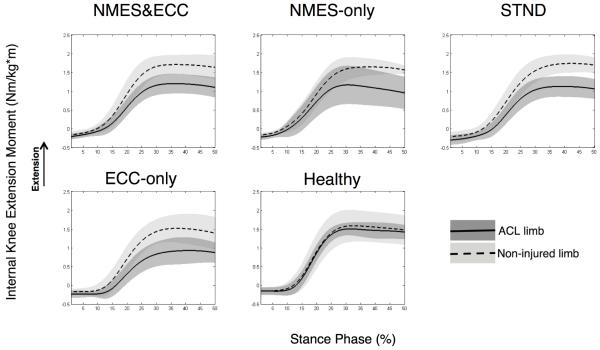
Compared to healthy, reduced sagittal plane knee limb symmetry was found for groups NMES-only, ECC-only and standard of care for knee extension moment (P<0.05). No difference was detected between healthy and NMES and eccentrics (P>0.06). No difference between groups was detected for knee flexion angle limb symmetry (P>0.05). Greater knee flexion angles and moments over stance were related to quadriceps strength.
The NMES and eccentrics group was found to restore biomechanical limb symmetry that was most closely related to healthy individuals following ACL reconstruction. Greater knee flexion angles and moments over stance were related to quadriceps strength.
我们之前曾报道,前交叉韧带重建术后基于离心运动的康复方案比神经肌肉电刺激(NMES)干预能引起更大的股四头肌激活和力量,并且与NMES和离心运动联合干预同样有效。然而,基于离心运动的干预对单腿落地任务中恢复正常膝关节力学的影响尚不清楚。
36名受伤后个体被分为四个治疗组:NMES与离心运动组、仅离心运动组、仅NMES组、标准护理组,并纳入健康对照组。NMES与离心运动组在重建后接受NMES和离心运动联合方案(每种治疗每周2次,共6周),而仅NMES组和仅离心运动组分别仅接受NMES或离心运动治疗。为了评估膝关节力学肢体对称性,得出膝关节屈曲角度和伸展力矩曲线下面积,然后将其与对侧肢体进行归一化。使用股四头肌指数评估股四头肌力量。
与健康组相比,仅NMES组、仅离心运动组和标准护理组在膝关节伸展力矩方面矢状面膝关节肢体对称性降低(P<0.05)。在健康组与NMES与离心运动组之间未检测到差异(P>0.06)。在膝关节屈曲角度肢体对称性方面,各治疗组之间未检测到差异(P>0.05)。站立期更大的膝关节屈曲角度和力矩与股四头肌力量相关。
发现NMES与离心运动组在ACL重建后恢复了与健康个体最密切相关的生物力学肢体对称性。站立期更大的膝关节屈曲角度和力矩与股四头肌力量相关。