Saavedra Kathleen, Valbuena José, Olivares Wilda, Marchant María José, Rodríguez Andrés, Torres-Estay Verónica, Carrasco-Avino Gonzalo, Guzmán Leda, Aguayo Francisco, Roa Juan Carlos, Corvalán Alejandro H
Advanced Center for Chronic Diseases (ACCDiS), Pontificia Universidad Católica de Chile, Santiago, Chile; UC-Center for Investigational Oncology (CITO), Pontificia Universidad Católica de Chile, Santiago, Chile; Scientific and Technological Bioresource Nucleus (BIOREN), Centro de Estudios Genéticos e Inmunológicos (CEGIN) and Department of Pathology, Universidad de La Frontera, Temuco, Chile.
Department of Pathology, Pontificia Universidad Católica de Chile, Santiago, Chile.
PLoS One. 2015 May 8;10(5):e0125834. doi: 10.1371/journal.pone.0125834. eCollection 2015.
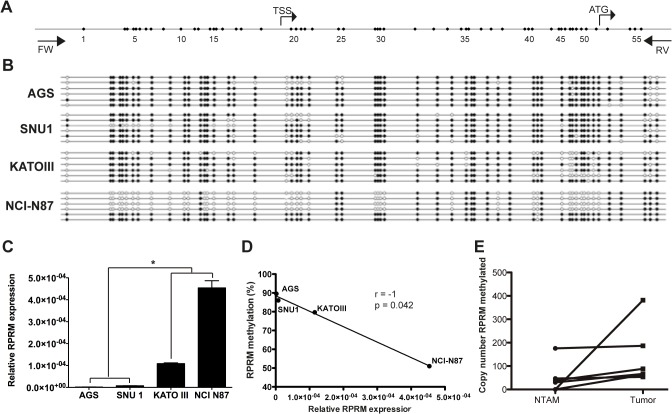
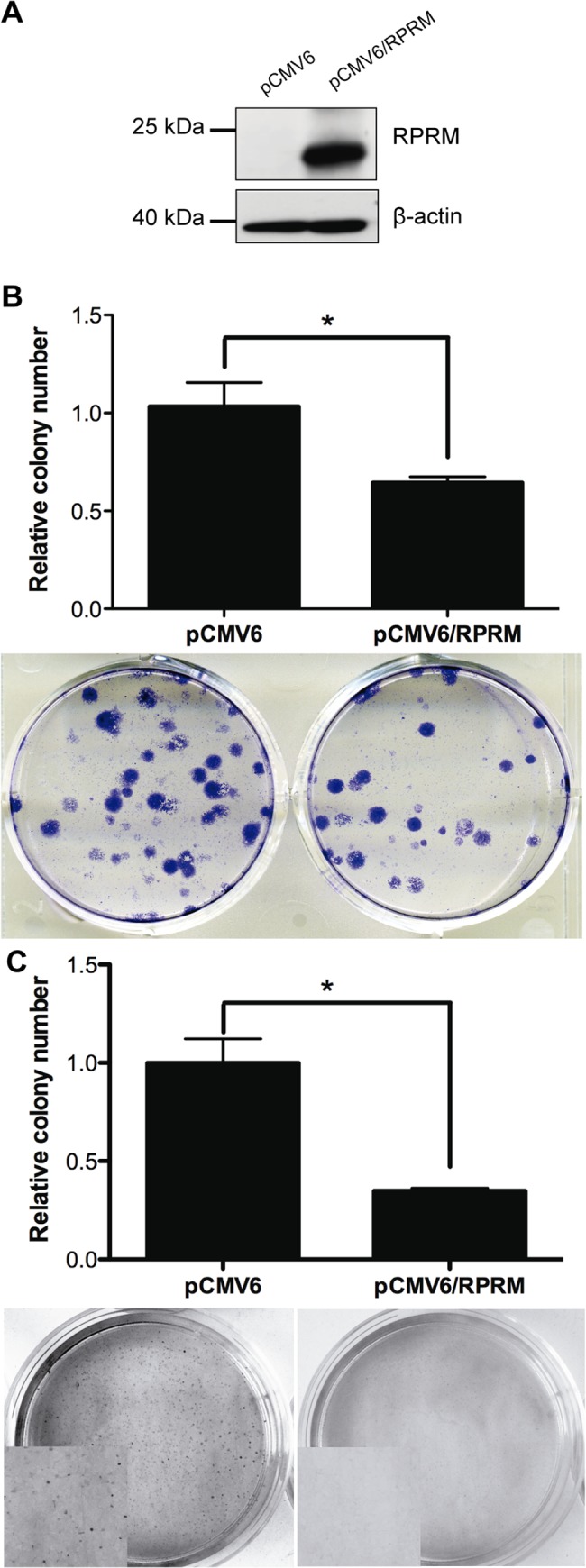
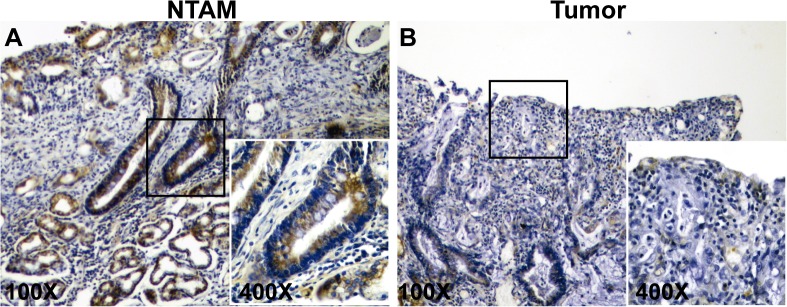
Reprimo (RPRM), a downstream effector of p53-induced cell cycle arrest at G2/M, has been proposed as a putative tumor suppressor gene (TSG) and as a potential biomarker for non-invasive detection of gastric cancer (GC). The aim of this study was to evaluate the epigenetic silencing of RPRM gene by promoter methylation and its tumor suppressor function in GC cell lines. Furthermore, clinical significance of RPRM protein product and its association with p53/p73 tumor suppressor protein family was explored. Epigenetic silencing of RPRM gene by promoter methylation was evaluated in four GC cell lines. Protein expression of RPRM was evaluated in 20 tumor and non-tumor matched cases. The clinical significance of RPRM association with p53/p73 tumor suppressor protein family was assessed in 114 GC cases. Tumor suppressor function was examined through functional assays. RPRM gene expression was negatively correlated with promoter methylation (Spearman rank r = -1; p = 0.042). RPRM overexpression inhibited colony formation and anchorage-independent growth. In clinical samples, RPRM gene protein expression was detected in 75% (15/20) of non-tumor adjacent mucosa, but only in 25% (5/20) of gastric tumor tissues (p = 0.001). Clinicopathological correlations of loss of RPRM expression were significantly associated with invasive stage of GC (stage I to II-IV, p = 0.02) and a positive association between RPRM and p73 gene protein product expression was found (p<0.0001 and kappa value = 0.363). In conclusion, epigenetic silencing of RPRM gene by promoter methylation is associated with loss of RPRM expression. Functional assays suggest that RPRM behaves as a TSG. Loss of expression of RPRM gene protein product is associated with the invasive stage of GC. Positive association between RPRM and p73 expression suggest that other members of the p53 gene family may participate in the regulation of RPRM expression.
Reprimo(RPRM)是p53诱导细胞周期在G2/M期停滞的下游效应分子,已被提出作为一种假定的肿瘤抑制基因(TSG)以及胃癌(GC)非侵入性检测的潜在生物标志物。本研究的目的是评估启动子甲基化对RPRM基因的表观遗传沉默及其在GC细胞系中的肿瘤抑制功能。此外,还探讨了RPRM蛋白产物的临床意义及其与p53/p73肿瘤抑制蛋白家族的关联。在四种GC细胞系中评估了启动子甲基化对RPRM基因的表观遗传沉默。在20例肿瘤与非肿瘤配对病例中评估了RPRM的蛋白表达。在114例GC病例中评估了RPRM与p53/p73肿瘤抑制蛋白家族关联的临床意义。通过功能试验检测肿瘤抑制功能。RPRM基因表达与启动子甲基化呈负相关(Spearman等级r = -1;p = 0.042)。RPRM过表达抑制集落形成和非锚定依赖性生长。在临床样本中,RPRM基因蛋白表达在75%(15/20)的非肿瘤邻近黏膜中检测到,但仅在25%(5/20)的胃肿瘤组织中检测到(p = 0.001)。RPRM表达缺失的临床病理相关性与GC的浸润期显著相关(I期至II-IV期,p = 0.02),并且发现RPRM与p73基因蛋白产物表达呈正相关(p<0.0001,kappa值 = 0.363)。总之,启动子甲基化对RPRM基因的表观遗传沉默与RPRM表达缺失有关。功能试验表明RPRM表现为一种TSG。RPRM基因蛋白产物表达缺失与GC的浸润期有关。RPRM与p73表达之间的正相关表明p53基因家族的其他成员可能参与RPRM表达的调控。