Jalasvuori Matti, Mattila Sari, Hoikkala Ville
Centre of Excellence in Biological Interactions, Department of Biological and Environmental Science, University of Jyväskylä, Jyväskylä, Finland.
PLoS One. 2015 May 8;10(5):e0126094. doi: 10.1371/journal.pone.0126094. eCollection 2015.
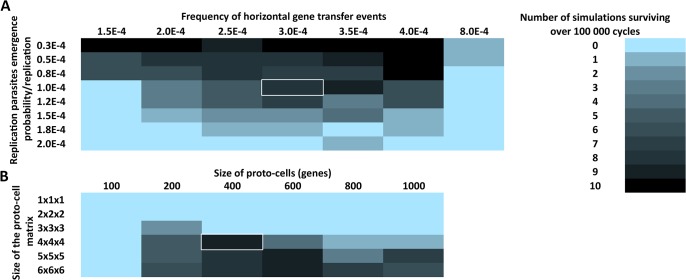
Virus capsids mediate the transfer of viral genetic information from one cell to another, thus the origin of the first viruses arguably coincides with the origin of the viral capsid. Capsid genes are evolutionarily ancient and their emergence potentially predated even the origin of first free-living cells. But does the origin of the capsid coincide with the origin of viruses, or is it possible that capsid-like functionalities emerged before the appearance of true viral entities? We set to investigate this question by using a computational simulator comprising primitive replicators and replication parasites within a compartment matrix. We observe that systems with no horizontal gene transfer between compartments collapse due to the rapidly emerging replication parasites. However, introduction of capsid-like genes that induce the movement of randomly selected genes from one compartment to another rescues life by providing the non-parasitic replicators a mean to escape their current compartments before the emergence of replication parasites. Capsid-forming genes can mediate the establishment of a stable meta-population where parasites cause only local tragedies but cannot overtake the whole community. The long-term survival of replicators is dependent on the frequency of horizontal transfer events, as systems with either too much or too little genetic exchange are doomed to succumb to replication-parasites. This study provides a possible scenario for explaining the origin of viral capsids before the emergence of genuine viruses: in the absence of other means of horizontal gene transfer between compartments, evolution of capsid-like functionalities may have been necessary for early life to prevail.
病毒衣壳介导病毒遗传信息从一个细胞转移到另一个细胞,因此第一批病毒的起源可以说与病毒衣壳的起源相吻合。衣壳基因在进化上很古老,它们的出现甚至可能早于第一批自由生活细胞的起源。但是衣壳的起源与病毒的起源是否一致,或者衣壳样功能是否有可能在真正的病毒实体出现之前就已经出现?我们通过使用一个包含原始复制子和复制寄生虫的计算模拟器来研究这个问题,这些复制子和复制寄生虫存在于一个区室矩阵中。我们观察到,区室之间没有水平基因转移的系统会因迅速出现的复制寄生虫而崩溃。然而,引入能诱导随机选择的基因从一个区室转移到另一个区室移动的衣壳样基因,通过为非寄生性复制子提供一种在复制寄生虫出现之前逃离其当前区室的手段来拯救生命。形成衣壳的基因可以介导一个稳定的集合种群的建立,在这个集合种群中,寄生虫只会造成局部灾难,但不会占据整个群落。复制子的长期生存取决于水平转移事件的频率,因为基因交换过多或过少的系统注定会屈服于复制寄生虫。这项研究提供了一种可能的情景来解释在真正的病毒出现之前病毒衣壳的起源:在区室之间没有其他水平基因转移方式的情况下,衣壳样功能的进化可能是早期生命得以延续的必要条件。