Lan Tien-Hung, Liu Qiuju, Li Chunman, Wu Guangyu, Steyaert Jan, Lambert Nevin A
Department of Pharmacology and Toxicology, Medical College of Georgia, Georgia Regents University, Augusta, GA 30912-2300 USA.
Structural Biology Brussels, Vrije Universiteit Brussel (VUB), and Structural Biology Research Center (VIB), Brussels, Belgium.
Sci Rep. 2015 May 8;5:10166. doi: 10.1038/srep10166.
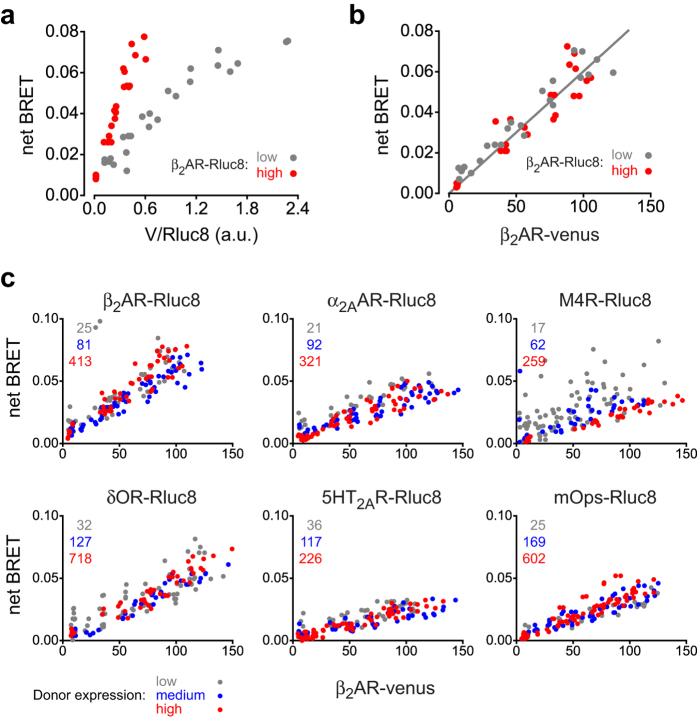
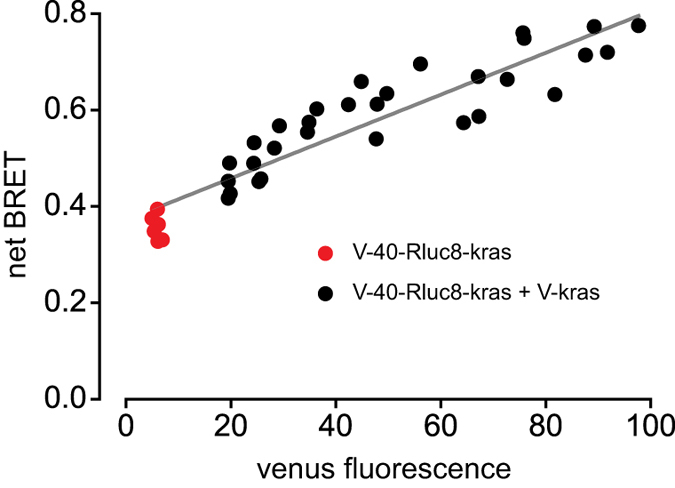
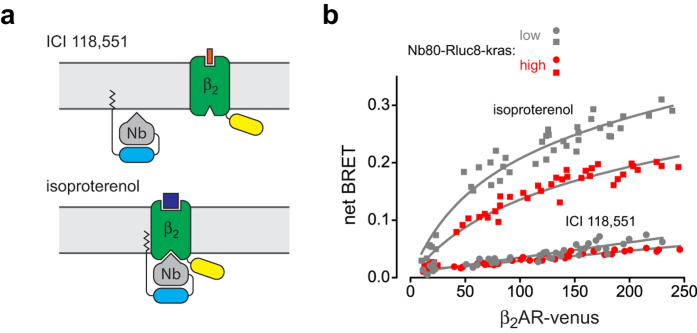
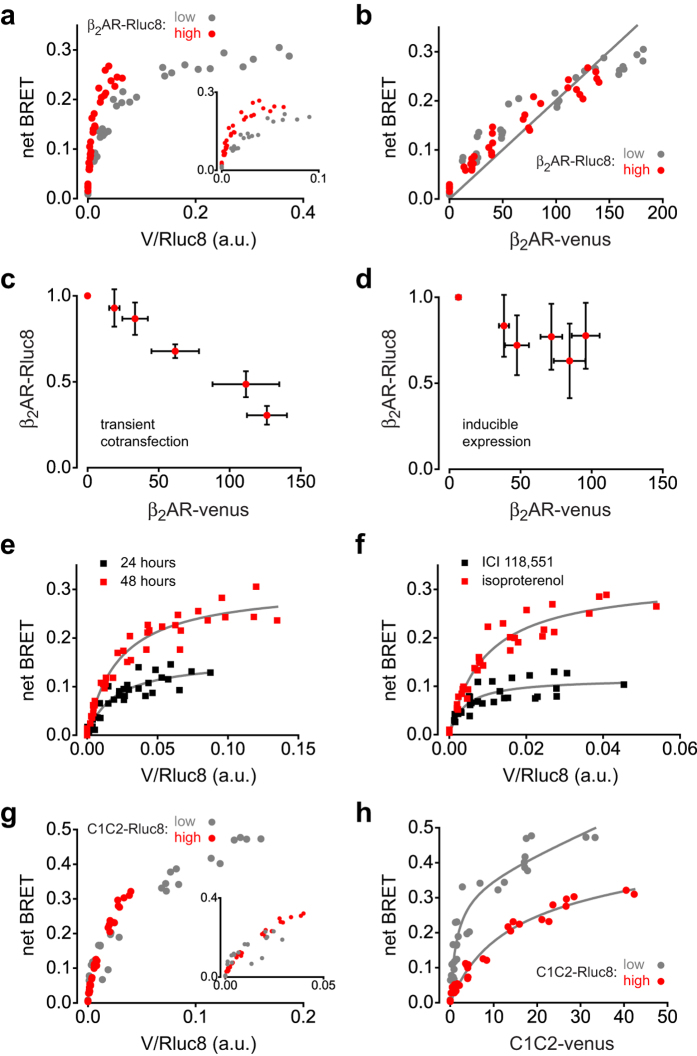
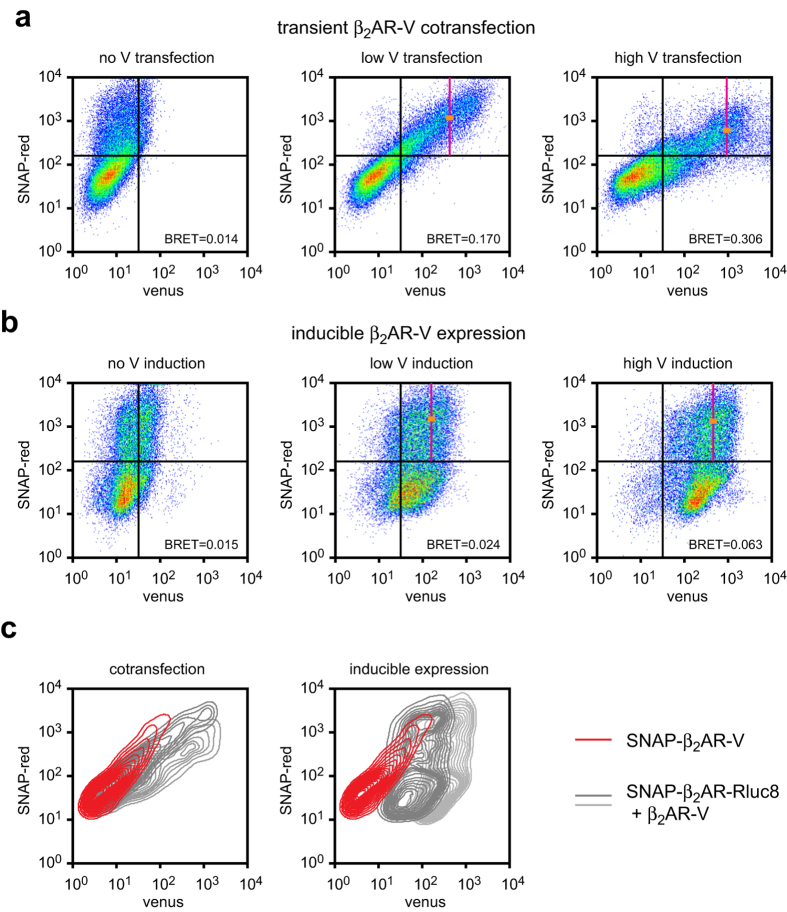
Bioluminescence resonance energy transfer (BRET) is often used to study association of membrane proteins, and in particular oligomerization of G protein-coupled receptors (GPCRs). Oligomerization of class A GPCRs is controversial, in part because the methods used to study this question are not completely understood. Here we reconsider oligomerization of the class A β2 adrenergic receptor (β2AR), and reevaluate BRET titration as a method to study membrane protein association. Using inducible expression of the energy acceptor at multiple levels of donor expression we find that BRET between β2AR protomers is directly proportional to the density of the acceptor up to ~3,000 acceptors μm(-2), and does not depend on the density of the donor or on the acceptor:donor (A:D) stoichiometry. In contrast, BRET between tightly-associating control proteins does not depend on the density of the acceptor, but does depend on the density of the donor and on the A:D ratio. We also find that the standard frameworks used to interpret BRET titration experiments rely on simplifying assumptions that are frequently invalid. These results suggest that β2ARs do not oligomerize in cells, and demonstrate a reliable method of assessing membrane protein association with BRET.
生物发光共振能量转移(BRET)常用于研究膜蛋白的缔合,尤其是G蛋白偶联受体(GPCRs)的寡聚化。A类GPCRs的寡聚化存在争议,部分原因是用于研究该问题的方法尚未完全明确。在此,我们重新审视A类β2肾上腺素能受体(β2AR)的寡聚化,并重新评估BRET滴定法作为研究膜蛋白缔合的一种方法。通过在供体表达的多个水平上诱导能量受体的表达,我们发现β2AR原体之间的BRET与受体密度直接成正比,直至约3000个受体μm(-2),且不依赖于供体密度或受体与供体(A:D)的化学计量比。相比之下,紧密缔合的对照蛋白之间的BRET不依赖于受体密度,但依赖于供体密度和A:D比值。我们还发现,用于解释BRET滴定实验的标准框架依赖于经常无效的简化假设。这些结果表明β2ARs在细胞中不会寡聚化,并证明了一种用BRET评估膜蛋白缔合的可靠方法。