Szalai Bence, Hoffmann Péter, Prokop Susanne, Erdélyi László, Várnai Péter, Hunyady László
Department of Physiology, Faculty of Medicine, Semmelweis University, Budapest, Hungary; MTA-SE Laboratory of Molecular Physiology, Budapest, Hungary.
Department of Physiology, Faculty of Medicine, Semmelweis University, Budapest, Hungary.
PLoS One. 2014 Oct 17;9(10):e109503. doi: 10.1371/journal.pone.0109503. eCollection 2014.
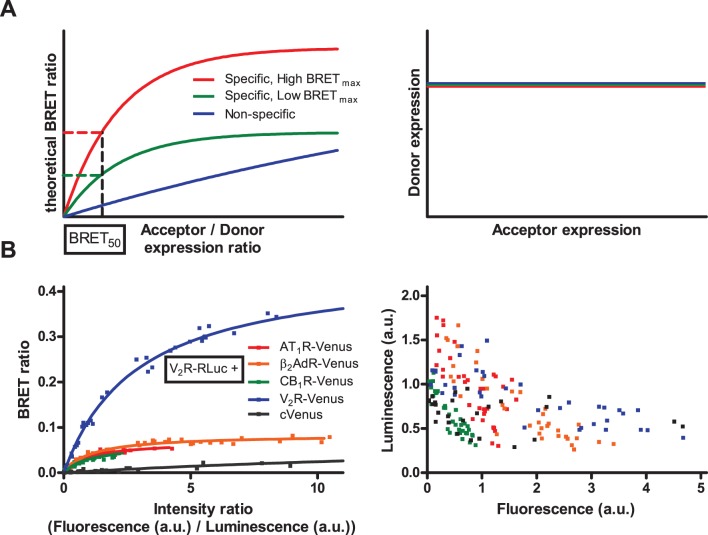
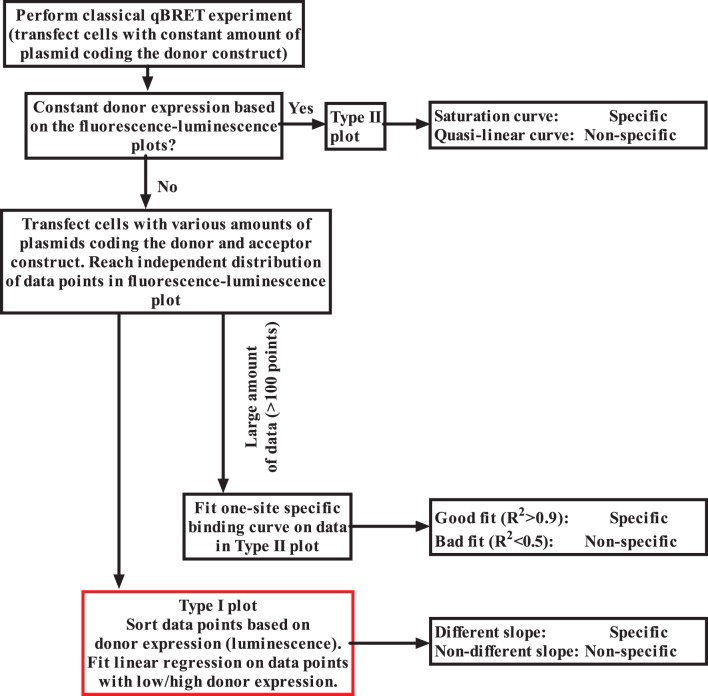
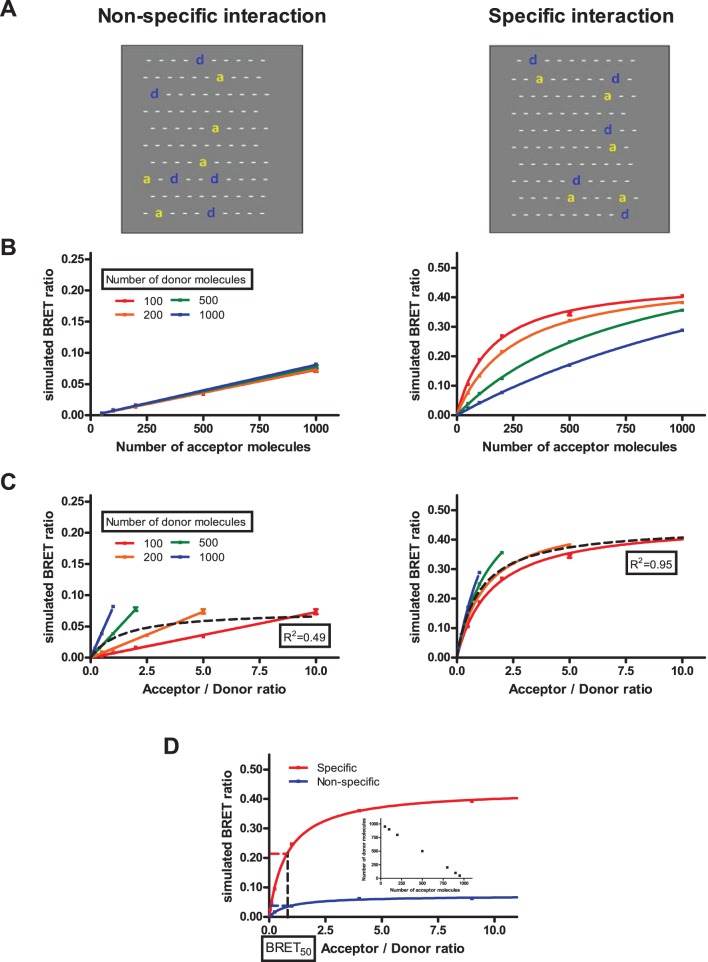
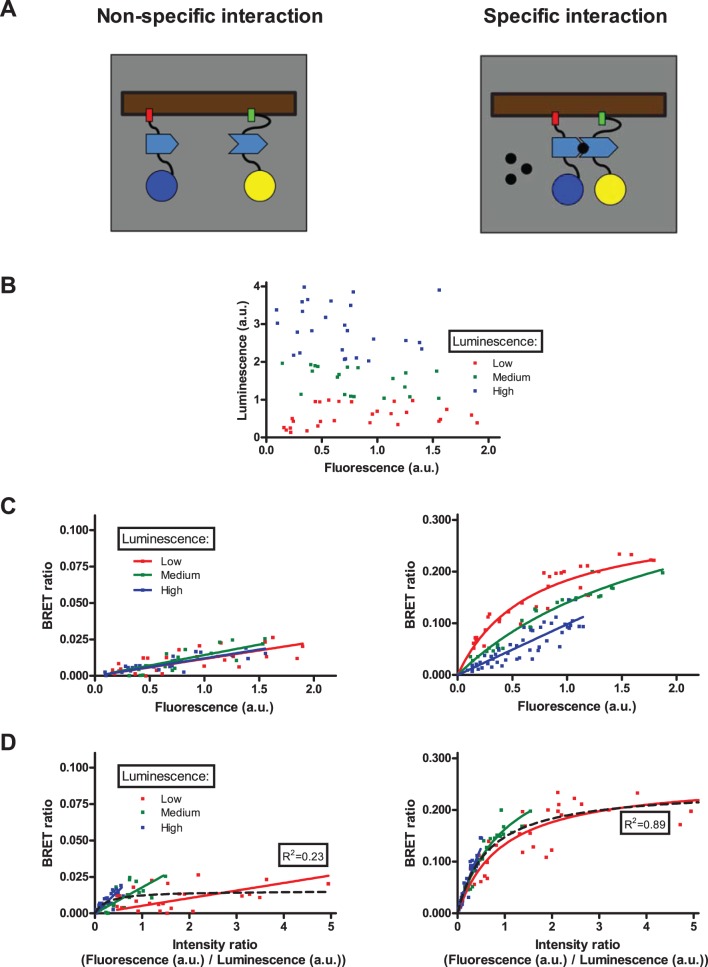
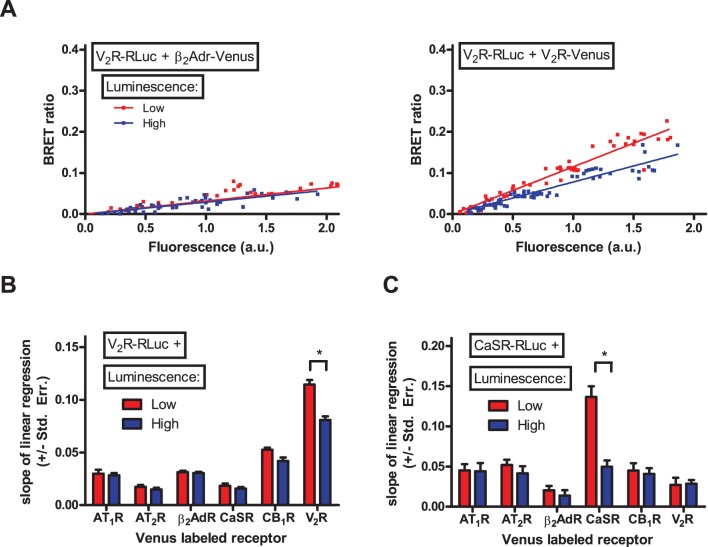
G Protein Coupled Receptors (GPCR) can form dimers or higher ordered oligomers, the process of which can remarkably influence the physiological and pharmacological function of these receptors. Quantitative Bioluminescence Resonance Energy Transfer (qBRET) measurements are the gold standards to prove the direct physical interaction between the protomers of presumed GPCR dimers. For the correct interpretation of these experiments, the expression of the energy donor Renilla luciferase labeled receptor has to be maintained constant, which is hard to achieve in expression systems. To analyze the effects of non-constant donor expression on qBRET curves, we performed Monte Carlo simulations. Our results show that the decrease of donor expression can lead to saturation qBRET curves even if the interaction between donor and acceptor labeled receptors is non-specific leading to false interpretation of the dimerization state. We suggest here a new approach to the analysis of qBRET data, when the BRET ratio is plotted as a function of the acceptor labeled receptor expression at various donor receptor expression levels. With this method, we were able to distinguish between dimerization and non-specific interaction when the results of classical qBRET experiments were ambiguous. The simulation results were confirmed experimentally using rapamycin inducible heterodimerization system. We used this new method to investigate the dimerization of various GPCRs, and our data have confirmed the homodimerization of V2 vasopressin and CaSR calcium sensing receptors, whereas our data argue against the heterodimerization of these receptors with other studied GPCRs, including type I and II angiotensin, β2 adrenergic and CB1 cannabinoid receptors.
G蛋白偶联受体(GPCR)可形成二聚体或更高阶的寡聚体,这一过程会显著影响这些受体的生理和药理功能。定量生物发光共振能量转移(qBRET)测量是证明假定的GPCR二聚体原聚体之间直接物理相互作用的金标准。为了正确解释这些实验,能量供体海肾荧光素酶标记受体的表达必须保持恒定,而这在表达系统中很难实现。为了分析供体表达不恒定对qBRET曲线的影响,我们进行了蒙特卡罗模拟。我们的结果表明,即使供体和受体标记受体之间的相互作用是非特异性的,供体表达的降低也会导致qBRET曲线饱和,从而导致对二聚化状态的错误解读。当将BRET比率绘制为在各种供体受体表达水平下受体标记受体表达的函数时,我们在此提出一种分析qBRET数据的新方法。使用这种方法,当经典qBRET实验的结果不明确时,我们能够区分二聚化和非特异性相互作用。使用雷帕霉素诱导的异源二聚化系统通过实验证实了模拟结果。我们使用这种新方法研究了各种GPCR的二聚化,我们的数据证实了加压素V2和钙敏感受体CaSR的同源二聚化,而我们的数据则反对这些受体与其他研究的GPCR(包括I型和II型血管紧张素、β2肾上腺素能和CB1大麻素受体)的异源二聚化。