Regnault Antoine, Burlina Alberto, Cunningham Amy, Bettiol Esther, Moreau-Stucker Flavie, Benmedjahed Khadra, Bosch Annet M
Mapi, Health Economics & Outcomes Research and Strategic Market Access, 27 rue de la Villette, Lyon, France.
Division of Metabolic Diseases, Department of Paediatrics, University Hospital of Padova, Padova, Italy.
Orphanet J Rare Dis. 2015 May 10;10:59. doi: 10.1186/s13023-015-0261-6.
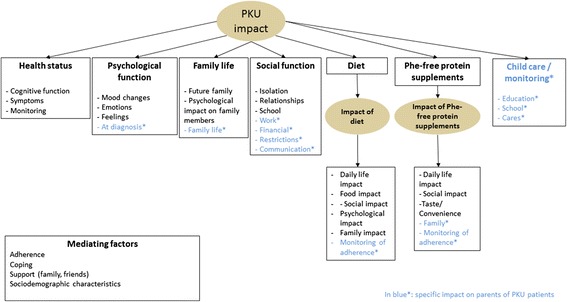
The aim of our study was to develop and validate the first set of PKU-specific Health-related Quality of Life (HRQoL) questionnaires that: 1) were developed for patients with PKU and their parents, 2) cover the physical, emotional, and social impacts of PKU and its treatment on patients' lives, 3) are age specific (Child PKU-QOL, Adolescent PKU-QOL, Adult PKU-QOL), 4) enable the evaluation of the HRQoL of children by their parents (Parent PKU-QOL), and 5) have been cross-culturally adapted for use in seven countries (i.e. France, Germany, Italy, The Netherlands, Spain, Turkey and the UK).
The PKU-QOL questionnaires were developed according to reference methods including patients', parents' and healthcare professionals' interviews; testing in a pilot study (qualitative step in six countries), and linguistic validation of the finalised pilot versions in Turkish. For finalisation and psychometric validation, the pilot versions were included in a multicentre, prospective, non-interventional, observational study conducted in 34 sites in France, Germany, Italy, The Netherlands, Spain, Turkey and the UK. Iterative multi-trait analyses were conducted. Psychometric properties were assessed (concurrent and clinical validity, internal consistency reliability and test-retest reliability).
Data from 559 subjects (306 patients, 253 parents) were analysed. After finalisation, the PKU-QOL questionnaires included 40 items (Child PKU-QOL), 58 items (Adolescent PKU-QOL), 65 items (Adult PKU-QOL) and 54 items (Parent PKU-QOL), distributed in four modules: PKU symptoms, PKU in general, administration of Phe-free protein supplements and dietary protein restriction. The measurement properties of the Adolescent, Adult and Parent PKU-QOL questionnaires were overall fairly satisfactory, but weaker for the Child questionnaire.
The four PKU-QOL questionnaires developed for different ages (Child PKU-QOL, Adolescent PKU-QOL, Adult PKU-QOL), and for parents of children with PKU (Parent PKU-QOL) are valid and reliable instruments for assessing the multifaceted impact of PKU on patients of different age groups (children, adolescents and adults) and their parents, and are available for use in seven countries. They are very promising tools to explore how patients' perceptions evolve with age, to increase knowledge of the impact of PKU on patients and parents in different countries, and to help monitor the effect of therapeutic strategies.
我们研究的目的是开发并验证第一套针对苯丙酮尿症(PKU)的特定健康相关生活质量(HRQoL)问卷,该问卷:1)为PKU患者及其父母设计;2)涵盖PKU及其治疗对患者生活的身体、情感和社会影响;3)按年龄划分(儿童PKU-QOL、青少年PKU-QOL、成人PKU-QOL);4)能够由父母评估儿童的HRQoL(家长PKU-QOL);5)已进行跨文化改编,可在七个国家使用(即法国、德国、意大利、荷兰、西班牙、土耳其和英国)。
PKU-QOL问卷根据参考方法制定,包括对患者、父母和医疗保健专业人员的访谈;在一项预试验研究中进行测试(六个国家的定性阶段),并对土耳其语的最终预试验版本进行语言验证。为了最终确定和进行心理测量学验证,将预试验版本纳入在法国、德国、意大利、荷兰、西班牙、土耳其和英国的34个地点进行的一项多中心、前瞻性、非干预性观察性研究。进行了迭代多特征分析。评估了心理测量学特性(同时效度和临床效度、内部一致性信度和重测信度)。
分析了来自559名受试者(306名患者,253名父母)的数据。最终确定后,PKU-QOL问卷包括40个项目(儿童PKU-QOL)、58个项目(青少年PKU-QOL)、65个项目(成人PKU-QOL)和54个项目(家长PKU-QOL),分布在四个模块中:PKU症状、一般PKU、无苯丙氨酸蛋白质补充剂的管理和饮食蛋白质限制。青少年、成人和家长PKU-QOL问卷的测量特性总体上相当令人满意,但儿童问卷的测量特性较弱。
为不同年龄(儿童PKU-QOL、青少年PKU-QOL、成人PKU-QOL)以及PKU患儿的父母(家长PKU-QOL)开发的四份PKU-QOL问卷是评估PKU对不同年龄组(儿童、青少年和成人)患者及其父母多方面影响的有效且可靠的工具,可在七个国家使用。它们是非常有前景的工具,可用于探索患者的认知如何随年龄演变,增加对PKU在不同国家对患者和父母影响的了解,并有助于监测治疗策略的效果。