Wang Ningjian, Kuang Lin, Han Bing, Li Qin, Chen Yi, Zhu Chunfang, Chen Yingchao, Xia Fangzhen, Cang Zhen, Zhu Chaoxia, Lu Meng, Meng Ying, Guo Hui, Chen Chi, Lin Dongping, Lu Yingli
Institute and Department of Endocrinology and Metabolism, Shanghai Ninth People's Hospital, Shanghai JiaoTong University School of Medicine, Shanghai, 200011, China.
Assisted Reproduction Unit, Department of Obstetrics and Gynecology, Sir Run Run Shaw Hospital, Zhejiang University School of Medicine, Zhejiang, China.
Acta Diabetol. 2016 Apr;53(2):227-36. doi: 10.1007/s00592-015-0769-1. Epub 2015 May 12.
No study explores the association between follicle-stimulating hormone (FSH) and glucose metabolism in general women. We aim to investigate whether the variation of FSH is associated with prediabetes and diabetes in postmenopausal women.
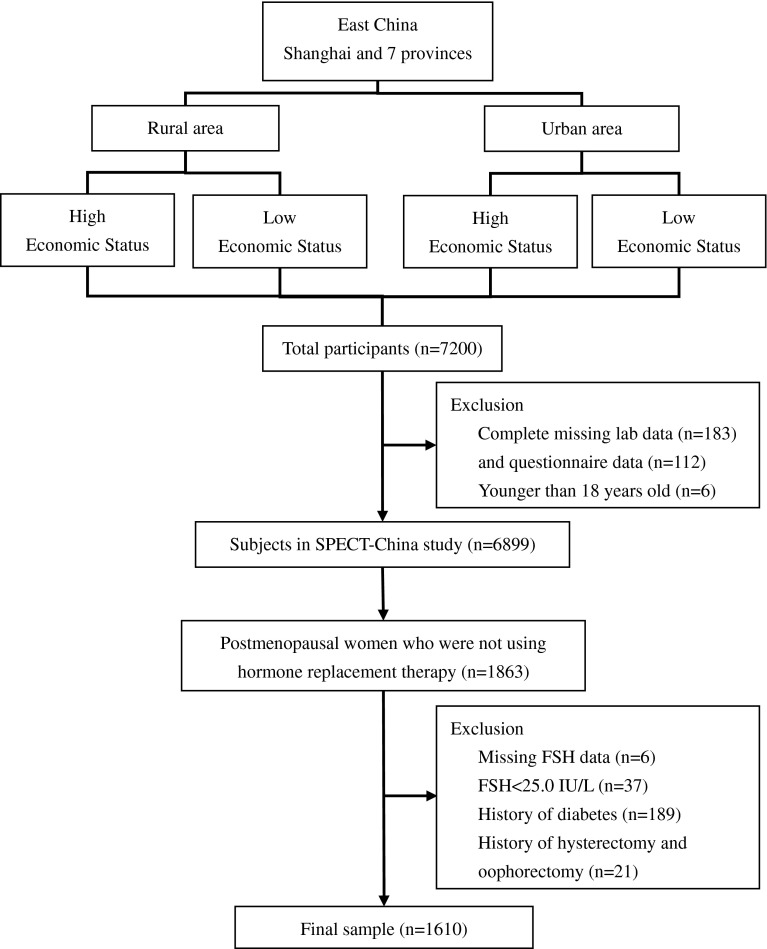
Our data were from survey on prevalence in East China for metabolic diseases and risk factors in 2014. Thousand six hundred and ten postmenopausal women at the age of 55-89 who were not using hormone replacement therapy were selected. Prediabetes and diabetes were defined according to American Diabetes Association 2014 criteria. FSH, luteinizing hormone, total testosterone and estradiol were measured by chemiluminescence. Multinomial logistic analyses were used for the association of FSH with prediabetes and diabetes, and linear regression for the association of FSH with fasting plasma glucose (FPG) and HbA1c.
Among the participants, 778 (48.3 %) had prediabetes and 121 (7.5 %) had newly diagnosed diabetes. In linear regression, after full adjustment for demographic variables, metabolic factors, E2 and LH, FSH was associated with FPG and HbA1c (P < 0.05). In logistic regression, increased quartiles of FSH were associated with significantly decreased odds ratios of prediabetes and diabetes (P for trend <0.01). This association was attenuated by waist circumference and HOMA-IR, but persisted in fully adjusted model (P for trend <0.05) in which, for the lowest compared with the highest quartile of FSH, the odds ratios of prediabetes and diabetes were 1.93 (95 % CI 1.21-3.08; P < 0.01) and 3.02 (95 % CI 1.10-8.31; P < 0.05), respectively.
Low FSH was associated with prediabetes and diabetes in postmenopausal women. The associations might be partially explained by adiposity and insulin resistance.
尚无研究探讨一般女性中促卵泡激素(FSH)与糖代谢之间的关联。我们旨在调查绝经后女性中FSH的变化是否与糖尿病前期及糖尿病相关。
我们的数据来自2014年华东地区代谢性疾病及危险因素患病率调查。选取了1610名年龄在55 - 89岁、未使用激素替代疗法的绝经后女性。根据美国糖尿病协会2014年标准定义糖尿病前期和糖尿病。采用化学发光法测量FSH、促黄体生成素、总睾酮和雌二醇。使用多项逻辑分析来研究FSH与糖尿病前期和糖尿病的关联,使用线性回归来研究FSH与空腹血糖(FPG)和糖化血红蛋白(HbA1c)的关联。
在参与者中,778人(48.3%)患有糖尿病前期,121人(7.5%)新诊断为糖尿病。在线性回归中,在对人口统计学变量、代谢因素、雌二醇(E2)和促黄体生成素(LH)进行全面调整后,FSH与FPG和HbA1c相关(P < 0.05)。在逻辑回归中,FSH四分位数增加与糖尿病前期和糖尿病的比值比显著降低相关(趋势P < 0.01)。这种关联因腰围和稳态模型评估的胰岛素抵抗(HOMA - IR)而减弱,但在完全调整模型中仍然存在(趋势P < 0.05),其中,与FSH最低四分位数相比,最高四分位数时糖尿病前期和糖尿病的比值比分别为1.93(95%可信区间1.21 - 3.08;P < 0.01)和3.02(95%可信区间1.10 - 8.31;P < 0.05)。
绝经后女性中低FSH与糖尿病前期和糖尿病相关。这些关联可能部分由肥胖和胰岛素抵抗解释。