Jin Feng, Zhu Hui, Kong Li, Yu Jinming
Department of Radiation Oncology, Shandong Cancer Hospital and Institute, Shandong Academy of Medical Sciences, University of Jinan, Jinan, People's Republic of China.
Department of Radiation Oncology, Shandong Cancer Hospital and Institute, Jinan, People's Republic of China.
Onco Targets Ther. 2015 Apr 23;8:943-6. doi: 10.2147/OTT.S83888. eCollection 2015.
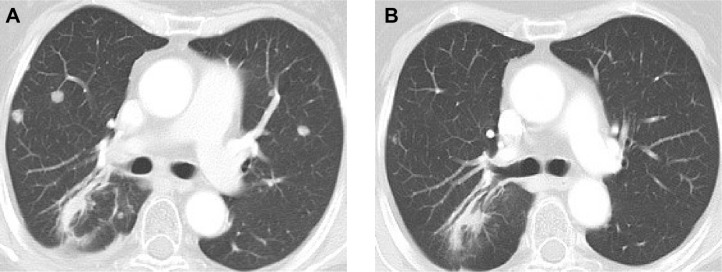
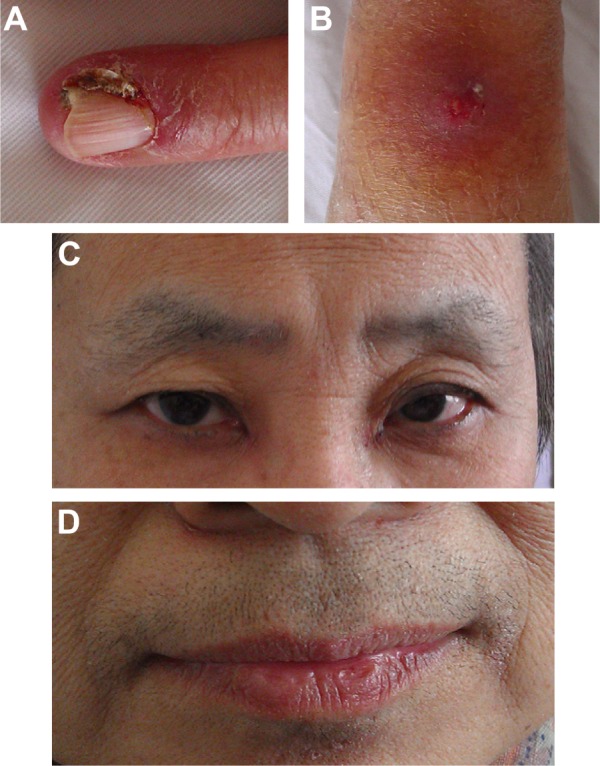
Some literature suggests that an EGFR inhibition-induced rash can be used as a clinical marker, but few studies report the correlation between a spectrum of cutaneous toxicities from EGFR inhibition and drug efficacy. We report about a woman with a stage IV lung adenocarcinoma using erlotinib monotherapy, who experienced a spectrum of cutaneous toxicities, including papulopustular rash, mucositis, pruritus, xerosis, paronychia, and facial hirsutism. With treatment, her metastatic lesions shrunk remarkably. This report suggests that some non-small-cell lung cancer patients experiencing a spectrum of cutaneous toxicities might have a good tumor response using erlotinib monotherapy. Our findings may provide a method for clinicians to predict erlotinib efficacy in non-small-cell lung cancer therapy without knowledge of the EGFR mutation status.
一些文献表明,表皮生长因子受体(EGFR)抑制引起的皮疹可作为一种临床标志物,但很少有研究报道EGFR抑制所导致的一系列皮肤毒性与药物疗效之间的相关性。我们报告了一名使用厄洛替尼单药治疗的IV期肺腺癌女性患者,她出现了一系列皮肤毒性,包括丘疹脓疱性皮疹、粘膜炎、瘙痒、皮肤干燥、甲沟炎和面部多毛症。随着治疗,她的转移病灶显著缩小。本报告表明,一些经历一系列皮肤毒性的非小细胞肺癌患者使用厄洛替尼单药治疗可能会有良好的肿瘤反应。我们的研究结果可能为临床医生在不了解EGFR突变状态的情况下预测厄洛替尼在非小细胞肺癌治疗中的疗效提供一种方法。