Woźniak Witold, Mlosek Robert K, Ciostek Piotr
First Department of General and Vascular Surgery, Second Faculty of Medicine with the English Division and the Physiotherapy Division, Medical University of Warsaw, Warsaw, Poland.
Department of Ultrasonographic Diagnostics and Mammography, Second Faculty of Medicine with the English Division and the Physiotherapy Division, Medical University of Warsaw, Warsaw, Poland.
Wideochir Inne Tech Maloinwazyjne. 2015 Apr;10(1):15-24. doi: 10.5114/wiitm.2015.48573. Epub 2015 Jan 27.
For the last 10 years, endovenous thermal ablation methods have gradually predominated over the classic Babcock procedure in varicose vein treatment. Steam vein sclerosis is the newest thermal ablation technique.
To assess the efficacy and safety of steam vein sclerosis as compared to the Babcock procedure in lower extremity varicose vein treatment.
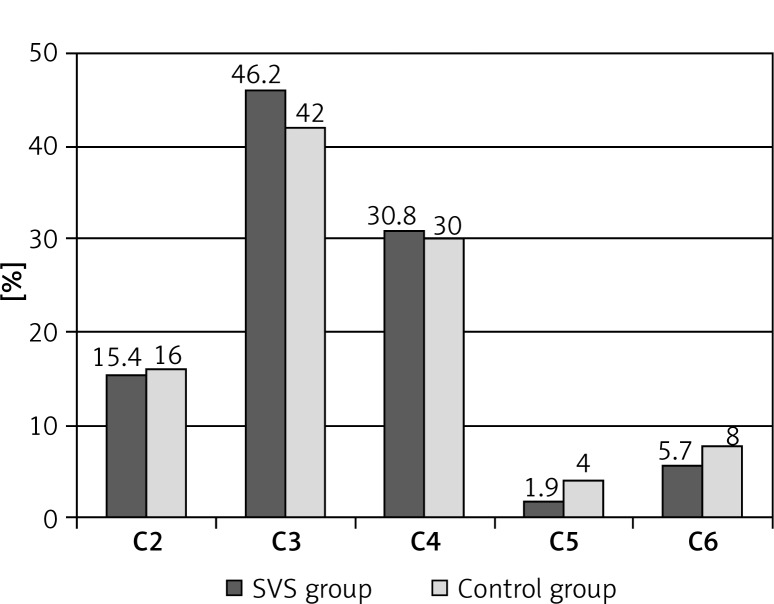
One hundred and two adult subjects with varicose veins of clinical grade C2 to C6 according to the CEAP classification, treated with varicose vein surgery between 2010 and 2012, were enrolled in the study. These were subdivided into two groups: the study group of 52 patients treated with endovenous steam vein sclerosis and the control group of 50 patients treated with the Babcock procedure. A single lower extremity with isolated great or small saphenous vein insufficiency was operated on in each subject. The groups were compared for demography, disease severity, involved veins, potential perioperative and postoperative complications, as well as treatment efficacy based on the VCSS score reduction.
There were no statistically significant differences between the groups in terms of demography, disease severity, involved veins, or perioperative and postoperative complications. The treatment efficacy of both methods, assessed based on the recurrence rate and the quantitative VCSS score reduction, was similar. Clinically significant recanalisation was observed in 1 (1.9%) patient in the study group.
The efficacy and safety analysis shows that steam vein sclerosis is a safe, simple method which can be recommended as effective varicose vein treatment.
在过去十年中,静脉内热消融方法在静脉曲张治疗中已逐渐取代经典的巴布科克手术。蒸汽静脉硬化术是最新的热消融技术。
评估蒸汽静脉硬化术与巴布科克手术相比在治疗下肢静脉曲张中的疗效和安全性。
选取2010年至2012年间接受静脉曲张手术治疗的102例成年患者,根据CEAP分类,其临床分级为C2至C6级。将这些患者分为两组:研究组52例接受静脉内热蒸汽静脉硬化术治疗,对照组50例接受巴布科克手术治疗。每位受试者仅对单一下肢的大隐静脉或小隐静脉孤立性功能不全进行手术。比较两组患者的人口统计学特征、疾病严重程度、受累静脉、潜在的围手术期和术后并发症,以及基于静脉临床严重程度评分(VCSS)降低情况的治疗效果。
两组在人口统计学特征、疾病严重程度、受累静脉或围手术期及术后并发症方面无统计学显著差异。基于复发率和定量VCSS评分降低评估的两种方法的治疗效果相似。研究组有1例(1.9%)患者出现临床显著的再通。
疗效和安全性分析表明,蒸汽静脉硬化术是一种安全、简单的方法,可作为有效的静脉曲张治疗方法推荐。