Ito Taku, Muskett Julie, Chattaraj Parna, Choi Byung Yoon, Lee Kyu Yup, Zalewski Christopher K, King Kelly A, Li Xiangming, Wangemann Philine, Shawker Thomas, Brewer Carmen C, Alper Seth L, Griffith Andrew J
Otolaryngology Branch, National Institute on Deafness and Other Communication Disorders, National Institutes of Health, Rockville, MD 20850, United States.
Laboratory of Molecular Genetics, National Institute on Deafness and Other Communication Disorders, National Institutes of Health, Rockville, MD 20850, United States.
World J Otorhinolaryngol. 2013 May 28;3(2):26-34. doi: 10.5319/wjo.v3.i2.26.
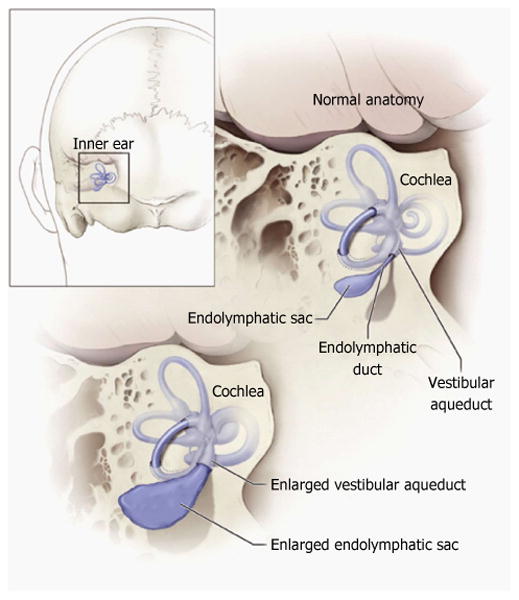
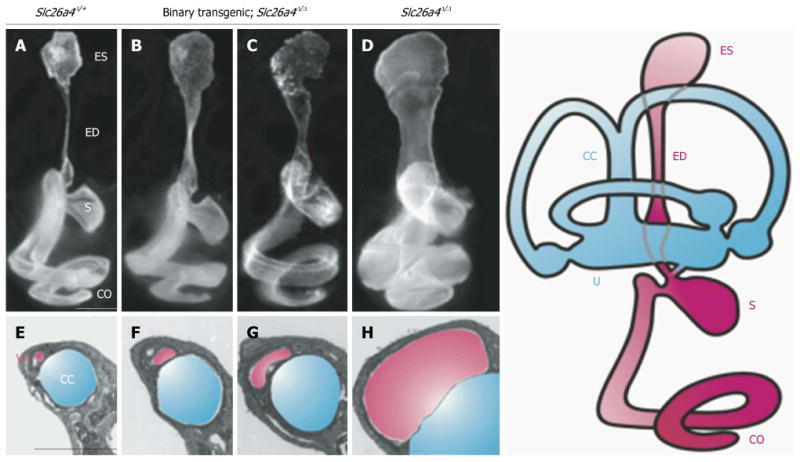
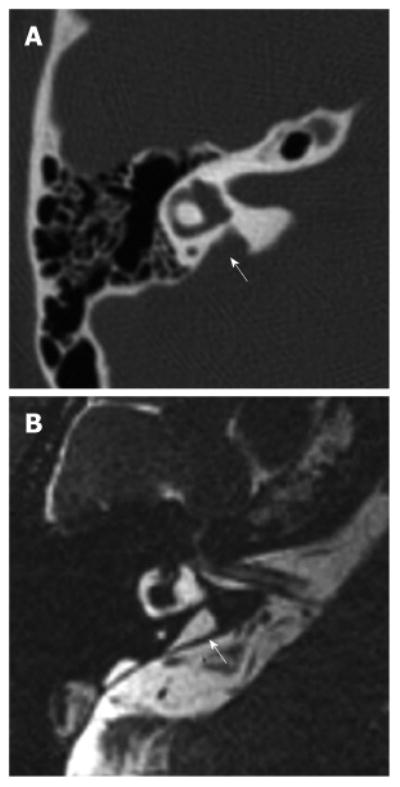
Pendred syndrome (PS) is characterized by autosomal recessive inheritance of goiter associated with a defect of iodide organification, hearing loss, enlargement of the vestibular aqueduct (EVA), and mutations of the gene. However, not all EVA patients have PS or mutations. Two mutant alleles of are detected in ¼ of North American or European EVA populations, one mutant allele is detected in another ¼ of patient populations, and no mutations are detected in the other ½. The presence of two mutant alleles of is associated with abnormal iodide organification, increased thyroid gland volume, increased severity of hearing loss, and bilateral EVA. The presence of a single mutant allele of is associated with normal iodide organification, normal thyroid gland volume, less severe hearing loss and either bilateral or unilateral EVA. When other underlying correlations are accounted for, the presence of a cochlear malformation or the size of EVA does not have an effect on hearing thresholds. This is consistent with observations of an mutant mouse model of EVA in which hearing loss is independent of endolymphatic hydrops or inner ear malformations. Segregation analyses of EVA in families suggest that the patients carrying one mutant allele of have a second, undetected mutant allele of , and the probability of a sibling having EVA is consistent with its segregation as an autosomal recessive trait. Patients without any mutations are an etiologically heterogeneous group in which siblings have a lower probability of having EVA. mutation testing can provide prognostic information to guide clinical surveillance and management, as well as the probability of EVA affecting a sibling.
Pendred综合征(PS)的特征为常染色体隐性遗传的甲状腺肿,伴有碘有机化缺陷、听力丧失、前庭导水管扩大(EVA)以及该基因的突变。然而,并非所有EVA患者都患有PS或该基因突变。在北美或欧洲的EVA患者群体中,四分之一检测到该基因的两个突变等位基因,另外四分之一的患者群体检测到一个突变等位基因,其余二分之一未检测到突变。该基因两个突变等位基因的存在与碘有机化异常、甲状腺体积增大、听力丧失严重程度增加以及双侧EVA相关。该基因单个突变等位基因的存在与碘有机化正常、甲状腺体积正常、听力丧失较轻以及双侧或单侧EVA相关。当考虑其他潜在相关性时,耳蜗畸形的存在或EVA的大小对听力阈值没有影响。这与EVA的突变小鼠模型的观察结果一致,在该模型中听力丧失与内淋巴积水或内耳畸形无关。对家庭中EVA的分离分析表明,携带该基因一个突变等位基因的患者有第二个未检测到的突变等位基因,同胞患EVA的概率与其作为常染色体隐性性状的分离情况一致。没有任何突变的患者是病因异质性群体,其同胞患EVA的概率较低。该基因突变检测可以提供预后信息,以指导临床监测和管理,以及EVA影响同胞的概率。