Center for Applied Health Research, Baylor Scott & White Health , Temple, TX , USA ; Department of Health Promotion and Community Health Science, Texas A&M Health Science Center School of Public Health , College Station, TX , USA.
Department of Health Promotion and Behavior, The University of Georgia , Athens, GA , USA ; Department of Health Promotion and Community Health Science, Texas A&M Health Science Center School of Public Health , College Station, TX , USA.
Front Public Health. 2015 Apr 27;3:26. doi: 10.3389/fpubh.2015.00026. eCollection 2015.
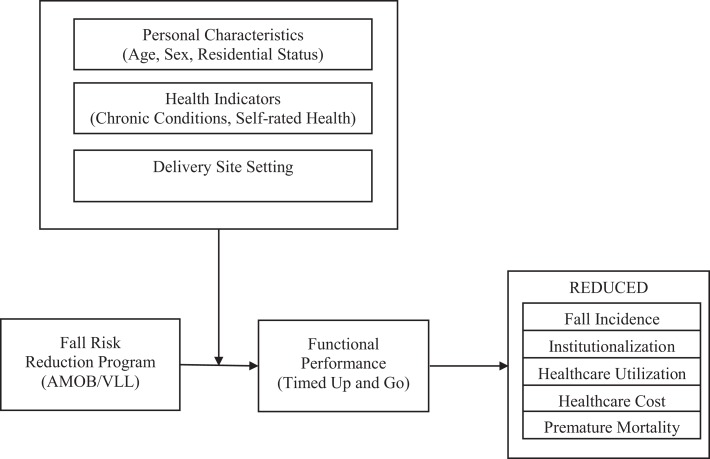
Functional decline is a primary risk factor for institutionalization and mortality among older adults. Although community-based fall risk reduction programs have been widely disseminated, little is known about their impact on gait speed, a key indicator of functional performance. Changes in functional performance between baseline and post-intervention were examined by means of timed up and go (TUG), a standardized functional assessment test administered to participants enrolled in A Matter of Balance/Volunteer Lay Leader (AMOB/VLL) model, an evidence-based fall risk reduction program.
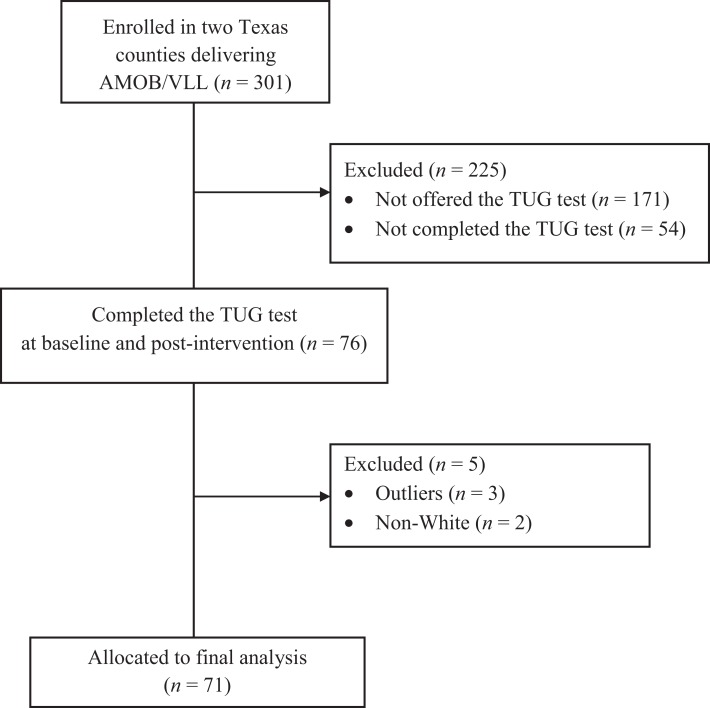
This study included 71 participants enrolled in an AMOB/VLL program in the Brazos Valley and South Plain regions of Texas. Paired t-tests were employed to assess program effects on gait speed at baseline and post-intervention for all participants and by subgroups of age, sex, living status, delivery sites, and self-rated health. The Bonferroni correction was applied to adjust inflated Type I error rate associated with performing multiple t-tests, for which p-values <0.0042 (i.e., 0.5/12 comparisons) were deemed statistically significant.
Overall, gait speed of enrolled participants improved from baseline to post-intervention (t = 3.22, p = 0.002). Significant changes in TUG scores were observed among participants who lived with others (t = 4.45, p < 0.001), rated their health as excellent, very good, or good (t = 3.05, p = 0.003), and attended program workshops at senior centers (t = 3.52, p = 0.003).
Findings suggest community-based fall risk reduction programs can improve gait speed for older adults. More translational research is needed to understand factors related to the effectiveness of fall risk reduction programs in various populations and settings.
功能下降是老年人住院和死亡的主要风险因素。尽管基于社区的降低跌倒风险的方案已得到广泛传播,但对于它们对步态速度(功能表现的关键指标)的影响知之甚少。通过计时起立行走(TUG)测试评估了参与者在基线和干预后的功能表现变化,TUG 是一种标准化的功能评估测试,用于评估参加基于平衡的 Matter/志愿者领导(AMOB/VLL)模式的证据基础降低跌倒风险的方案的参与者。
本研究包括德克萨斯州布拉索斯谷和南平原地区参加 AMOB/VLL 计划的 71 名参与者。采用配对 t 检验评估了所有参与者以及年龄、性别、居住状况、分娩地点和自我评估健康状况的亚组在基线和干预后的步态速度的方案效果。Bonferroni 校正用于调整与执行多次 t 检验相关的膨胀的 I 型错误率,对于 p 值<0.0042(即 0.5/12 次比较),认为具有统计学意义。
总体而言,参加者的步态速度从基线到干预后有所提高(t=3.22,p=0.002)。与同住者(t=4.45,p<0.001)、自我评估健康状况为优秀、非常好或好(t=3.05,p=0.003)以及在老年人中心参加方案研讨会的参与者相比,TUG 评分有显著变化(t=3.52,p=0.003)。
研究结果表明,基于社区的降低跌倒风险的方案可以提高老年人的步态速度。需要更多的转化研究来了解与不同人群和环境中降低跌倒风险方案的有效性相关的因素。