Chiang C P, Caulfield J P
Department of Rheumatology, Harvard Medical School, Boston, Massachusetts.
Am J Pathol. 1989 Dec;135(6):1015-24.
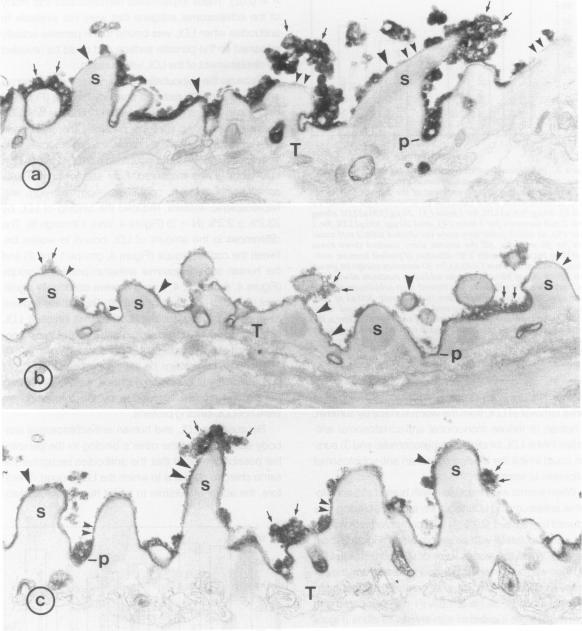
It was previously shown by the authors that the binding of human low-density lipoprotein (LDL) to the surface of schistosomula inhibits the binding of human anti-schistosomal antibodies and is inhibited by suramin. Here, three questions were considered. 1) Are LDLs bound to schistosomula displaced from the membrane by polyanions? 2) Does bound LDL mask or hide antigens recognized by human anti-schistosomal antibodies? 3) Is LDL, binding capability present when the larvae enter the blood stream? The first question was tested by measuring the percentage of the schistosomular surface membrane covered by LDL after exposure to LDL with or without dextran sulfate or suramin. The bound LDL was visualized with polyclonal goat anti-human apolipoprotein B (anti-apo B) antibodies and peroxidase-conjugated secondary antibodies. After overnight culture in 20 micrograms/300 microliters LDL, 84.0% +/- 0.3% of the parasite surface was covered by LDL reaction product. When the polyanions suramin or dextran sulfate were added to the cultures for 30 minutes, only 59.7% +/- 4.9% of the surface was covered by reaction product, demonstrating that the LDL was partially displaced from the membrane by these compounds. The second question was tested by measuring the binding of human and mouse monoclonal anti-schistosomal antibodies before and after exposure to LDL, with or without partial removal of the bound LDL by suramin. LDL partially inhibited antibody binding in a reversible fashion. The LDL clearly masked parasite antigens, most probably by steric hindrance. However, there may be competitive inhibition of antibody binding by the LDL as well, because human anti-schistosomal antibodies inhibited LDL binding to worms and both human anti-schistosomal antibody and LDL binding to schistosomula were inhibited by suramin. Finally, the third question was tested by quantitative immunofluorescence. The LDL binding capability persisted and nearly doubled by 72 hours after transformation from cercariae. These experiments demonstrated that LDL bound to the surface of schistosomula through the time they enter the blood stream. LDL bound to the parasite surface may help the parasite to evade antibody-dependent cytotoxic reactions by masking parasite antigens.
作者之前曾表明,人低密度脂蛋白(LDL)与童虫表面的结合会抑制人抗血吸虫抗体的结合,且这种结合会被苏拉明抑制。在此,研究了三个问题。1)与童虫结合的LDL是否会被聚阴离子从膜上置换下来?2)结合的LDL是否会掩盖或隐藏人抗血吸虫抗体识别的抗原?3)幼虫进入血流时是否存在LDL结合能力?通过测量在有或没有硫酸葡聚糖或苏拉明的情况下暴露于LDL后,被LDL覆盖的童虫表面膜的百分比来测试第一个问题。用多克隆山羊抗人载脂蛋白B(抗载脂蛋白B)抗体和过氧化物酶偶联的二抗来观察结合的LDL。在20微克/300微升LDL中过夜培养后,84.0%±0.3%的寄生虫表面被LDL反应产物覆盖。当将聚阴离子苏拉明或硫酸葡聚糖加入培养物中30分钟时,只有59.7%±4.9%的表面被反应产物覆盖,这表明这些化合物使LDL从膜上部分被置换下来。通过测量在暴露于LDL之前和之后,以及在有或没有通过苏拉明部分去除结合的LDL的情况下,人源和鼠源单克隆抗血吸虫抗体的结合情况来测试第二个问题。LDL以可逆的方式部分抑制抗体结合。LDL显然通过空间位阻掩盖了寄生虫抗原。然而,LDL对抗体结合可能也存在竞争性抑制,因为人抗血吸虫抗体抑制LDL与虫体的结合,并且人抗血吸虫抗体和LDL与童虫的结合都被苏拉明抑制。最后,通过定量免疫荧光测试第三个问题。从尾蚴转变后72小时,LDL结合能力持续存在且几乎翻倍。这些实验表明,从童虫进入血流开始,LDL就与童虫表面结合。结合在寄生虫表面的LDL可能通过掩盖寄生虫抗原帮助寄生虫逃避抗体依赖性细胞毒性反应。