Fleischer Wiebke, Theiss Stephan, Slotta Johannes, Holland Christine, Schnitzler Alfons
Institute of Clinical Neuroscience and Medical Psychology, Medical Faculty, Heinrich Heine University, Düsseldorf, Germany
Institute of Clinical Neuroscience and Medical Psychology, Medical Faculty, Heinrich Heine University, Düsseldorf, Germany RESULT Medical GmbH, Düsseldorf, Germany.
Physiol Rep. 2015 May 11;3(5). doi: 10.14814/phy2.12400.
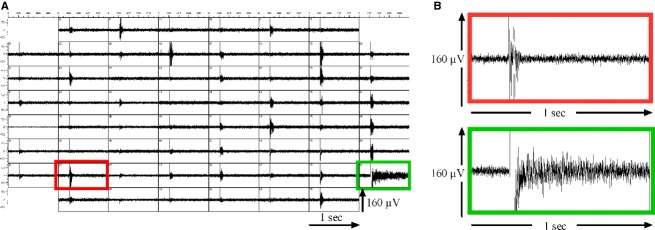
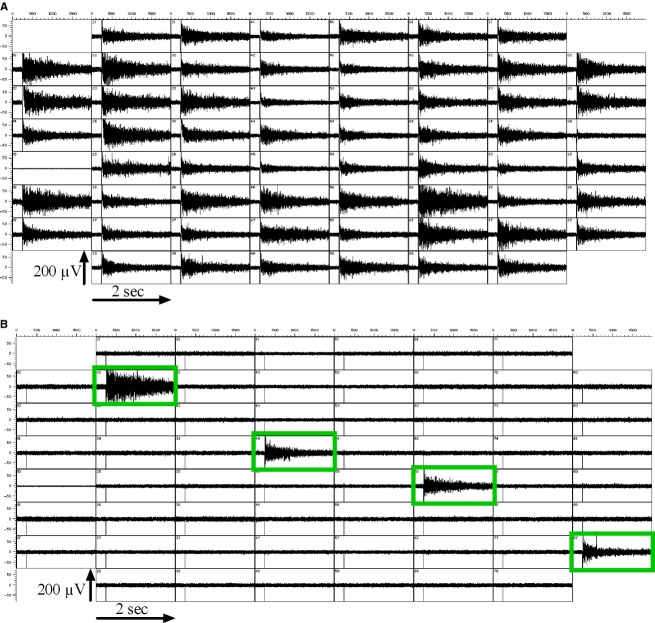
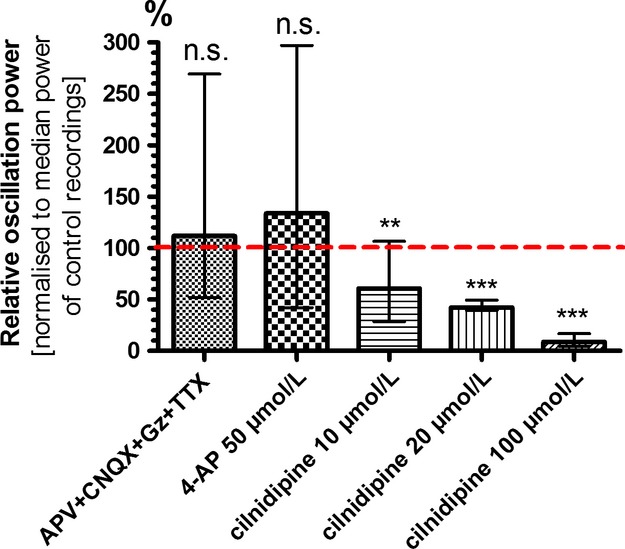
Because of their close interaction with neuronal physiology, astrocytes can modulate brain function in multiple ways. Here, we demonstrate a yet unknown astrocytic phenomenon: Astrocytes cultured on microelectrode arrays (MEAs) exhibited extracellular voltage fluctuations in a broad frequency spectrum (100-600 Hz) after electrical stimulation. These aperiodic high-frequency oscillations (HFOs) could last several seconds and did not spread across the MEA. The voltage-gated calcium channel antagonist cilnidipine dose-dependently decreased the power of the oscillations. While intracellular calcium was pivotal, incubation with bafilomycin A1 showed that vesicular release of transmitters played only a minor role in the emergence of HFOs. Gap junctions and volume-regulated anionic channels had just as little functional impact, which was demonstrated by the addition of carbenoxolone (100 μmol/L) and NPPB (100 μmol/L). Hyperpolarization with low potassium in the extracellular solution (2 mmol/L) dramatically raised oscillation power. A similar effect was seen when we added extra sodium (+50 mmol/L) or if we replaced it with NMDG(+) (50 mmol/L). The purinergic receptor antagonist PPADS suppressed the oscillation power, while the agonist ATP (100 μmol/L) had only an increasing effect when the bath solution pH was slightly lowered to pH 7.2. From these observations, we conclude that astrocytic voltage oscillations are triggered by activation of voltage-gated calcium channels and driven by a downstream influx of cations through channels that are permeable for large ions such as NMDG(+). Most likely candidates are subtypes of pore-forming P2X channels with a low affinity for ATP.
由于星形胶质细胞与神经元生理学密切相关,它们可以通过多种方式调节脑功能。在此,我们展示了一种尚未知晓的星形胶质细胞现象:在微电极阵列(MEA)上培养的星形胶质细胞在电刺激后会在宽频谱(100 - 600Hz)中表现出细胞外电压波动。这些非周期性高频振荡(HFOs)可持续数秒且不会在MEA上扩散。电压门控钙通道拮抗剂西尼地平剂量依赖性地降低了振荡功率。虽然细胞内钙起关键作用,但用巴弗洛霉素A1孵育表明,递质的囊泡释放对HFOs的出现仅起次要作用。间隙连接和容积调节性阴离子通道的功能影响同样很小,这通过添加羧苄青霉素(100μmol/L)和NPPB(100μmol/L)得以证明。在细胞外溶液中用低钾(2mmol/L)进行超极化显著提高了振荡功率。当我们添加额外的钠(+50mmol/L)或用NMDG(+)(50mmol/L)替代时也观察到了类似的效果。嘌呤能受体拮抗剂PPADS抑制了振荡功率,而激动剂ATP(100μmol/L)仅在浴液pH略微降至pH 7.2时具有增强作用。从这些观察结果中,我们得出结论,星形胶质细胞电压振荡是由电压门控钙通道的激活触发的,并由阳离子通过对诸如NMDG(+)等大离子通透的通道的下游内流驱动。最有可能的候选者是对ATP亲和力低的形成孔道的P2X通道亚型。