Santiago-Tirado Felipe H, Peng Tao, Yang Meng, Hang Howard C, Doering Tamara L
Department of Molecular Microbiology, Washington University School of Medicine, St. Louis, Missouri, United States of America.
Laboratory of Chemical Biology and Microbial Pathogenesis, The Rockefeller University, New York, New York, United States of America.
PLoS Pathog. 2015 May 13;11(5):e1004908. doi: 10.1371/journal.ppat.1004908. eCollection 2015 May.
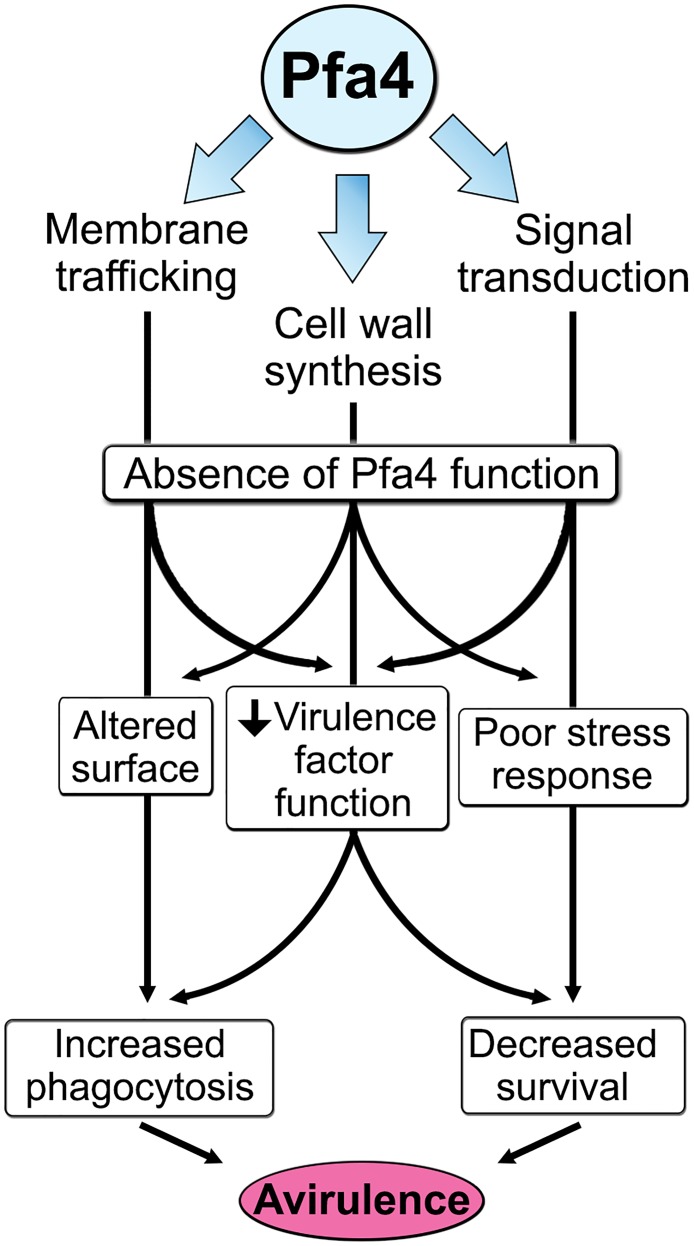
Cryptococcus neoformans is an opportunistic yeast that kills over 625,000 people yearly through lethal meningitis. Host phagocytes serve as the first line of defense against this pathogen, but fungal engulfment and subsequent intracellular proliferation also correlate with poor patient outcome. Defining the interactions of this facultative intracellular pathogen with host phagocytes is key to understanding the latter's opposing roles in infection and how they contribute to fungal latency, dissemination, and virulence. We used high-content imaging and a human monocytic cell line to screen 1,201 fungal mutants for strains with altered host interactions and identified multiple genes that influence fungal adherence and phagocytosis. One of these genes was PFA4, which encodes a protein S-acyl transferase (PAT), one of a family of DHHC domain-containing proteins that catalyzes lipid modification of proteins. Deletion of PFA4 caused dramatic defects in cryptococcal morphology, stress tolerance, and virulence. Bioorthogonal palmitoylome-profiling identified Pfa4-specific protein substrates involved in cell wall synthesis, signal transduction, and membrane trafficking responsible for these phenotypic alterations. We demonstrate that a single PAT is responsible for the modification of a subset of proteins that are critical in cryptococcal pathogenesis. Since several of these palmitoylated substrates are conserved in other pathogenic fungi, protein palmitoylation represents a potential avenue for new antifungal therapeutics.
新型隐球菌是一种机会性酵母,每年通过致死性脑膜炎导致超过62.5万人死亡。宿主吞噬细胞是抵御这种病原体的第一道防线,但真菌的吞噬及随后的细胞内增殖也与患者的不良预后相关。明确这种兼性细胞内病原体与宿主吞噬细胞之间的相互作用,是理解吞噬细胞在感染中所起的相反作用以及它们如何导致真菌潜伏、播散和毒力的关键。我们利用高内涵成像技术和一种人类单核细胞系,对1201个真菌突变体进行筛选,以寻找宿主相互作用发生改变的菌株,并鉴定出多个影响真菌黏附和吞噬作用的基因。其中一个基因是PFA4,它编码一种蛋白质S-酰基转移酶(PAT),PAT是含DHHC结构域的蛋白质家族中的一员,可催化蛋白质的脂质修饰。PFA4的缺失导致新型隐球菌在形态、应激耐受性和毒力方面出现显著缺陷。生物正交棕榈酰化组分析确定了参与细胞壁合成、信号转导和膜运输的Pfa4特异性蛋白质底物,这些底物导致了这些表型改变。我们证明,单一的PAT负责修饰新型隐球菌致病过程中关键的一部分蛋白质。由于这些棕榈酰化底物中的几种在其他致病真菌中是保守的,蛋白质棕榈酰化代表了新型抗真菌治疗的一个潜在途径。