Pimentel Mark, Morales Walter, Rezaie Ali, Marsh Emily, Lembo Anthony, Mirocha James, Leffler Daniel A, Marsh Zachary, Weitsman Stacy, Chua Kathleen S, Barlow Gillian M, Bortey Enoch, Forbes William, Yu Allen, Chang Christopher
GI Motility Program, Cedars-Sinai Medical Center, Los Angeles, California, United States of America.
Beth Israel Deaconess Medical Center, Boston, Massachusetts, United States of America.
PLoS One. 2015 May 13;10(5):e0126438. doi: 10.1371/journal.pone.0126438. eCollection 2015.
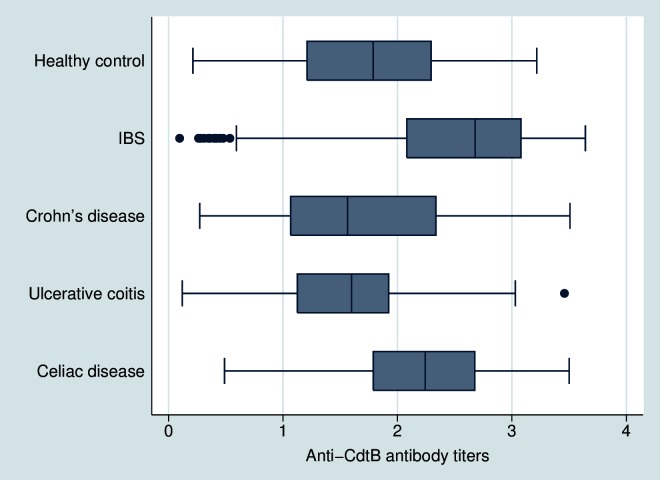
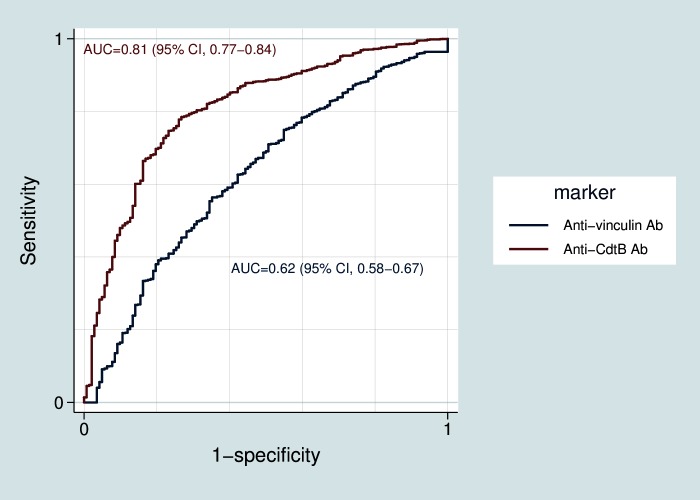
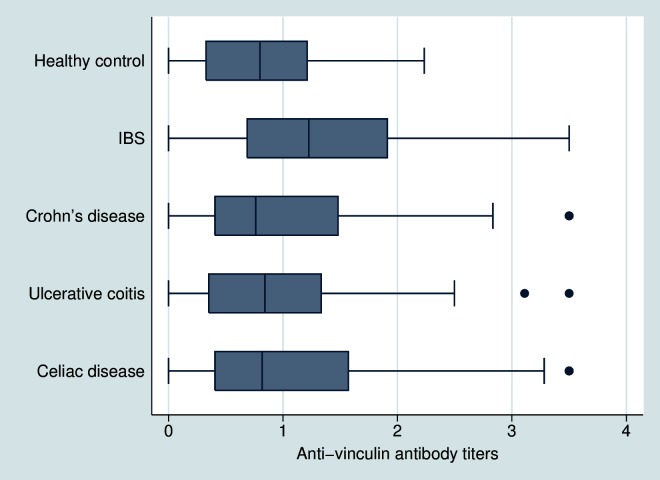
Diarrhea-predominant irritable bowel syndrome (IBS) is diagnosed through clinical criteria after excluding "organic" conditions, and can be precipitated by acute gastroenteritis. Cytolethal distending toxin B (CdtB) is produced by bacteria that cause acute gastroenteritis, and a post-infectious animal model demonstrates that host antibodies to CdtB cross-react with vinculin in the host gut, producing an IBS-like phenotype. Therefore, we assessed circulating anti-CdtB and anti-vinculin antibodies as biomarkers for D-IBS in human subjects. Subjects with D-IBS based on Rome criteria (n=2375) were recruited from a large-scale multicenter clinical trial for D-IBS (TARGET 3). Subjects with inflammatory bowel disease (IBD) (n=142), subjects with celiac disease (n=121), and healthy controls (n=43) were obtained for comparison. Subjects with IBD and celiac disease were recruited based on the presence of intestinal complaints and histologic confirmation of chronic inflammatory changes in the colon or small intestine. Subjects with celiac disease were also required to have an elevated tTG and biopsy. All subjects were aged between 18 and 65 years. Plasma levels of anti-CdtB and anti-vinculin antibodies were determined by ELISA, and compared between groups. Anti-CdtB titers were significantly higher in D-IBS subjects compared to IBD, healthy controls and celiac disease (P<0.001). Anti-vinculin titers were also significantly higher in IBS (P<0.001) compared to the other groups. The area-under-the-receiver operating curves (AUCs) were 0.81 and 0.62 for diagnosis of D-IBS against IBD for anti-CdtB and anti-vinculin, respectively. Both tests were less specific in differentiating IBS from celiac disease. Optimization demonstrated that for anti-CdtB (optical density≥2.80) the specificity, sensitivity and likelihood ratio were 91.6%, 43.7 and 5.2, respectively, and for anti-vinculin (OD≥1.68) were 83.8%, 32.6 and 2.0, respectively. These results confirm that anti-CdtB and anti-vinculin antibodies are elevated in D-IBS compared to non-IBS subjects. These biomarkers may be especially helpful in distinguishing D-IBS from IBD in the workup of chronic diarrhea.
腹泻型肠易激综合征(IBS)是在排除“器质性”疾病后通过临床标准进行诊断的,且可由急性肠胃炎诱发。细胞致死性膨胀毒素B(CdtB)由引起急性肠胃炎的细菌产生,一种感染后动物模型表明,宿主针对CdtB的抗体与宿主肠道中的纽蛋白发生交叉反应,产生类似IBS的表型。因此,我们评估了循环抗CdtB和抗纽蛋白抗体作为人类受试者腹泻型IBS(D-IBS)的生物标志物。基于罗马标准的D-IBS受试者(n = 2375)来自一项针对D-IBS的大规模多中心临床试验(TARGET 3)。招募了炎症性肠病(IBD)受试者(n = 142)、乳糜泻受试者(n = 121)和健康对照者(n = 43)进行比较。IBD和乳糜泻受试者根据肠道症状以及结肠或小肠慢性炎症变化的组织学确认进行招募。乳糜泻受试者还需要tTG升高且进行活检。所有受试者年龄在18至65岁之间。通过酶联免疫吸附测定法(ELISA)测定血浆抗CdtB和抗纽蛋白抗体水平,并在各组之间进行比较。与IBD、健康对照者和乳糜泻相比,D-IBS受试者的抗CdtB滴度显著更高(P < 0.001)。与其他组相比,IBS患者的抗纽蛋白滴度也显著更高(P < 0.001)。抗CdtB和抗纽蛋白诊断D-IBS与IBD的受试者工作特征曲线下面积(AUC)分别为0.81和0.62。在区分IBS与乳糜泻方面,这两种检测的特异性均较低。优化结果表明,对于抗CdtB(光密度≥2.80),特异性、敏感性和似然比分别为91.6%、43.7和5.2,对于抗纽蛋白(OD≥1.68)分别为83.8%、32.6和2.0。这些结果证实,与非IBS受试者相比,D-IBS患者的抗CdtB和抗纽蛋白抗体升高。在慢性腹泻的检查中,这些生物标志物可能对区分D-IBS与IBD特别有帮助。