Rispel Laetitia C, Moorman Julia
Centre for Health Policy & Medical Research Council Health Policy Research Group, School of Public Health, Faculty of Health Sciences, University of the Witwatersrand, Johannesburg, South Africa;
Department of Community Health, School of Public Health, Faculty of Health Sciences, University of the Witwatersrand, Johannesburg, South Africa.
Glob Health Action. 2015 May 11;8:26494. doi: 10.3402/gha.v8.26494. eCollection 2015.
Globally, flexible work arrangements - through the use of temporary nursing staff - are an important strategy for dealing with nursing shortages in hospitals.
The objective of the study was to determine the direct and indirect costs of agency nurses, as well as the advantages and the problems associated with agency nurse utilisation in two public sector hospitals in South Africa.
Following ethical approval, two South African public sector hospitals were selected purposively. Direct costs were determined through an analysis of hospital expenditure information for a 5-year period from 2005 until 2010, obtained from the national transversal Basic Accounting System database. At each hospital, semi-structured interviews were conducted with the chief executive officer, executive nursing services manager, the maternity or critical care unit nursing manager, the human resource manager, and the finance manager. Indirect costs measured were the time spent on pre-employment checks, and nurse recruitment, orientation, and supervision. All expenditure is expressed in South African Rands (R: 1 USD=R7, 2010 prices).
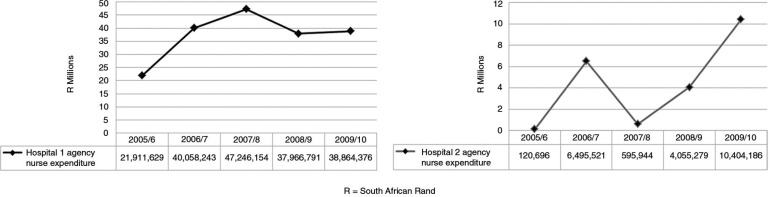
In the 2009/10 financial year, Hospital 1 spent R38.86 million (US$5.55 million) on nursing agencies, whereas Hospital 2 spent R10.40 million (US$1.49 million). The total estimated time spent per week on indirect cost activities at Hospital 1 was 51.5 hours, and 60 hours at Hospital 2. The estimated monetary value of this time at Hospital 1 was R962,267 (US$137,467) and at Hospital 2 the value was R300,121 (US$42,874), thus exceeding the weekly direct costs of nursing agencies. Agency nurses assisted the selected hospitals in dealing with problems of nurse recruitment, absenteeism, shortages, and skills gaps in specialised clinical areas. The problems experienced with agency nurses included their perceived lack of commitment, unreliability, and providing sub-optimal quality of patient care.
Hospital managers and policy-makers need to address the effective utilisation of agency nurses and quality of patient care in tandem.
在全球范围内,通过使用临时护理人员来安排灵活的工作模式,是应对医院护理人员短缺的一项重要策略。
本研究的目的是确定代理护士的直接和间接成本,以及南非两家公立医院使用代理护士的优势和问题。
在获得伦理批准后,有目的地选择了两家南非公立医院。直接成本通过分析2005年至2010年这5年期间从国家横向基本会计系统数据库获取的医院支出信息来确定。在每家医院,对首席执行官、护理服务执行经理、产科或重症监护病房护理经理、人力资源经理和财务经理进行了半结构化访谈。所衡量的间接成本是在入职前检查、护士招聘、入职培训和监督方面所花费的时间。所有支出均以南非兰特表示(R:2010年价格下1美元 = R7)。
在2009/10财政年度,医院1在护理代理机构上花费了3886万兰特(555万美元),而医院2花费了1040万兰特(149万美元)。医院1每周在间接成本活动上花费的总估计时间为51.5小时,医院2为60小时。医院1这段时间的估计货币价值为962267兰特(137467美元),医院2的价值为300121兰特(42874美元),因此超过了护理代理机构的每周直接成本。代理护士协助所选医院解决了护士招聘、旷工、短缺以及专业临床领域技能差距等问题。使用代理护士遇到的问题包括他们被认为缺乏敬业精神、不可靠以及提供的患者护理质量欠佳。
医院管理人员和政策制定者需要同时解决代理护士的有效利用和患者护理质量问题。