Brzóska Kamil, Kruszewski Marcin
Centre for Radiobiology and Biological Dosimetry, Institute of Nuclear Chemistry and Technology, Dorodna 16, 03-195, Warsaw, Poland,
Radiat Environ Biophys. 2015 Aug;54(3):353-63. doi: 10.1007/s00411-015-0603-8. Epub 2015 May 14.
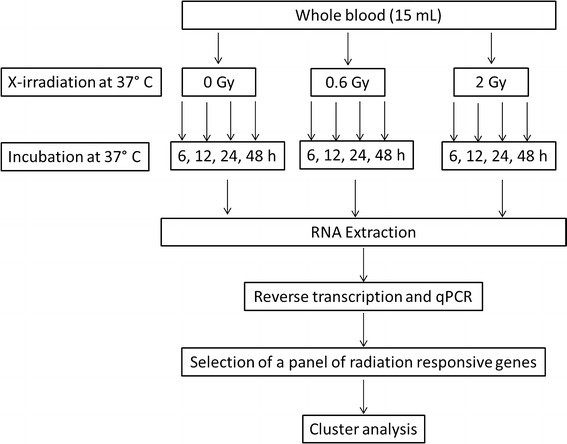
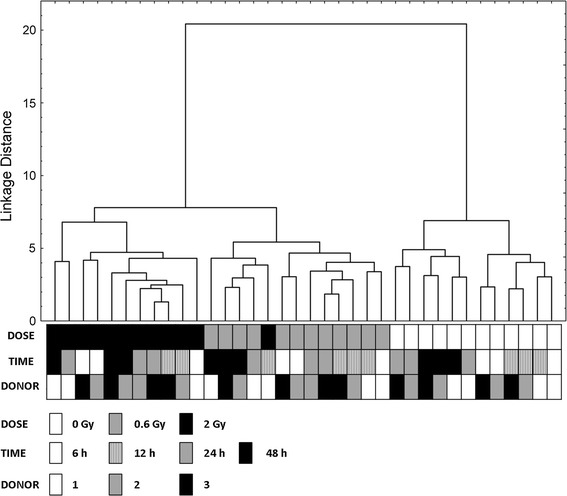
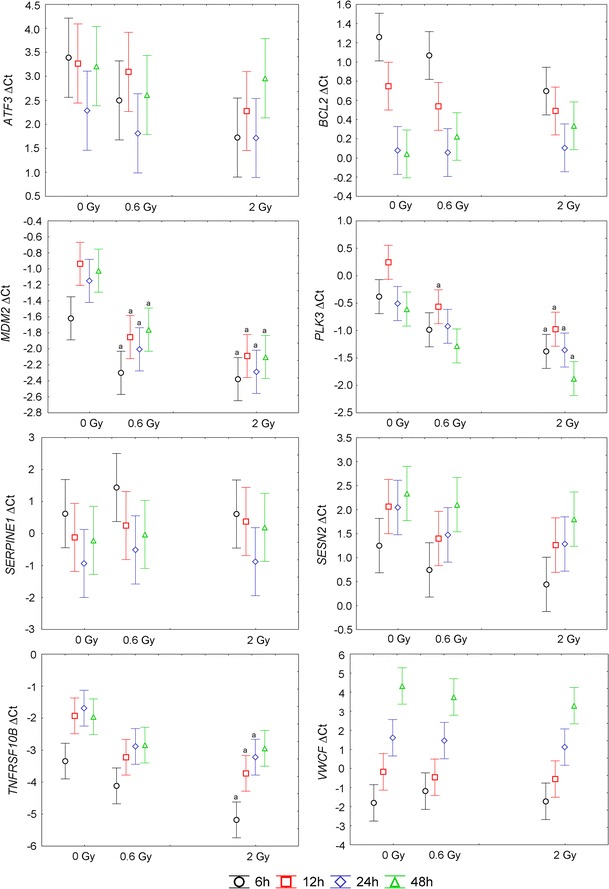
The most frequently used and the best established method of biological dosimetry at present is the dicentric chromosome assay, which is poorly suitable for a mass casualties scenario. This gives rise to the need for the development of new, high-throughput assays for rapid identification of the subjects exposed to ionizing radiation. In the present study, we tested the usefulness of gene expression analysis in blood cells for biological dosimetry. Human peripheral blood from three healthy donors was X-irradiated with doses of 0 (control), 0.6, and 2 Gy. The mRNA level of 16 genes (ATF3, BAX, BBC3, BCL2, CDKN1A, DDB2, FDXR, GADD45A, GDF15, MDM2, PLK3, SERPINE1, SESN2, TNFRSF10B, TNFSF4, and VWCE) was assessed by reverse transcription quantitative PCR 6, 12, 24, and 48 h after exposure with ITFG1 and DPM1 used as a reference genes. The panel of radiation-responsive genes was selected comprising GADD45A, CDKN1A, BAX, BBC3, DDB2, TNFSF4, GDF15, and FDXR. Cluster analysis showed that ΔC t values of the selected genes contained sufficient information to allow discrimination between irradiated and non-irradiated blood samples. The samples were clearly grouped according to the absorbed doses of radiation and not to the time interval after irradiation or to the blood donor.
目前,生物剂量测定中最常用且最成熟的方法是双着丝粒染色体分析,但该方法不太适用于大规模伤亡情况。因此,需要开发新的高通量检测方法,以便快速识别遭受电离辐射的个体。在本研究中,我们测试了血细胞基因表达分析在生物剂量测定中的实用性。采集了三名健康供体的人外周血,分别用0(对照)、0.6和2 Gy的剂量进行X射线照射。在照射后6、12、24和48小时,通过逆转录定量PCR评估16个基因(ATF3、BAX、BBC3、BCL2、CDKN1A、DDB2、FDXR、GADD45A、GDF15、MDM2、PLK3、SERPINE1、SESN2、TNFRSF10B、TNFSF4和VWCE)的mRNA水平,以ITFG1和DPM1作为参照基因。选择了一组辐射响应基因,包括GADD45A、CDKN1A、BAX、BBC3、DDB2、TNFSF4、GDF15和FDXR。聚类分析表明,所选基因的ΔCt值包含足够的信息,能够区分受照射和未受照射的血样。样本根据吸收的辐射剂量清晰分组,而不是根据照射后的时间间隔或供血者分组。