She Wenjing, Baroux Célia
Department of Plant Developmental Genetics, Institute of Plant Biology and Zürich-Basel Plant Science Center, University of Zürich Zürich, Switzerland.
Front Plant Sci. 2015 Apr 28;6:294. doi: 10.3389/fpls.2015.00294. eCollection 2015.
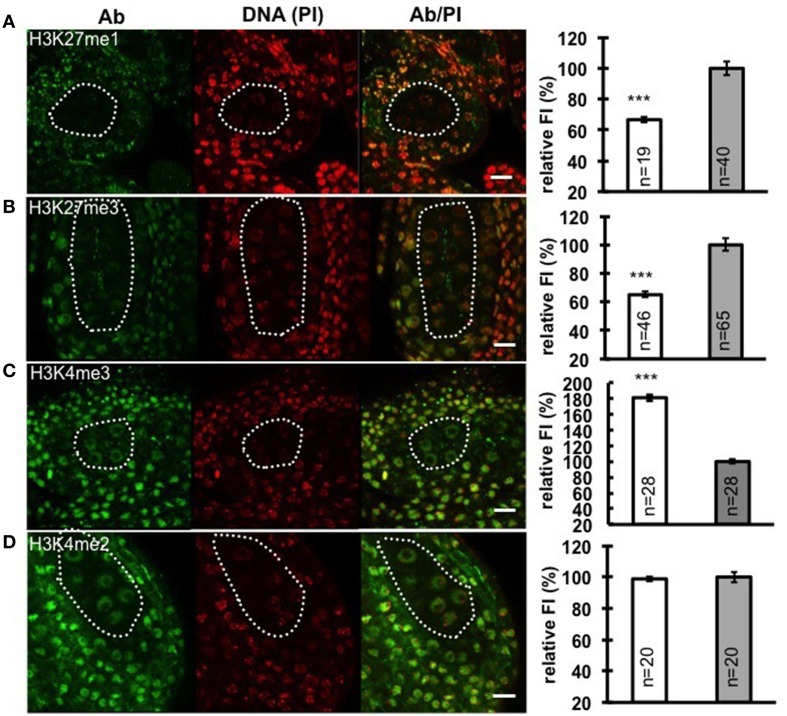
Unlike animals, where the germline is established early during embryogenesis, plants set aside their reproductive lineage late in development in dedicated floral organs. The specification of pollen mother cells (PMC) committed to meiosis takes place in the sporogenous tissue in anther locules and marks the somatic-to-reproductive cell fate transition toward the male reproductive lineage. Here we show that Arabidopsis PMC differentiation is accompanied by large-scale changes in chromatin organization. This is characterized by significant increase in nuclear volume, chromatin decondensation, reduction in heterochromatin, eviction of linker histones and the H2AZ histone variant. These structural alterations are accompanied by dramatic, quantitative changes in histone modifications levels compared to that of surrounding somatic cells that do not share a sporogenic fate. All these changes are highly reminiscent of those we have formerly described in female megaspore mother cells (MMC). This indicates that chromatin reprogramming is a common underlying scenario in the somatic-to-reproductive cell fate transition in both male and female lineages.
与动物不同,动物的生殖系在胚胎发育早期就已确立,而植物在发育后期才在专门的花器官中确定其生殖谱系。致力于减数分裂的花粉母细胞(PMC)的特化发生在花药小室的造孢组织中,标志着向雄性生殖谱系的体细胞到生殖细胞命运的转变。在这里,我们表明拟南芥PMC分化伴随着染色质组织的大规模变化。其特征是核体积显著增加、染色质解聚、异染色质减少、连接组蛋白和H2AZ组蛋白变体的排出。与不具有孢子发生命运的周围体细胞相比,这些结构改变伴随着组蛋白修饰水平的显著定量变化。所有这些变化都与我们之前在雌性大孢子母细胞(MMC)中描述的变化高度相似。这表明染色质重编程是雄性和雌性谱系中体细胞到生殖细胞命运转变的共同潜在情况。