Nyenswah Tolbert, Fallah Mosoka, Sieh Sonpon, Kollie Karsor, Badio Moses, Gray Alvin, Dilah Priscilla, Shannon Marnijina, Duwor Stanley, Ihekweazu Chikwe, Cordier-Lassalle Thierry, Shinde Shivam A, Hamblion Esther, Davies-Wayne Gloria, Ratnesh Murugan, Dye Christopher, Yoder Jonathan S, McElroy Peter, Hoots Brooke, Christie Athalia, Vertefeuille John, Olsen Sonja J, Laney A Scott, Neal Joyce J, Yaemsiri Sirin, Navin Thomas R, Coulter Stewart, Pordell Paran, Lo Terrence, Kinkade Carl, Mahoney Frank
MMWR Morb Mortal Wkly Rep. 2015 May 15;64(18):500-4.
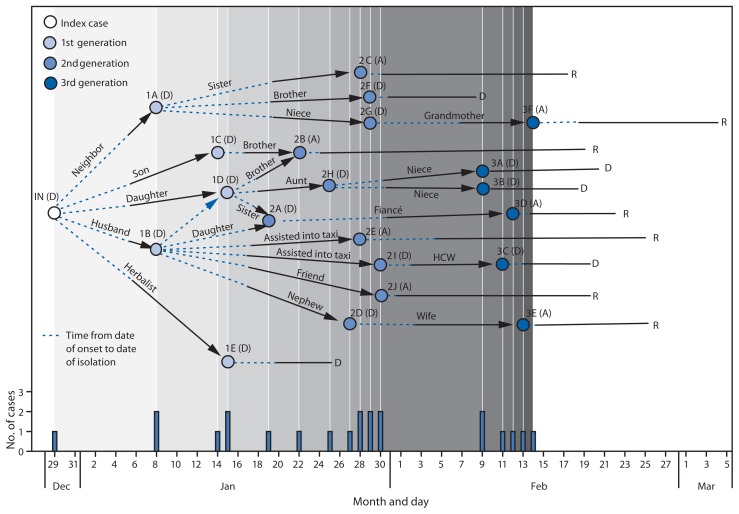
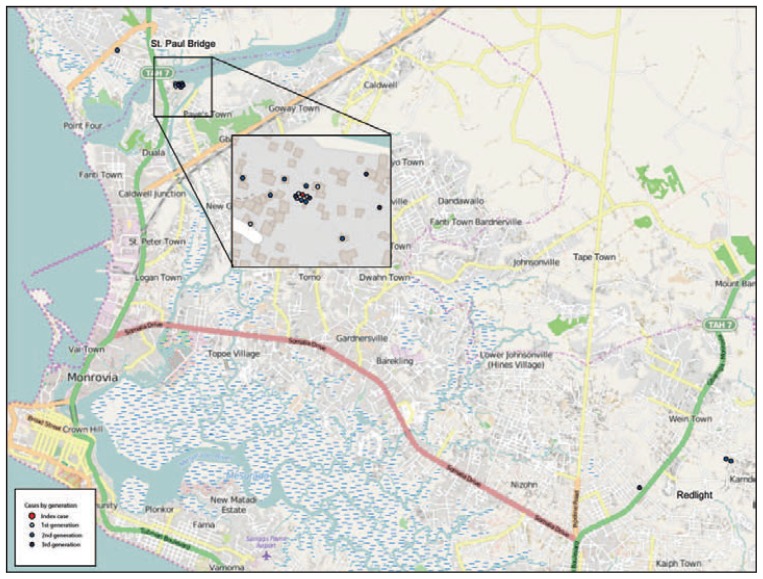
As one of the three West African countries highly affected by the 2014-2015 Ebola virus disease (Ebola) epidemic, Liberia reported approximately 10,000 cases. The Ebola epidemic in Liberia was marked by intense urban transmission, multiple community outbreaks with source cases occurring in patients coming from the urban areas, and outbreaks in health care facilities (HCFs). This report, based on data from routine case investigations and contact tracing, describes efforts to stop the last known chain of Ebola transmission in Liberia. The index patient became ill on December 29, 2014, and the last of 21 associated cases was in a patient admitted into an Ebola treatment unit (ETU) on February 18, 2015. The chain of transmission was stopped because of early detection of new cases; identification, monitoring, and support of contacts in acceptable settings; effective triage within the health care system; and rapid isolation of symptomatic contacts. In addition, a "sector" approach, which divided Montserrado County into geographic units, facilitated the ability of response teams to rapidly respond to community needs. In the final stages of the outbreak, intensive coordination among partners and engagement of community leaders were needed to stop transmission in densely populated Montserrado County. A companion report describes the efforts to enhance infection prevention and control efforts in HCFs. After February 19, no additional clusters of Ebola cases have been detected in Liberia. On May 9, the World Health Organization declared the end of the Ebola outbreak in Liberia.
作为2014 - 2015年埃博拉病毒病(埃博拉)疫情受影响最严重的三个西非国家之一,利比里亚报告了约10000例病例。利比里亚的埃博拉疫情特点是城市传播强烈,多个社区爆发,源头病例出现在来自城市地区的患者中,以及医疗机构内的爆发。本报告基于常规病例调查和接触者追踪数据,描述了利比里亚阻止最后已知埃博拉传播链的努力。首例患者于2014年12月29日发病,21例相关病例中的最后一例是于2015年2月18日入住埃博拉治疗单元的一名患者。传播链得以阻断是因为新病例的早期发现;在可接受环境中对接触者的识别、监测和支持;医疗系统内有效的分诊;以及有症状接触者的快速隔离。此外,一种将蒙特塞拉多县划分为地理单元的“分区”方法,提高了应对小组快速响应社区需求的能力。在疫情的最后阶段,需要合作伙伴之间的密集协调以及社区领袖的参与,以阻止在人口密集的蒙特塞拉多县的传播。一份配套报告描述了加强医疗机构感染预防和控制工作的努力。2月19日之后,利比里亚未再检测到埃博拉病例群。5月9日,世界卫生组织宣布利比里亚埃博拉疫情结束。